

Alibaba Health Brings Tiered Diagnosis System to Rural Fengjie, Chongqing: A Major Leap for Internet Healthcare
On November 17, Fengjie County held the launch ceremony for the “Internet + Healthcare Poverty Alleviation” initiative. The Fengjie County Government, Ali Health, Fengjie County People’s Hospital, and Chongqing Southwest Hospital signed a four-party agreement. Under this agreement, Ali Health will leverage Rural Taobao service stations to extend remote consultation services to rural areas, facilitating medical access for villagers and achieving the goal of “managing minor illnesses within the village, treating major illnesses at the county level, and referring critical cases to provincial hospitals.”
VCBeat (WeChat ID: vcbeat) was fully involved in the field research conducted at the Zhuping Village Clinic in Caotang Town, Fengjie County, and the Online Consultation Center of Fengjie County People’s Hospital. This system, designed to facilitate medical access for rural patients and implement tiered diagnosis and treatment, has achieved coverage of healthcare resources at the most grassroots level in terms of telemedicine and medical resource utilization. The “Fengjie Model” may serve as a benchmark for the large-scale promotion of telemedicine combined with tiered diagnosis and treatment.
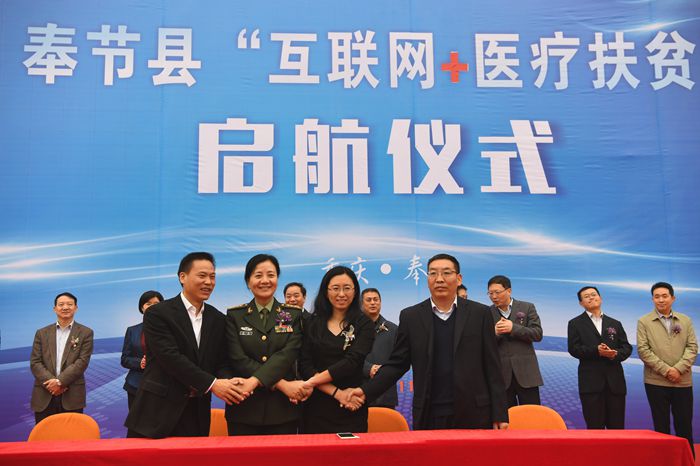
(From left to right: Xiang Chenggang, Executive Deputy Director of the Office of the Fengjie County Committee of the Communist Party of China; Chen Hong, Vice President of Southwest Hospital; Ma Li, Vice President of Alibaba Health; Yang Lin, Vice President of Fengjie County People's Hospital)
At the launch ceremony, Ma Li, Vice President of Alibaba Health, addressed three questions I had previously raised: Why Fengjie? Why internet healthcare? And how can tiered diagnosis and treatment be implemented in the online healthcare context?
According to Ma Li, Alibaba Health began engaging with the Fengjie County government over two months ago. Throughout the process, Fengjie County demonstrated a strong willingness to cooperate and remarkably swift administrative approval procedures, which greatly facilitated the implementation of the telemedicine project. The county’s population size, distribution, and economic conditions are highly suitable for the development of internet-based healthcare. Furthermore, the original intent of the project is to fully leverage medical resources at all levels through a tiered diagnosis and treatment system.
In Fengjie County, due to factors such as inconvenient transportation and underdeveloped economy, there are still as many as 120,000 people living in poverty. Among this impoverished population, the rate of poverty caused or exacerbated by illness is as high as 30%. As poverty alleviation is a key priority of current government work, this segment of the population cannot be overlooked. The ideal approach is to ensure that villagers have access to affordable medical care, giving rise to the concept of “Internet + Healthcare for Poverty Alleviation.”
Fengjie has made many proactive attempts to alleviate poverty and achieve prosperity, including a series of measures such as introducing Rural Taobao and developing e-commerce. Early this year, Fengjie was designated by the National Development and Reform Commission, the Cyberspace Administration of China, and the State Council Leading Group Office of Poverty Alleviation and Development as a pilot county for “Internet + Targeted Poverty Alleviation,” demonstrating a deep-rooted internet DNA within its county-level economy.
Rural Taobao is a distinctive feature of Fengjie’s economy. The county has established 120 Rural Taobao service points, which enable rural residents to sell local specialties and access external information, making these hubs central to rural life. To further leverage the potential of these service points, incorporating healthcare services is a logical next step.
Ma Li explained the role of “Cuntao” in this tiered diagnosis and treatment project, namely “Patient Assistance.” Cuntao service points can help patients access medical care more effectively. By leveraging Cuntao’s bandwidth coverage and information communication capabilities, it facilitates remote healthcare connections between village doctors and residents. Much of the infrastructure required for this process is also provided by Cuntao.
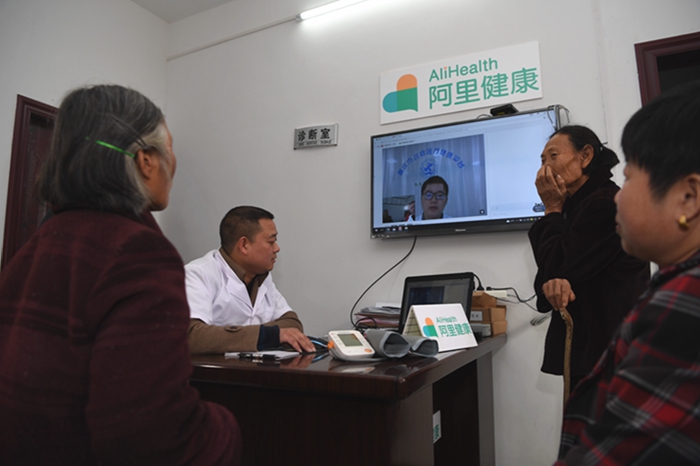
Village doctors connect with county hospitals via the Alibaba Health Online Hospital
According to data released by Fengjie County, 65 of the county’s 120 Village Taobao service points have already enabled remote consultation services. In the future, the county aims to connect all 390 village clinics, achieving comprehensive coverage of grassroots healthcare with integrated remote consultation and tiered diagnosis and treatment.
During the media research event on the 17th, we witnessed a scene where villagers received medical consultations through remote diagnosis and treatment. The village doctor introduced the patient's condition to Fengjie County People's Hospital via video link, and the doctors at the county hospital provided corresponding treatment plans and testing recommendations.
Fengjie County People’s Hospital can also connect with experts from the affiliated Southwest Hospital via the remote diagnosis and treatment system built by Alibaba Health. Experts from Southwest Hospital provide diagnostic and therapeutic assistance for difficult and complex cases. On that day, Dr. Kuang Jinbing, a resident physician in the General Department, and Dr. Zhou Xiangdong, a chief physician at Southwest Hospital, discussed a case involving recurrent symptoms of “cough, sputum production, and shortness of breath.”
“We established a pairing assistance relationship with Fengjie County People’s Hospital long ago and had previously set up a remote conferencing system; this remote consultation system represents an upgrade,” said Chen Hong, Vice President of Southwest Hospital.
According to the reporter’s observations, doctors connected via Alibaba Health’s Online Hospital can share medical imaging data—such as color Doppler ultrasound and CT scans—as well as case records, thereby achieving the same level of information acquisition in remote consultations as in face-to-face visits.
Within the overall system framework, Village Taobao serves as a “patient assistance” platform, village doctors provide primary healthcare services, and county-level secondary Grade-A and tertiary hospitals handle complex case consultations and implement two-way referrals. This structure ensures the full utilization of medical resources at every level, thereby highlighting the effectiveness of tiered diagnosis and treatment.
“The situation in Fengjie is highly typical and representative. If our ‘Fengjie Model’ proves successful, it could be rolled out nationwide,” Ma Li said at the launch ceremony.
Beyond telemedicine, Alibaba Health’s project in Fengjie encompasses multiple initiatives, including medical networks, pharmaceutical distribution, and health management. The Fengjie government stated that the Chongqing municipal government strongly supports the implementation of Alibaba Health’s tiered diagnosis and treatment project in Fengjie. The Fengjie County government hopes to further collaborate with Alibaba Health to explore targeted poverty alleviation and online medical insurance payments. In the next phase, efforts will be made to enable online settlement of medical insurance claims through the tiered diagnosis and treatment platform. Meanwhile, the government will purchase physical examination services for residents in impoverished areas, thereby alleviating their financial burden related to medical care and medication purchases.
This means that Alibaba Health may usher in a new landscape in Fengjie County regarding electronic prescriptions, open access to medical insurance, and pharmaceutical distribution—areas that represent both the focus and the challenges of healthcare reform. Since its inception in 2009, China’s healthcare reform has followed a path from rural areas to cities, then to integrated urban-rural models, and finally to provincial-level comprehensive pilots. Several key issues have remained unresolved, including electronic prescriptions, medical insurance coverage, and the purchase of prescription drugs. If the current “Internet + Healthcare Poverty Alleviation” initiative can demonstrate meaningful value, it would constitute a successful endeavor.
An insider at Alibaba Health also told VCBeat (WeChat ID: vcbeat) that Alibaba Health’s business is divided into four segments: pharmaceutical e-commerce, medical network, health management, and product traceability. Currently, each segment operates around its respective core focus, but these areas will be integrated and interconnected in the future.
According to reporters, in July this year, Alibaba Health acquired Guangzhou Wunianqian Pharmaceutical Chain Co., Ltd. and obtained the Drug Circulation License C. After third-party pharmaceutical platforms were suspended, it retained its B2C pharmaceutical e-commerce qualification. In terms of medical networks, Alibaba Internet Hospital has established collaborations with Wuhan Intermediate People's Court, Capital Medical University Sanbo Brain Hospital, Southwest Hospital, and others. Currently, it covers departments such as general practice, traditional Chinese medicine, internal medicine, surgery, pediatrics, and dentistry. Patients can make appointments with renowned doctors through Alibaba Health Internet Hospital, including those from Fengjie County People's Hospital mentioned earlier. Resident physicians Kuang Jinbing, Chen Long, and Yang Mei have already opened online appointment services. The aforementioned online consultation prices can be as low as 1 cent, and user reviews are very positive.
The Ali Health app has launched a family-based signing service, enabling daily health monitoring and consultation advice on a household basis. Additionally, it offers intelligent care plans such as chronic disease management.
Overall, Alibaba Health aims to build a closed loop connecting pharmaceuticals, users, and medical resources. This approach not only provides users with comprehensive medical services ranging from health management to disease treatment but also facilitates the maximized utilization of medical resources through the tiered diagnosis and treatment system combined with telemedicine.
Through the Fengjie Model, Alibaba Health can gain experience in providing cloud computing and data analytics tools to various stakeholders. In line with Alibaba’s consistent platform- and data-centric approach, such services will help Alibaba Health optimize and adjust its product lines and operational strategies. The blueprint for Alibaba Health extends far beyond the Fengjie Model.