

AirXpanders Submits IPO Prospectus for AeroForm, a Patient-Controlled Tissue Expander Enabling At-Home Breast Reconstruction Preparation
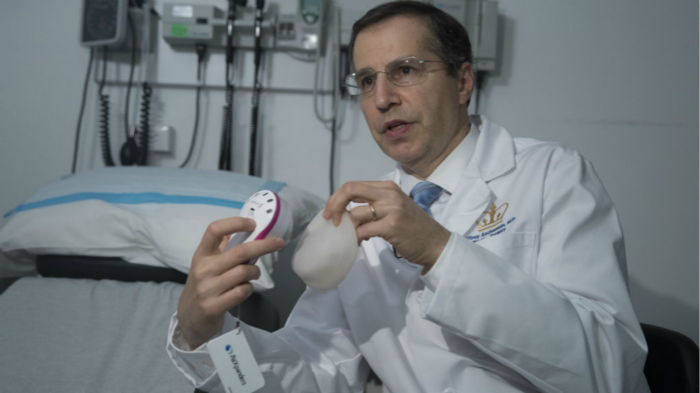
Dr. Jeffrey Ascherman of NewYork-Presbyterian Hospital and Columbia University Irving Medical Center holds the AeroForm tissue expander system, which helps female breast cancer patients prepare for breast reconstruction surgery.
This Could Be the Ultimate DIY Project: Doctors Are Testing a Device That Enables Women to Perform Partial Breast Reconstruction at Home. Its Aim Is Not Only to Make Treatment More Comfortable and Convenient, but Also to Restore a Sense of Control—Something Cancer Patients Often Lack. VCBeat (WeChat ID: vcbeat) Has Compiled an Introduction to This Cutting-Edge Technology.
In the United States,Each year, more than 100,000 women undergo surgical removal of breast cancer cells, and many of these patients opt for implant-based breast reconstruction.. To implant permanent fillers, doctors mostly use tissue expanders (a temporary saline bag that is gradually inflated with saline) to stretch the remaining skin and muscles. This means that doctors need to inject saline into the small bag once a week, every two months, or every few months, which is a very painful process.
Daniel Jacobs, a plastic surgeon at Kaiser Permanente in San Jose, California, stated, “We inject as much saline as possible until the patient says they can’t take it anymore.” One day, while cycling home, Jacobs had an idea: Why not use small canisters of compressed gas, like those used to repair flat tires, to help women expand their tissue expanders? Injecting just a small amount of gas each day could reduce the degree of stretching and alleviate pain.
With his assistance, AirXpanders was established in Palo Alto, California, and developed a product namedAeroFormdevice. This product is already on sale in Australia and has received European approval, and is currently under review by the U.S. Food and Drug Administration.
Users do not need to undergo special training or configure wiring and tubing themselves. Female users can activate the small medication cartridge inside the pouch to generate gas, up to three times per day, using a palm-sized remote control based on their own sensation.
Dr. Jeffrey Ascherman, the principal investigator from NewYork-Presbyterian/Columbia University Irving Medical Center, stated that in a company-sponsored study involving 150 women, patients using AeroForm completed tissue expansion in half the time and were able to undergo implant surgery one month earlier than those receiving saline treatment.
“My patients love it. When some women who agreed to participate in the study learned they had been assigned to the saline control group, one of my patients burst into tears, while others begged me to switch them to the AeroForm group,” he said.
Ascherman stated that there was no difference between the two in terms of side effects such as wound infection; however, seven air expanders malfunctioned, compared with only one saline expander. The company subsequently made adjustments to AeroForm to address this issue.
“‘This is a very interesting concept,’ said Deanna Attai, former president of the American Society of Breast Surgeons, a surgeon at the University of California, Los Angeles, and an external expert. ‘Providing patients with a sense of control is psychologically important, as many women feel that cancer treatment deprives them of this sense,’ Attai stated. ‘This can be a very significant issue for patients undergoing cancer treatment.’”
Susan E. Downey, a plastic surgeon from Los Angeles, used AeroForm on two patients in a study. He stated, “I believe this will make life easier for many people.”
One of the patients is Luincys Fernandez, a 35-year-old high school chemistry teacher who lives in Bogota, New Jersey, and teaches in New York. A year ago, after becoming pregnant with her second son, she was diagnosed with breast cancer and used AeroForm as part of the study.
“I really like it,” she said. She put the remote control in her wallet and completed tissue expansion within just 18 days.
“It did not interfere with my daily activities. I was able to resume a normal lifestyle. The results were immediate, and I could achieve the breast size and appearance I desired.” Angelina Jolie Pitt has encouraged more women with BRCA mutations to undergo risk-reducing surgery, but racial disparities persist.
“Overall, cultural factors do play a role in the decision to remove healthy breasts and ovaries,” said Joy Larsen Haidle, a genetic counselor at the Humphrey Cancer Center in Minneapolis and former president of the National Society of Genetic Counselors.
These influences include whether a society views mastectomy as disfigurement or even as bodily mutilation; whether spouses and family members support women in removing healthy breasts or ovaries; and whether women can afford the costs of breast reconstruction.
If she cannot afford the associated costs or lacks appropriate insurance coverage—insurers are highly likely to deny coverage to Black women—she is less likely to opt for this surgery. Fortunately, Jolie’s announcement has fostered “greater awareness” of the procedure among the public, enhancing their “acceptance and support.” This may help eliminate racial disparities in risk-reducing mastectomy and oophorectomy.
The AeroForm device is available in three sizes. Female patients can select the inflation volume based on the amount of remaining tissue and the maximum expansion capacity of the device. Once fully expanded, the device is removed and replaced with a breast implant.
In Australia,Although AeroForm is more expensive than saline tissue expanders, the two are not directly comparable in terms of cost because patients do not need to make frequent hospital visits.. In the United States,Tissue expanders are generally considered part of mastectomy with breast reconstruction surgery., reimbursed at a uniform rate. It remains unclear what impact AeroForm (pending FDA approval) will have on these costs.
New Federal Guidelines on MammographySparked a New Round of Scrutiny Over Breast Cancer Screening and Treatment Approaches. Approximately 40,000 American women die from this cancer each year. Through our research, we have outlined five surprising and important facts about this disease:
1. Physical breast examination is ineffective.
These examinations constitute the main components of annual physical checkups. Many gynecologists still urge women to perform monthly self-examinations (as do some women’s magazines). However, evidence indicates that manual breast examinations performed by physicians or by women themselves offer no benefit. Consequently, the American Cancer Society does not recommend such routine screenings. Instead, the Society encourages women to “become familiar with how their breasts normally look and feel, and to report any changes to a healthcare provider promptly.”
2. If you have the earliest stage of breast cancer, your doctor may recommend that you do nothing
“Stage 0” cancer, scientifically known as ductal carcinoma in situ (DCIS), refers to the presence of early-stage cancerous or precancerous cells within the breast ducts. DCIS can be treated with surgery or radiation therapy. However, some physicians advise female patients at this stage to undergo no intervention. A large-scale study published last autumn in JAMA (The Journal of the American Medical Association) observed 100,000 women diagnosed with DCIS. The majority of these patients had undergone lumpectomy or mastectomy before the standard treatments for “Stage 0” disease were established. Nevertheless, their risk of dying from breast cancer remained comparable to that of women who had never been diagnosed with DCIS.
“These findings suggest that ‘we should rethink our strategy,’” wrote Dr. Laura Esserman in an editorial accompanying the study. However, this watchful-waiting approach has also sparked controversy. Physicians are urging women at high risk to pay greater attention to their breast health, including the use of screening tests that are more sensitive than mammography. Dr. Len Lichtenfeld, Deputy Chief Medical Officer of the American Cancer Society, stated that for these women, magnetic resonance imaging (MRI) and ultrasound “are important components of breast cancer surveillance, and they must be closely monitored.”
3. For advanced-stage cancer, surgery may be the primary treatment modality
A study involving 21,000 women, published last autumn in the Journal of the American Medical Association (JAMA), showed that surgical removal of the primary tumor appears to extend the survival of women with stage IV breast cancer, even after the cancer has metastasized. The standard approach when cancer has spread is systemic chemotherapy or radiation therapy. “It’s somewhat counterintuitive to remove the initial tumor surgically,” said Mary Schroeder, Assistant Professor of Health Services Research at the University of Iowa.
However, studies have found that the median survival time for patients who underwent surgical treatment during the first round of therapy was 28 months, whereas it was only 19 months for those who did not undergo surgery.
4. Variations in Chemotherapy
An analysis published last fall in the Journal of Clinical Oncology showed that for certain aggressive forms of breast cancer, cure rates among African American and Hispanic women were slightly lower than those among White or Asian women.
“This is a thorny issue,” said Dr. Brigid Killelea, the study’s lead author and a professor of surgery at Yale University. “The factors may be multifaceted. That is why we should encourage Black and Hispanic women to participate in clinical trials.”
5. Breast cancer is not the most lethal cancer, but it receives the most funding
More American women die from lung cancer than from breast cancer each year. Data from the American Cancer Society shows that as many as 72,000 female patients died of lung cancer last year, compared with only 40,000 who died of breast cancer.
Even so, breast cancer still receives more federal research funding than lung cancer. The National Institutes of Health invests $685 million annually in breast cancer research, compared to just $255 million for lung cancer research.