

Holyvision Aims to Become the 'Intel of Telemedicine' Following Tiangong-2 Remote Consultation Milestone
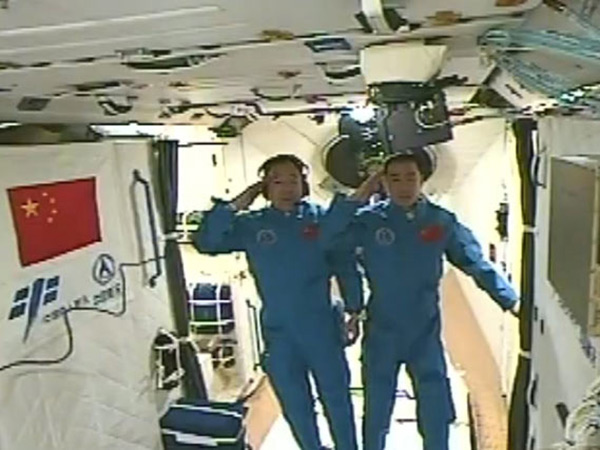
At 4:00 p.m. on October 19, 2016, Shenzhou-11 astronauts Jing Haipeng and Chen Dong used the space-ground remote medical consultation system aboard the Tiangong-2 space laboratory to establish a remote connection with the Telemedicine Center of the PLA General Hospital (301 Hospital). This successfully achieved an interplanetary-level “remote consultation” between space and Earth, established the data transmission link required for coordinated space-ground telemedicine consultations, and validated China’s first space-ground remote medical consultation system.
Hushi Technology,CurrentlyJoin the People's Liberation ArmyOriginal Manufacturer of the Overall Solution for Phase II of the PLA General Hospital (301 Hospital) Telemedicine Consultation System 。
Prior to founding the company, Yu Chaobin, Chairman of Hushi Technology, had already spent more than a decade working in the audio-video communications industry. At that time, his employer primarily focused on software-based video solutions, and frequently received requests from clients for product customization tailored to industries such as healthcare. However, due to limitations inherent in the existing product architecture, it proved consistently difficult to meet the customization needs of the healthcare sector and other industries.
He recalled, “Eight years ago, we observed that the Second Affiliated Hospital of Zhejiang University School of Medicine conducted remote consultations with U.S. hospitals via hard-wired video systems. Although the audio and video quality was satisfactory, these systems lacked image-sharing capabilities. For Western medicine practitioners, the sharing of imaging data is paramount, as specialists can only make accurate remote diagnoses by reviewing clear medical images and other clinical data.”
Since then, Yu Chaobin has nurtured an idea: Could a system be developed that not only meets the stringent requirements of medical consultations but also enables users to conduct remote video consultations with family doctors and experts both domestically and abroad via smartphones?
In 2015, driven by an irresistible urge to embark on entrepreneurship, Hushi Technology was officially founded in “Paradise Silicon Valley” through the efforts of Yu Chaobin and a group of like-minded friends.
Hushi Technology’s core product is the Holyvision Remote Consultation System, a medical-grade remote converged communications system that integrates cross-platform software and hardware, including iOS, Android, Windows, H.323, SIP, and wearable smart devices.
With over a decade of accumulated experience in the audio-video communications industry, Hushi Technology’s Holyvision remote consultation system incorporates multiple industry-leading technologies.
With only 1 Mbps of bandwidth, it can achieve latency-free transmission of 1080P HD video at 30 frames per second, while simultaneously capturing and encoding four or more streams of 1080P HD video. In other words, in addition to supporting one-on-one, point-to-point full-HD remote consultation, it also enables real-time full-HD video interaction, as well as image and picture sharing among multiple medical institutions.
Building on video and audio capabilities, the Holyvision remote consultation system also supports pathology database management, enabling users to share medical records with multiple experts in real time via mobile devices. Most critically, the company has developed China’s first medical-grade SDK. This client-side SDK allows Hushi Technology’s telemedicine system to be integrated into the information systems of health commissions at all administrative levels and healthcare institutions across China, while also achieving cross-platform interoperability among PCs, mobile devices (smart hardware, smartphones, and iPads), and set-top boxes.
Captured 60% of Zhejiang Province’s telemedicine market in 10 months
Leveraging its technological advantages, the Military-Civilian Collaborative Network Telemedicine Platform, jointly developed by Hushi Technology and Xinfangxun for the PLA General Hospital (301 Hospital), was officially launched on October 27, 2016. This platform is interconnected with the Holyvision Remote Consultation System, enabling users of the Holyvision system to participate in medical conferences held on the 301 Telemedicine Platform. In addition to supporting space-ground collaboration, military-civilian coordination, inter-hospital cooperation, and expert consultations, this application will be further expanded into other fields in the future.
Yu Chaobin stated, “Online medical services represent a new modality but can never fully replace offline clinical practice. Internet-enabled healthcare can address the pain points of both patients and medical institutions, thereby reshaping the traditional healthcare landscape. The online allocation of offline medical resources enhances service convenience and efficiency.”
Domestic health management companies have conducted surveys on the telemedicine market: currently, less than 1% of medical institutions truly utilize “healthcare + Internet” remote video technology. Driven by strong market forces, gradually forming consumer habits, and supportive national policies, the market is poised for rapid explosive growth.
As a startup founded just 10 months ago, Hushi Technology has established its base in Zhejiang Province, with its products covering tiered diagnosis and treatment systems—including remote consultation, emergency command, and remote education—for prestigious Grade A tertiary hospitals such as the First Affiliated Hospital of Zhejiang University School of Medicine (Zhejiang No. 1 Hospital) and the Second Affiliated Hospital of Zhejiang University School of Medicine (Zhejiang No. 2 Hospital), as well as their affiliated municipal, county, and community-level healthcare institutions.
Simultaneously collaborating with multiple renowned enterprises in the industry, we have successively launched integrated medical and elderly care applications represented by Zhejian Health; high-end community telemedicine applications represented by Greentown Health; premium cross-border telemedicine applications represented by Hangzhou Wuzhou and the Chinese American Medical Association (CAMA) Telehospital; as well as telemedicine solutions represented by Zhuojian Technology, the leading mobile healthcare provider in China—including projects for the Henan Provincial Health and Family Planning Commission, Qingdao Municipal Hospital, and The First Affiliated Hospital of Zhejiang University School of Medicine Internet Hospital.
Its superior audio and video codecs, audio and video transmission, cross-platform meeting access, and comprehensive solutions provide major medical institutions with high-quality, one-stop services for building remote consultation platforms.
To date, Hushi Technology has captured over 60% of the remote healthcare market share in Zhejiang Province.
“Telemedicine, as an emerging phenomenon, has initially taken off in developed regions, among high-net-worth individuals, or in areas with robust internet infrastructure, akin to China’s special economic zones. Hushi Technology is one of the practitioners driving the development of these ‘special zones,’” Yu Chaobin told reporters.
In terms of profitability, Hushi Technology adopts a B2B payment and C2C benefit model, with health care institutions and doctors as the core service objects. It solves the problem of effective on-demand supply of expert resources for health care institutions. In the future, it will even allow multi-site practicing physicians to establish virtual cloud clinics on the platform.
In terms of future development, Hushi Technology plans to expand its business into hospitals, health management institutions, cross-border medical organizations, elderly care service providers, and aesthetic clinics. It will also integrate third-party testing and inspection services, pharmaceutical distribution channels, wearable devices, and even AR/VR products to create a more comprehensive telemedicine service matrix.
Regarding the positioning of Hushi Technology, Yu Chaobin has stated on multiple occasions in interviews: “We aim to be the Intel of the telemedicine industry—empowering others first, then ourselves, and always remaining the enabler behind those who succeed.”
At this year’s Wuzhen World Internet Conference, Jack Ma remarked, “Only those individuals or enterprises that truly harness internet technology will succeed.” For Hushi Technology, integrating healthcare with internet technologies—deepening its focus on medical instant messaging and converged communications while consolidating offline medical institutions, health management organizations, testing and inspection agencies, and pharmaceutical distribution channels into a closed-loop ecosystem—brings its aspiration to become the “Intel of telemedicine” within reach, much like the successful docking of Tiangong-2 with Shenzhou-11.