

Biomarkers Driving Personalized Medicine: Enabling Novel Drug Development and Tailored Therapeutic Strategies
The development of biomarkers is not directly linked to drug discovery and development; however, they exhibit significant overlap at every stage, from exploratory laboratory research and clinical trials to actual therapeutic application.
As medicine becomes more personalized and increasingly reliant on molecular-level research, genomic and proteomic studies have demonstrated thatThe overlap between drug development and biomarker advancement is also showing an inevitable upward trend.。
The capacity of molecular biology methods (primarily genomics and proteomics technologies) to concurrently track multiple biomolecules is steadily improving. Consequently, methodologies for identifying potential biomarker signatures are evolving toward greater simplicity, serving as objective indicators for detecting and assessing normal biological processes, pathogenic processes, or pharmacological responses to therapeutic interventions.
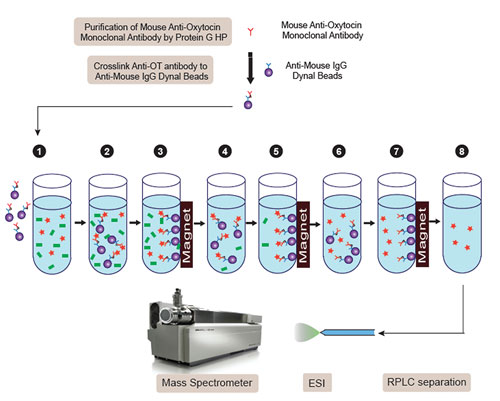
This is an example of Pfizer using hybrid technology for biomarker assays. A purified monoclonal antibody is conjugated to magnetic beads and then added to the sample. A separation magnet is subsequently used to isolate the target protein or peptide. Finally, further analysis is performed using liquid chromatography-tandem mass spectrometry (LC-MS/MS).
It is important to note that the definition of biomarkers extends beyond genomic and proteomic signatures to include other types, such as physiological measures (e.g., blood pressure), imaging findings (e.g., radiographic images), and basic blood analytes (e.g., glucose levels). The combined use of these markers can enhance the accuracy of assessments and bolster confidence among researchers and regulatory agencies in candidate biomarkers.
However, the most critical issue at present is: How can we determine whether each specific biomarker has its own reliable guidelines to meet specific needs? This is because varying degrees of confidence are placed in biomarkers when they are applied, and each biomarker serves specific intended purposes. For instance, the “fit-for-purpose” criterion may be sufficient for internal deliberations by R&D teams or for meeting the requirements for publishing research findings. However, if a biomarker is to undergo validation or qualification, it must comply with more stringent standards.
Applications of Biomarkers
The applications of biomarkers are extensive, ranging fromEstablishing diagnostic and prognostic symptom screening, followed by prediction of drug efficacy, can be regarded as surrogate endpoints in clinical research.。
Dr. Mahmoud Loghman-Adham, Medical Director at Shire, stated, “Clinical biomarkers must be extremely simple and stable to meet the requirements for use in hospital laboratories. For instance, mass spectrometry, which performs well in research settings, is unsuitable for clinical environments due to its high specificity and cost.”
“About 10 years ago, the development of biomarkers had not yet begun. But now, biomarkers have entered preclinical research, starting with animal models and progressing to the clinical development stage.”
“There is significant interest in identifying biomarkers that predict the risk of disease progression before symptoms become clinically apparent. Given the efficacy of early intervention in cancer and cardiovascular conditions, this area—much like in kidney disease—is currently one of the most prominent research directions.”
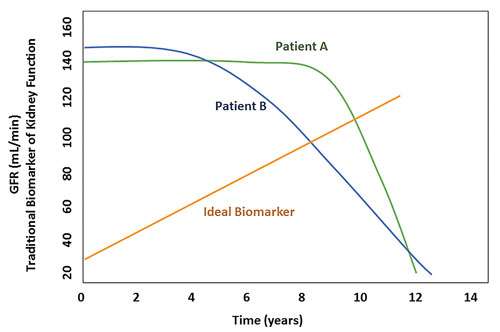
This is a comparison of changes in the levels of ideal biomarkers with changes in the levels of traditional markers of renal function (e.g., glomerular filtration rate (GFR) or serum creatinine). Changes in traditional markers typically occur in the late stages of disease, at which point irreversible damage may have already occurred. [Mahmoud Loghman-Adham, M.D., Shire]
From Dr. Loghman-Adham's remarks, we can see thatThe availability of appropriate biomarkers can accelerate the initiation of clinical trials or clinical treatments.. For example, if biomarkers are available, they enable physicians to keep pace with the progression of early-stage acute kidney injury and initiate therapeutic interventions.
Currently, the detection of kidney diseases mainly relies on “traditional” laboratory tests, such as BUN (blood urea nitrogen) and creatinine level assessments. Unfortunately, these tests can only detect problems long after the injury has occurred.
Despite these limitations, Dr. Loghman-Adham remains optimistic. He pointed out that “biobanks of blood and other bodily fluid samples are a rich resource for developing and validating new potential biomarkers for various diseases,” while also ensuring patient information is de-identified and obtaining patient consent to store samples for several years for further research.
“There are hundreds of publicly funded biomarker projects in Europe to support medical decision-making, itsThe ultimate goal is to develop personalized treatment plans for patients.,” said Dr. Thomas Joos, Deputy Director of the Institute for Natural Medical Sciences at the University of Tübingen. “New biomarkers will better predict drug responses and enable the selection of optimal treatment regimens for each patient.。”
“This project requires the integration of robust assay technologies, solid-phase assays, and high-quality samples for biomarker development and validation initiatives. Basic data analysis will be conducted. Specifically, we are seeking biomarkers that indicate the early stages of disease. Ideally, such biomarkers should be absent or not elevated under healthy physiological conditions.”
“The identification of biomarkers is a dual drain on resources and time, necessitating the careful selection of representative sample cohorts. Therefore, such projects are more likely to succeed when implemented through a combination of private and public partnerships.”
Dr. Joos pointed out that in Europe, there is a public-private partnership between the European Union and the European pharmaceutical industry, known as the Innovative Medicines Initiative (IMI), which helps accelerate the development of better and safer medicines for patients.
Dr. Joos explained, “IMI accelerates drug development by supporting collaborative research projects between industry and academia. Furthermore, IMI supports the development of biomarkers, such as through the IMI SAFE-T project, which enables the use of biomarkers to assess drug-induced organ injury.”
In the United States, similar work is undertaken by the Predictive Safety Testing Consortium (PSTC). This organization connects pharmaceutical companies to share and validate innovative safety testing methods under the guidance of the U.S. Food and Drug Administration (FDA), the European Medicines Agency (EMA), and Japan’s Pharmaceuticals and Medical Devices Agency (PMDA). To date, the PSTC has identified a panel of proteins that can indicate liver injury.
Dr. Joos pointed out, “When examining genomic data, we cannot observe cellular activity. Using immunoassay techniques to study proteins provides a high-quality source of biomarker candidates and enables the observation of more detailed cellular activity.”
“Developing and validating biomarker assays to support clinical trials presents numerous challenges,” said Dr. Jenny Y. Zhang, Senior Manager of the Clinical Analysis Group at Pfizer and an expert in biomarker assays. “Compliance with FDA guidelines is key to successfully conducting bioanalytical assays, while maintaining open lines of communication with regulatory authorities is also critical for successful biomarker development.”
“Our group primarily uses pharmacodynamic (PD) biomarkers, which can demonstrate the link between a drug and its intended biological effect. In recent years, there has been significant emphasis on biomarker research, as biomarkers play a critical role in deciding whether to continue or discontinue a project.”
“Pfizer has developed and validated PD biomarker assays for clinical trials. Data generated from these validated biomarker assays are often used as a reference to select appropriate doses of new drugs in clinical trials. Moreover, biomarker data can link mechanistic evidence with proof of concept,” said Dr. Zhang.
“Many factors contribute to the variability of biomarker data: the inherent properties of the biomarkers, variations between individual patients and patient populations, whether the drug is taken with food, and the circadian rhythm of the biomarkers. Therefore, it is essential to conduct a validated analytical assay for the biomarker before initiating clinical trials. This analytical method needs to distinguish between normal and disease samples and assess the progression from one state to another.”
Dr. Zhang believes that achieving accurate measurement of biomarkers is challenging due to certain technical issues. The absence of blank matrix samples and endogenous analytes poses significant challenges in selecting surrogate matrices.
Furthermore, several isoforms of the same protein can be detected in vivo, which may confound biomarker assays. This presents another significant challenge. We can address this issue by integrating multiple analytical techniques.
“Quantifying serum oxytocin levels using mass spectrometry alone fails to achieve ideal sensitivity, while antibody-based quantification lacks sufficient specificity,” explained Dr. Zhang. “However, by combining antibody recognition with magnetic bead technology to enrich and isolate oxytocin from serum, we can employ a hybrid mass spectrometry approach for selective and precise measurement of serum oxytocin.”
However, sample integrity presents another challenge, requiring particular attention to the details of sample processing. How can samples be rapidly frozen after collection? Can proteins or peptides used as biomarkers undergo further biodegradation after sample collection? Can preclinical biomarkers be translated into actual clinical applications? Can we measure and analyze biomarkers in target matrices that are both accessible and clinically relevant?
All of these issues must be investigated and resolved before initiating clinical trials, particularly when biomarker data are used for primary and secondary endpoints in the study. Assays for exploratory biomarkers used for internal decision-making do not require the rigorous validation mandated for clinical biomarker assays.
For those seeking to develop biomarker assays with multiplexing capabilities, assistance is available from Meso Scale Discovery (MSD). The company also offers a service for developing biomarker assays, said Dr. Fiona Coats, Vice President of Marketing at MSD.
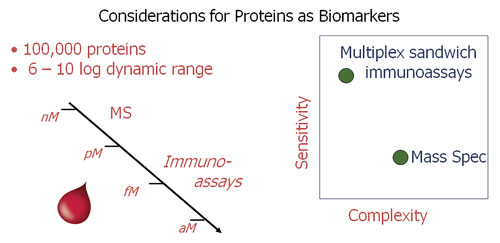
The concentration of the target protein in the sample is a key aspect of target validation. In blood, the concentrations of approximately 100,000 proteins span a wide range—typically covering 6 to 10 orders of magnitude. Most novel biomarkers reside at the lower end of this range; therefore, immunoassays are required to achieve the desired sensitivity.
“Typically, our clients in this field are large pharmaceutical or biotechnology companies,” said Dr. Fiona. “Our collaborative services with clients span from the initial stages of assay development to delivering validated assays for one or more biomarkers.”
“Our specialty lies in leveraging our expertise in electrochemiluminescence (ECL) to develop robust analytical assays. Scientists using our assays can achieve precise, reproducible protein measurements in complex sample matrices.”
While most people have begun to use proteins as biomarkers, there is also a trend toward using DNA or RNA as biomarkers. Custom-coated plates provided by Meso Scale Discovery can be modified for the detection of nucleic acids.
Meso Scale Discovery has recently launched U-Plex®, a platform that enables users to design their own multiplex assays. Crucially, when commercial assays are unavailable, it allows researchers to select their own panels to establish biomarker analytical assays. The U-Plex platform is designed to help customers create their own biomarker panels while allowing customization based on species, antibodies, and quantity. U-Plex is used in conjunction with MSD’s Multi-Spot® immunoassay plates, supporting multiplex assays in both 96- and 384-well formats.
“MSD Multi-Spot® plates feature 10 distinct spots per well, enabling the measurement of 10 different analytes,” Dr. Coats elaborated. “The MSD platform helps overcome the challenges of multiplexing and reproducibility in biomarker development.”
We use a position camera in the plate reader to determine the signal from each of the 10 points within the wells. The background and cross-talk signals in ECL technology are very low, resulting in high sensitivity. Many commercially available ELISAs are essentially analytical kits and do not allow for detection at picogram-level protein concentrations.
A biobank stated that Meso Scale Discovery’s technology enables measurements of multiple targets within a single well across a broad dynamic range. This is highly advantageous for clients with limited sample volumes.
Rigor is the key to biomarker validation. Despite these challenges, significant progress has been made in the characterization and identification of biomarkers applied across various uses.
Dr. Mahmoud Loghman-Adham, Medical Director at Shire, stated, “Care must be taken to distinguish between validation and qualification, as both biomarker validation and qualification have well-defined regulatory pathways.”
According to a review article (Hunter et al., Current Drug Targets), validation is the process of evaluating a biomarker and its analytical performance characteristics, determining the conditions under which reproducibility and accuracy data are established; whereas qualification is the evidentiary process linking a biomarker to biological processes and clinical endpoints. In short, validation pertains to the performance metrics of a biomarker, while qualification pertains to its contextual suitability.
“Validation is the process of demonstrating that a biomarker can accurately predict a diagnostic, prognostic, or clinical endpoint of interest,” explained Dr. Loghman-Adham. “Qualification requires completion in conjunction with regulatory health agencies, such as the FDA. This is a resource-intensive process that typically necessitates forming alliances between academia and industry to enable the implementation of biomarkers.”
The FDA has established detailed guidelines for the validation and qualification of biomarkers. For example, in 2013, the FDA updated its bioanalytical method validation documentation by issuing draft guidance that included biomarkers and diagnostics. Furthermore, the FDA has established a Biomarker Qualification Program, which addresses requests for regulatory qualification of biomarkers for specific “contexts of use” in drug development. Once a biomarker is approved through this process, it can be used in clinical trials, as a companion diagnostic, and for other healthcare-related applications.