

Shanghai Chengdian Technology: China's Sole Medical-Grade Miniature EMG Sensor Developer Enabling Home-Based Rehabilitation
VCBeat(WeChat ID: vcbeat)In "Applications of Innovative Sensors in Healthcare》The research report points out: Sensors, being at the forefront of data collection, have always played an important role in the field of medical health. In 2015, the market size of medical sensors reached $8.21 billion. It is expected that the medical sensor market will reach $15 billion by 2022, with a compound annual growth rate (CAGR) of 8.5% from 2016 to 2022.
The market outlook is promising, yet top-tier sensors remain monopolized by developed countries. As China’s only company specializing in miniature electromyography (EMG) sensors, Shanghai Chengdian Technology Co., Ltd. has already applied its products in rehabilitation medicine and bionic prosthetics, with future expansion planned into emerging industries such as VR/AR, sports and fitness, and exoskeletons. A reporter from VCBeat (WeChat ID: vcbeat) conducted an exclusive interview with Ye Kehan, founder of Shanghai Chengdian, to learn about his entrepreneurial journey.
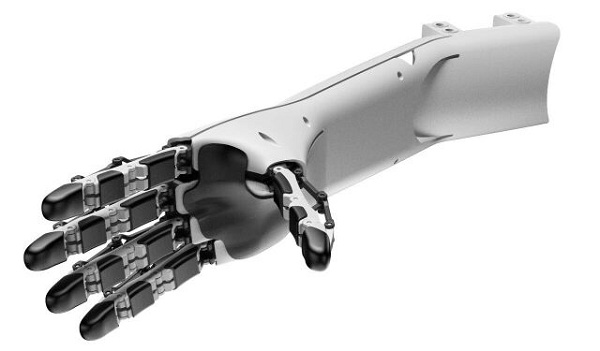
Shanghai Chengdian's Bionic Prosthetics
When discussing the original intention behind starting the business, founder Ye Kehan told reporters that during her time as a researcher at Shanghai Zhisheng, she worked on projects related to electroencephalography (EEG). Although EEG research was highly popular and conducive to publishing theoretical papers, the technology was not yet mature enough for practical implementation. During this period, Ye Kehan discovered that the theoretical framework for electromyography (EMG) signals had already matured and could be applied in production practices. Moreover, there was no company in China specifically dedicated to the research, development, and manufacturing of small-scale commercial EMG sensors.
Meanwhile, Thalmic Labs, a U.S. manufacturer of EMG gesture control technology, secured $14.5 million in 2013 in a funding round led by Intel Capital and Spark Capital. The Myo armband raised over $2 million through crowdfunding on Kickstarter. Another EMG-based fitness apparel manufacturer, Athos, raised $35.5 million in 2015. These developments inspired Ye Kehan to establish Shanghai Chengdian, a small R&D company specializing in EMG sensors.
Co-founder Zhang Yunhai holds a Master’s degree in Finance from the United States. After graduation, he worked in information services at Boston Technologies and the Harvard Innovation Lab. He is well-versed in the medical device markets and sales channels in both China and the United States, and possesses strong professional networks in medical sales.
Most members of the R&D team previously worked at major medical device companies such as Novocure and Siemens, bringing extensive experience in the development and commercialization of medical devices.
As a technology company dedicated to the research, development, and application of sensors, product quality is pivotal to its growth. The primary function of sensors is data acquisition. Data accuracy has become the main barrier preventing many innovative medical sensors from truly entering the healthcare market. As the gateway to health and medical data, data accuracy represents the greatest application value of medical sensors. The accuracy of data collected by medical sensors primarily depends on three factors: the intrinsic characteristics of the sensor itself, the measurement method and placement, and the underlying algorithms.
Shanghai Chengdian’s independently developed EMG sensor is a charge-based sensor characterized by high sampling rate, strong anti-interference capability, and effective filtering. Its core algorithm converts acquired valid electromyographic data into clear waveforms through filtering, which are then processed for applications in rehabilitation, fitness, VR/AR, and other fields. The product has currently passed the quality inspection for Class II medical devices as mandated by Chinese national standards.
Electromyography (EMG) sensors are a foundational technology with a wide range of applications. This article provides a detailed overview of their use in rehabilitation medicine and bionic prosthetics. Currently, patients with orthopedic and neurological conditions typically undergo rehabilitation in hospitals, rehabilitation centers, or at home.
Patients in orthopedics and neurology often require extended rehabilitation during the early stages. While hospital-based rehabilitation, under the supervision of physicians and guidance from nurses, provides patients with reassurance, the capacity of rehabilitation departments in Chinese hospitals, along with the time and financial burdens on patients, falls far short of meeting demand. As a result, many patients are unable to adhere to optimal rehabilitation frequencies.
Patients receiving rehabilitation therapy at specialized rehabilitation institutions do benefit from professional guidance and high-quality services, but the high costs make it unaffordable for most people in the long term.
When most people choose to recover at home, patients may be uncertain about what actions to take, unable to verify whether their movements are performed correctly, and lack professional assessment of rehabilitation outcomes by physicians, all of which hinder smooth recovery. This is particularly true for stroke survivors, who require prolonged rehabilitation; therefore, mobile rehabilitation solutions are clearly of significant value.
Addressing pain points in the rehabilitation market, Shanghai Chengdian has designed a compact EMG-based rehabilitation system using miniature electromyography (EMG) sensors. The system features wireless data transmission and supports the coordinated operation of 2–3 units. Users can secure the device to the target muscle groups at home using integrated electrode patches or straps. When worn on the upper limbs, it facilitates exercises such as grasping and lifting; when applied to the lower limbs, it aids in practicing walking and pedaling movements. Complementing these functions with a visualized user interface, the system offers a simpler and more user-friendly experience compared to large-scale hospital equipment.
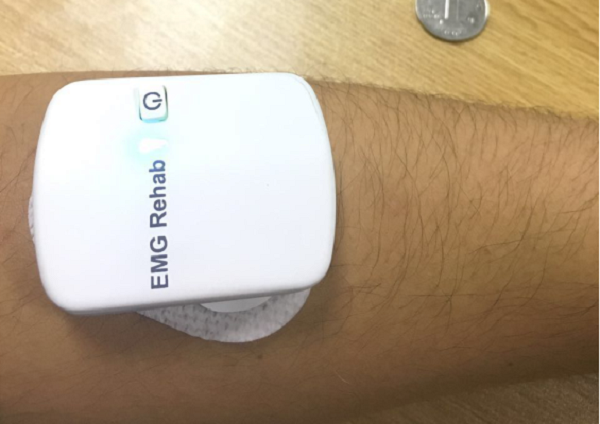
Gamified Rehabilitation Training Solution: In the United States, video game-based training has already been recognized by the FDA (U.S. Food and Drug Administration) as a rehabilitative digital prescription. Currently, Chengdian Technology has collaborated with rehabilitation physicians from major hospitals to design highly immersive rehabilitation games based on existing rehabilitation exercises.
In-game arm movements are determined by the user’s muscle exertion, electromyographic (EMG) signals, and motion posture data. This allows users to intuitively monitor their rehabilitation progress. By training muscle relaxation, endurance, precise control, and hand-eye coordination, the system facilitates rehabilitation through a process that enhances patient compliance and engagement.
In rehabilitation games, EMGRehab can also monitor movement posture in real time, alerting and assisting patients in correcting improper postures to prevent sequelae.
Additionally, the sensors can record muscle exertion and movement data into a database, enabling physicians to perform remote diagnosis and guidance via the EMGRehab cloud platform.
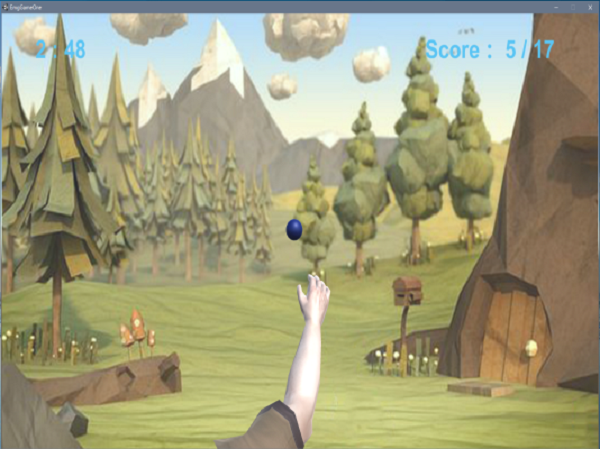
Ye Kehan revealed to reporters that the EMGRehab product currently enters the market through active rehabilitation,It is expected that R&D will be launched in 2017 for passive rehabilitation devices targeting the upper limbs and single joints of the lower limbs.
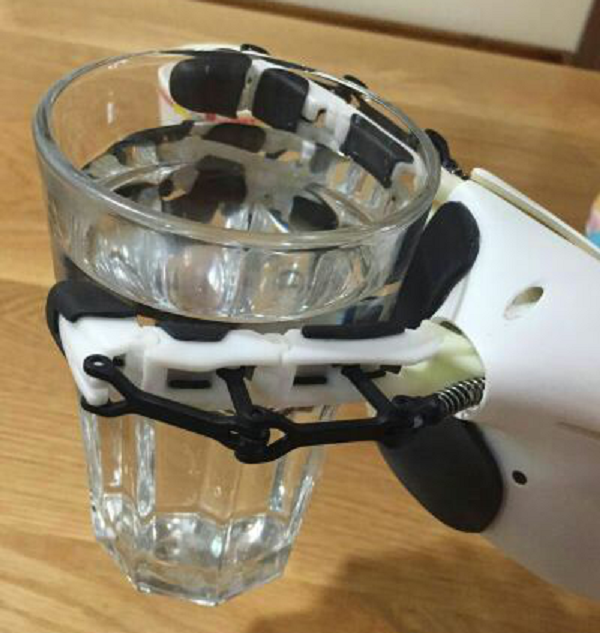
According to statistics from the China Disabled Persons’ Federation, there are 2.26 million amputees in China. Ye Kehan revealed that research into bionic prosthetics (and exoskeletons) has identified several major issues: First, high cost—prices typically range from $50,000 to $100,000, making widespread adoption difficult. Second, lack of practicality and excessive focus on research-grade technology, resulting in difficulties in maintenance and updates. Third, poor scalability—the devices cannot surpass biological performance mechanisms to provide multidimensional support for daily life and work.
Shanghai Chengdian has developed a bionic prosthetic limb (exoskeleton) that can quickly enter the market by utilizing electromyography sensors. This bionic prosthetic limb is positioned as follows:Low-Cost, Practical, and Highly Adaptable(The potential for human-machine integration).
The following section elucidates Shanghai Chengdian’s product philosophy through a technical comparison with similar products:
Low-Cost, High-Efficiency Grasping Solutions: Seventy percent of human daily activities rely on grasping; therefore, bionic prostheses that can effectively master grasping motions enable users to regain a level of self-care ability close to that of able-bodied individuals.
A key technical challenge in bionic hand grasping lies in controlling grip strength to prevent crushing fragile objects, such as disposable paper cups. Current solutions involve equipping the fingers with 15–20 pressure sensors and using machine learning algorithms to control servo motors for object manipulation. This complexity explains why similar bionic prosthetics cannot be made waterproof, as mentioned in the first paragraph. It also increases the user’s learning curve and is one of the primary reasons for the high cost of bionic prosthetic limbs.
Shanghai Chengdian has adopted an innovative solution using air clutches. When encountering resistance while gripping an object, it operates on the same principle as shifting a car into neutral: maintaining the original gripping force without applying additional force. Combined with high static friction materials selected for the fingers and a five-finger gripping method, this low-cost approach achieves the performance of the original design.
Addressing the Cost Challenges of Customization: In addition to the reasons mentioned above, similar products are expensive for two other reasons. First, the dimensions of the socket require customization, resulting in high mold-making costs. Second, the integrated structure leads to extremely high maintenance costs; furthermore, as bionic prostheses are frequently used items, regular servicing and maintenance of servos and bearings are essential.
Shanghai Chengdian’s products feature an interlocking socket design that accommodates variations in residual limb circumference. In the future, bionic prostheses and exoskeletons will be offered in S, M, and L sizes to meet the needs of over 90% of users.Enabling mass production of the product and reducing manufacturing costs.
Furthermore, to facilitate future maintenance and scalability, all five fingers of the Shanghai Chengdian bionic prosthesis feature a unified structure, which simplifies manufacturing and replacement. Additionally, the fingers are secured to the palm via slots, forming a detachable assembly that eases repair.
Highly extensible: Servos in similar products are typically located in the palm area, whereas Chengdian’s product places them at the posterior aspect of the hand. This design first shifts the product’s weight posteriorly, thereby enhancing stability. More importantly, it significantly improves the extensibility of bionic prosthetics. Imagine replacing the hand with a climbing hook for mountain climbing or transforming it into an electric screwdriver for assembly tasks; such human-computer interaction is believed to be one of the future trends.
Ye Kehan revealed that the company’s bionic prosthetic products have already entered the mass production stage. It will initially collaborate with the Red Cross Society and the China Disabled Persons’ Federation to determine the next steps in R&D direction through practical cooperation, and will leverage bionic technology to expand into the exoskeleton field.
In addition to its applications in the medical field, Ye Kehan stated that it will also be applied in the future toAR/VR and Sports & Fitness Sectors.
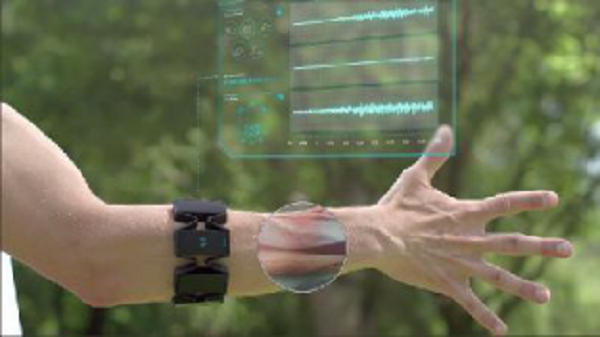
There is a company in Canada that applies electromyography sensors toAR\VRThalmic Labs, a company in this field, was founded by a team emerging from the University of Waterloo’s laboratories. In 2013, the company secured $14.5 million in funding led by Intel and Spark Capital. In December 2016, it raised RMB 120 million in its Series B financing round. Its electromyography (EMG) devices have been integrated with the Oculus Rift and deployed in various outdoor scenarios. The company’s core technology consists of a suite of gesture recognition solutions based on compact EMG sensors.
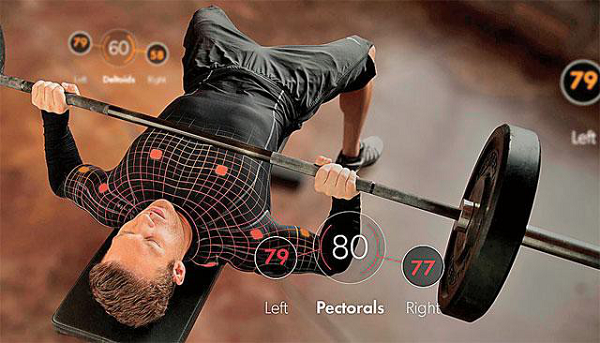
atFitness IndustryAthos, a manufacturer of EMG-enabled fitness apparel, has also secured $51.2 million in funding. Many professional sports teams in the United States have already begun using Athos products, including the NBA’s Golden State Warriors. The products are also selling very well in the consumer market, particularly among sports and fitness enthusiasts, with prices for a full set (including clothing) ranging from $299 to $499. Chengdian stated that collaborations with teams in the VR gaming and sports fitness sectors are already underway, and multi-disciplinary products are expected to emerge in the near future.
Ye Kehan stated that for medical devices such as EMGRehab, the company’s development isFirst, enter authoritative B2B institutions to establish a professional brand image., while enabling users to experience the product, we are bringing it into households across the country. Currently, the company has established collaborations with 20 Grade A tertiary hospitals, 160 Grade B secondary hospitals, and chain community healthcare institutions. Partner organizations include New Start Rehabilitation Hospital and the Chinese Association of Rehabilitation Physicians.
Phase II isEnable Mobile Rehabilitation and Establish Remote Rehabilitation Guidance. This phase primarily focuses on deepening engagement with Tier II and Tier III medical institutions.
In the future, the company will provide customized services to build an online rehabilitation management platform. Rehabilitation physicians can view, track, and manage their patients’ care plans on the platform anytime and anywhere, monitor patients’ home-based rehabilitation training progress, and provide immediate feedback. Additionally, personalized rehabilitation training programs will be tailored for each patient at different stages of their recovery.
In 2015, the company secured tens of millions of RMB in Pre-A financing from Hangzhou Sharing Fund and Shenzhen Fengchouxia. The company is currently raising its Series A round.