

Helix by Illumina Launches DNA-Powered Personalization Platform Beyond Healthcare
Before Steve Jobs passed away from pancreatic cancer in 2011, he spent $100,000 to have his DNA sequenced. At the time, this procedure was both expensive and rare. Who would have thought that just five years after his death, the cost of identical gene sequencing had plummeted to a few thousand dollars—or even lower—making it accessible to millions of people.
The company that has revolutionized DNA sequencing is undoubtedly the genomics giant Illumina. This biotech behemoth, valued at over $20 billion, is nothing short of a legend in the genetic testing industry: DNA data processed by its high-performance computing systems accounts for 90% of all sequencing data generated to date. Illumina’s awe-inspiring instruments have transformed gene sequencing into a powerful tool, further enabling companies such as Ancestry.com and 23andMe to leverage its technology to drive down testing costs. As a result, using genetic testing for disease treatment and predicting drug efficacy is no longer confined to scientists’ laboratories.
Now, genetic testing is poised for another wave, propelling it beyond purely therapeutic applications. To gain a deeper understanding of this emerging trend, you may wish to follow VCBeat (WeChat ID: vcbeat) as it tracks Helix, a subsidiary of Illumina and the future “Apple of gene sequencing.”
Contrary to the common perception of genetic sequencing, Helix’s initial focus was not on disease diagnosis. Instead, it aimed to create a “Genetic App Store”: a platform that offers customized services based on genetic information. Consumers’ initial motivation might be to obtain certain types of their own genetic data through genetic testing, but these data could subsequently serve asUsed by Helix, enabling users toFind tailored services and products on the platform.
The process of bringing users into the “genomic ecosystem” generally unfolds as follows: Initially, you may simply be curious about your athletic potential and thus apply to Helix for testing to determine whether you possess genes particularly suited to specific sports (a type of testing already widely adopted among athletes worldwide). Helix sends you a sample collection kit; after your saliva is collected and sequenced, you pay a modest fee to receive results regarding your athletic predispositions. However, through this initial test, Helix already obtains your complete genomic information. When you subsequently request other services, there is no need for retesting; instead, your previously generated genomic data are directly accessed and utilized.The cost of whole-genome sequencing will inevitably exceed the amount users pay for a single-gene test.. What deeper significance lies behind Helix’s approach?
First, they anticipate that you will return for additional tests: Helix is launching an app platform featuring a variety of engaging applications to attract users. The genetic information stored on the platform will be shared with all apps, and Helix will take a cut from the profits generated by these apps, which naturally requires a substantial reserve of genetic data. Second, Helix aims to serve as the intermediary between consumers and brands, encouraging customers of partner brands to undergo genetic testing, helping brands deliver personalized services, and sharing in their revenue.

Imagine meal-planning and supplement companies offering the most suitable foods and supplements based on customers’ genetic profiles, or a sports brand launching “genetically customized” limited-edition shoes. According to a recent report by UBS, such direct-to-consumer personalized services are projected to capture a market share worth $2 billion to $7 billion across various sectors in the coming years.
Currently, Helix needs to partner with major consumer brands to bring its app-store model into the mainstream. Rumor has it that the company is in negotiations with WW International (formerly Weight Watchers), a global health and weight-management consulting firm, and will also collaborate with a well-known fitness brand. More impressively, increasingly precise gene-sequencing technologies are continually reshaping our understanding. With just a single DNA test, gene-related services are becoming ever more comprehensive, covering every aspect of your life.
Helix aims to further democratize gene sequencing, which necessitates careful consideration of cost-effectiveness and scalability. Currently, there are three tiers of DNA decoding methods available on the market: the top tier isWhole Genome Sequencing(i.e., the type of testing Steve Jobs underwent), the entire process is quite exhausting, providing an overwhelming amount of genetic information; the least expensive but least informative option isGenotyping, which tests only a specific segment of the genome to derive information on ancestry, kinship, or risk for certain diseases; offering an intermediate level of informational content isExome Sequencing, typically priced under $1,000, it involves sequencing the protein-coding regions of the human genome.
“Compared with the most commonly used genotyping methods, exome sequencing offers a wealth of information that is worlds apart,” says Eric Topol, a cardiologist and geneticist at the Scripps Research Institute in San Diego. It can identify genes and mutations associated with complex diseases; furthermore, it can unlock insights into an individual’s lifestyle, personality traits, and more. Illumina considers this sequencing approach to be the fastest, most cost-effective, and relatively comprehensive method available, and it is the area that Helix aims to pioneer.
“All you need to do is provide some of your genetic information at the right time,” said CEO Robin Thurston. Before joining Helix, he sold his fitness tracking app company, MapMyFitness, to Under Armour, a premium sports apparel brand, and served as its Chief Digital Officer for the digital fitness platform. Currently, Helix’s laboratory in San Diego employs more than 30 PhDs and leverages Illumina’s advanced sequencing technology. Helix states that it will strictly safeguard genetic data and provide genetic interpretation services when needed.
On the Path of Next-Generation Sequencing (NGS) Technology,23andMe withdrew due to cost and technical reasons,HelixyetSeeminglyAdvancing with great momentumNow, genetic testing companies such as 23andMe and Ancestry.com have abandoned more in-depth technical research, shifting their focus to accumulating consumer data and even collaborating with pharmaceutical companies for free to seize the market for genetic testing. Helix does not deny that it will also accumulate large amounts of genetic information through free means in the future, but they believe that the genotyping services provided by 23andMe and Ancestry.com are significantly inferior to Helix’s exome sequencing in terms of the comprehensiveness of genetic information. Additionally, the “repeat customer effect” and the sustainability of their services are weaker than those of Helix.
The Helix product, making its debut, was launched in collaboration with National Geographic this November.Geno 2.0 Test, providing users with ancestral information. National Geographic magazine conducted a similar test over the past decade, but this collaboration with Helix has reduced the service price from $200 to $149. Even better, if users purchase other genetic services from National Geographic or Helix in the future, their data will already be archived, eliminating the need for repeated gene sequencing. Thurston stated that Geno 2.0 will become the first deep gene sequencing widely applied in the consumer market.
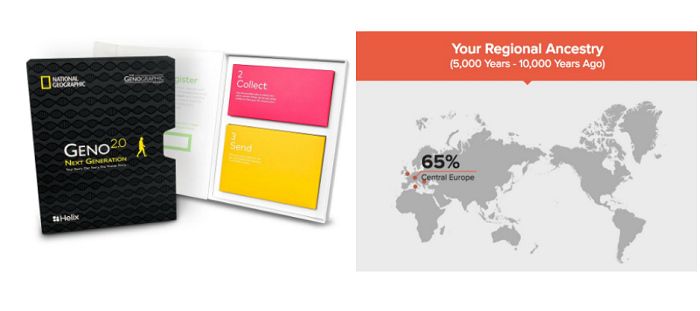
Co-launched with National Geographic MagazineGeno 2.0, Capable of TrackingAncestral Information
Helix’s product launch has put it in direct competition with Illumina’s customers, 23andMe and Ancestry.com, seemingly contradicting Illumina’s prior commitment to “never compete with its own customers.” “We provided financial support to Helix,” said Jay Flatley, former CEO of Illumina, “with the aim of helping Helix reduce sequencing costs and establish a viable business model.” Flatley hoped that Helix’s low-cost exome sequencing would encourage other consumer-facing genetic testing companies to adopt its technology and join its platform. “This is a model that no other company can replicate.”
Flatley also stated that genetic research has reached a turning point in terms of cost, scale, and public awareness, holding significant potential to unlock precise personal information that remains unknown to the general public.
Last August, Helix secured $100 million in its Series A financing round. In addition to Illumina, Helix’s other investors include prominent healthcare providers such as the independent clinical laboratory LabCorp, Mayo Clinic, Duke University, and Mount Sinai Hospital. Mount Sinai Hospital is planning to apply Helix’s technology in several areas, including predicting genetic diseases that may affect future offspring of couples and providing genetic counseling services. “We strongly support individuals’ access to their own genetic information and are honored to bring our reproductive health counseling services to the public through the Helix platform. In the future, we will consider developing more products by integrating genetic technologies with clinical expertise.”
Just as Helix hopes that precise genetic customization can optimize every aspect of life, fun derivative products from genetic testing are also emerging. Early next year, a company called Exploragen plans to launch aVinomeofAlcohol Recommendation EngineIt is built upon a study of how DNA influences people’s taste perception. “The precision of genetic information is so high that it can be used to create your personalized taste profile,” claims Ronnie Andrews, founder of Vinome. “We then use this profile to recommend wines for you.”
There is also one calledHabit's company is set to launch next yearDNA-Customized DietHaving secured a $32 million investment from Campbell Soup, a renowned U.S. food company, Habit has attracted significant attention. You may have heard of the Blood Type Diet; Habit’s “Genetic Diet” service offers a more scientific and precise alternative. The company has developed a “special beverage” containing sugars, fats, and carbohydrates, requiring users to provide two blood samples—one before and one after consuming the drink. By integrating the analysis and sequencing results of these blood samples with data on age, weight, height, and activity level, Habit identifies the most suitable foods for each user and creates personalized dietary plans.
![N]P7KX10D3]C(U4)34SOK~X.png](https://cdn.vcbeat.top/upload/image/20/db/37/42/8a6682ca94ec1605e4367ca9437ec8df.png "1479996935881274.png")
However, whether these companies are more hype than substance remains to be further verified. The renowned news commentary outlet Vox criticized this in an articleHabit has refused to disclose its algorithms and has not undergone any clinical trials. Nevertheless, Vox remains open to the practice of gene-customized nutrition, expressing hope for the future prospects of genetic information interpretation.
Of course, the promotion of the “DNA App Store” and precision gene sequencing services will face numerous challenges.
The first question isGenetic Data Privacy and SecurityDNA is not merely an individual’s code; it can also reveal information about relatives. Once leaked, it could adversely affect many people in terms of employment and health insurance. However, some bioethicists hold a different view: For gene technology companies like Helix, customers’ genetic information constitutes trade secrets that would lose most of their value if made public. Driven by self-interest, such companies will go to great lengths to keep these data confidential.
Indeed, to safeguard user privacy, Helix has implemented data encryption technologies and authentication-based access controls on its information storage platform. The company also empowers users by granting them control over how their genetic data is used, including whether to permit Helix to utilize such data for providing customized products.
Another issue, which is currently the biggest challenge facing Helix, lies in its current stage ofTechnical Capabilities Still Lag Behind Ambitions. Setting aside other matters, even within the medical field, although genetic research has garnered significant attention in recent years, genetic testing remains in its infancy. Robert Green, a genetics consultant at Helix and a Harvard affiliate, stated that currently only 1%–2% of genetic tests truly play an effective role in disease prevention. Therefore, applying genetics to identify suitable skincare regimens and other lifestyle-oriented applications is even more challenging.
Illumina may be a household name in the biomedical field, but it is certainly not universally recognized. Through Helix, the company aims to integrate genetic testing into every aspect of daily life. To reap future rewards, this “Apple of gene sequencing” must still deepen its roots and broaden its reach.
Geneticist Eric Topol was among the first to undergo whole-genome sequencing. While he does not consider the information provided by sequencing to be particularly useful, he is highly enthusiastic about its potential: “The 3 billion base pairs of human genomic DNA can give rise to variations that are simply beyond our imagination. As the gaps are gradually filled in, we will gain greater control over our own destiny.” Or at least, by then, we will have a clearer idea of which type of wine best suits our palate.