

Yu Mingde: Lifting Restrictions on Prescription Refills Will Bring Disruptive Changes to Pharmaceutical Distribution
The 2nd Hengqin International Medical and Health Industry Summit Forum and Investment & Financing Conference (hereinafter referred to as the “Hengqin Forum”) was held on November 25 at the Zhuhai International Convention & Exhibition Center. The forum was organized by the Zhuhai Branch of the China Council for the Promotion of International Trade, Zhuhai Regeneration Times Culture Communication Co., Ltd., and Hengqin Financial Investment Co., Ltd., among others, with co-organization support from the Zhuhai Municipal Bureau of Commerce, Zhuhai Food and Drug Administration, Zhuhai Convention and Exhibition Bureau, and Hengqin New Area Bureau of Commerce, among other entities.
VCBeat has curated Mr. Yu Mingde’s insightful commentary on the interpretation of pharmaceutical policies for our readers’ benefit.
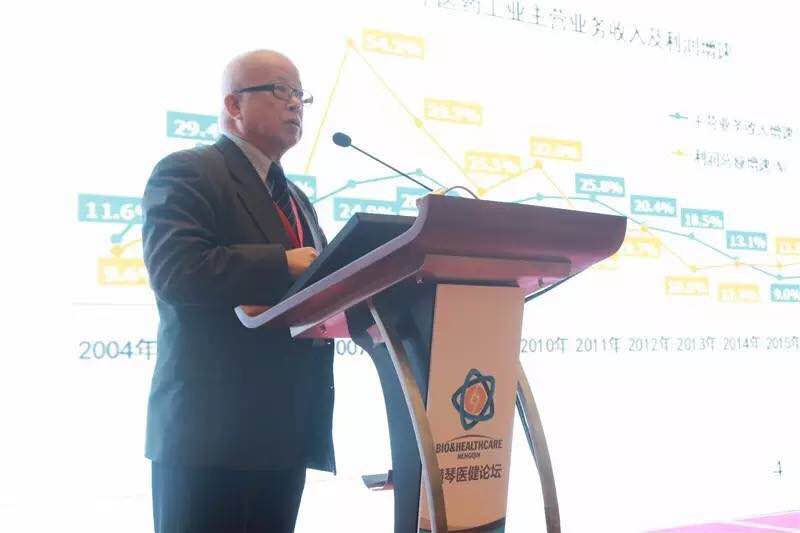
Yu Mingde, President of the China Pharmaceutical Enterprise Management Association and the China Pharmaceutical Entrepreneurs Association. He has long been engaged in the management of pharmaceutical production and distribution. He previously served as Chief of the Technology Section and Factory Director at Fuxin Pharmaceutical Factory and Traditional Chinese Medicine Factory in Liaoning Province; General Manager of Fuxin Pharmaceutical Corporation and Director of the Fuxin Municipal Pharmaceutical Administration Bureau; Deputy Director and Director of the Liaoning Provincial Pharmaceutical Administration Bureau; Director of the Finance and Distribution Department of the State Pharmaceutical Administration; Director of the Pharmaceutical Department and Deputy Director of the Bureau of Economic Operation of the State Economic and Trade Commission; Deputy Director of the Bureau of Economic Operation of the National Development and Reform Commission (NDRC). He currently serves as Honorary Chairman of Beijing Pharmaceutical Group Co., Ltd.; Chief Expert of Pharmaceutical Economic News; Deputy Director of the Biopharmaceutical Expert Committee of the NDRC; and Expert Member of the National Major Special Projects Expert Committee of the Ministry of Science and Technology.
1Stability Is Policy, Change Is Policy
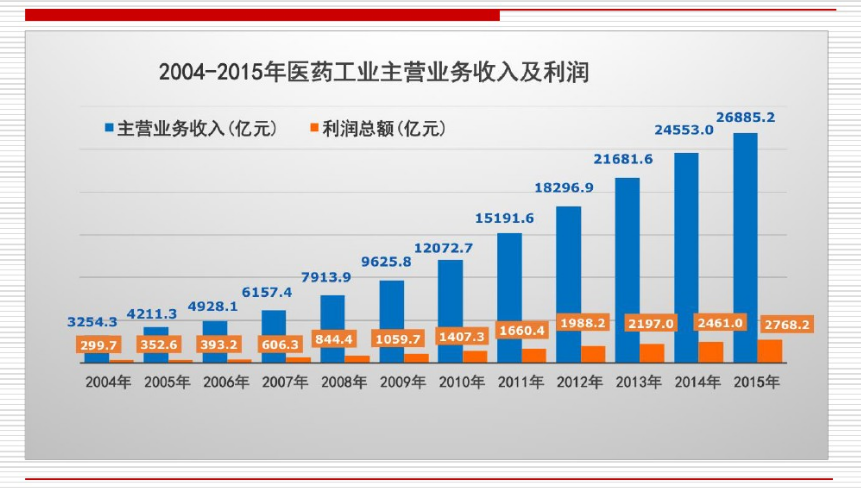
(Image source: Mr. Mingde’s presentation slides)
From 2004, the main business income and profits of China's pharmaceutical industry maintained a stable upward trend for 11 consecutive years. This long-term stability is largely attributable to the reform and opening-up policy. During this period, the industry experienced both rapid growth rates of 50% and moderate growth rates of 6%-7%. Numerous factors contributed to these fluctuations in growth speed, but what was the primary driver? Policy—this is the distinctive characteristic of China. While talent is universally regarded as the foremost element for development worldwide, China stands as an exception. Therefore, in China, we must thoroughly study and effectively implement policies to ensure the successful execution of every endeavor.
2State-owned enterprise profit growth is negative; reform efforts remain insufficient!
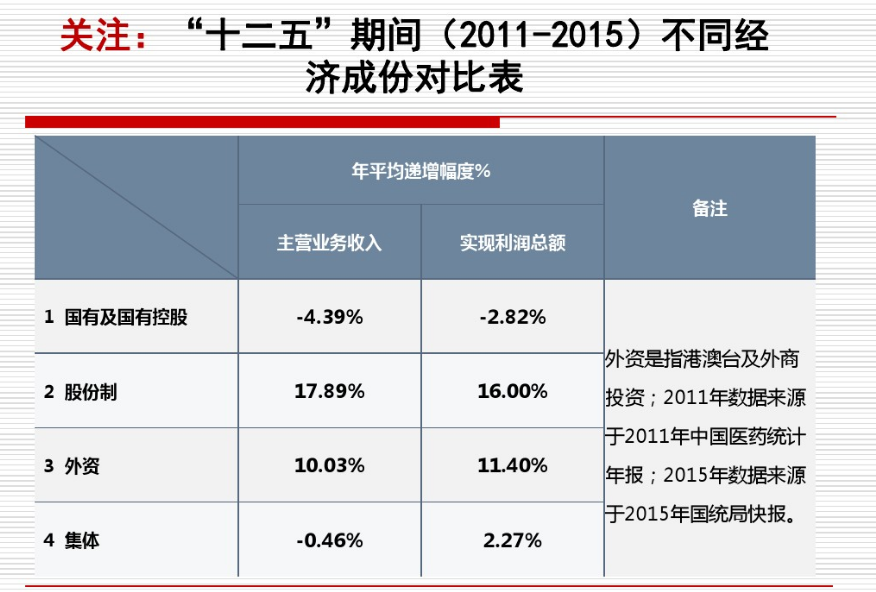
(Image sourced from Mr. Mingde’s presentation slides)
From the comparison of different economic sectors during the 12th Five-Year Plan period, the growth rates of both main business revenue and total profits realized by state-owned and state-controlled enterprises showed a negative trend. Based on these results, the slowest-growing segment in this industry is the state-owned and state-controlled sector, which also has the lowest input-output ratio. This indicates that China’s current reforms of state-owned enterprises are still insufficient.
From the GDP growth chart, we can see a shift from double-digit growth to single-digit growth, and further to a consistent 6.7% over three consecutive quarters this year. This indicates that China’s economic growth has entered a phase of slow expansion, with all factors of production experiencing sluggish growth. The pharmaceutical industry is no exception; therefore, in this environment, we must first recognize that the overall trend of current development is a slowdown in growth rate.
Coupled with the global economic downturn, stringent national controls on excessive health insurance expenditures, and waning momentum in social capital investment, these combined factors dictate that our development trajectory and pace cannot be particularly rapid.
3Cooperation benefits both sides, while conflict harms all; only global resources can foster more vigorous development.
Our country's GDP has maintained a generally positive growth trend, yet it also faces significant pressure. There is no magic bullet that can instantly spur economic growth. The only viable path is reform—namely, to overcome challenges as they arise and thereby rectify all existing conditions that are incompatible with economic development.
President Xi has stated on two occasions: “China and the United States benefit from cooperation and suffer from confrontation,” and “By adhering to cooperation and avoiding confrontation, we not only benefit our two countries but also contribute to the well-being of the world.” President Xi told Donald Trump, “Facts have proven that cooperation is the only correct choice for China and the United States.”China’s manufacturing sector is dominated by low- to mid-end industries, whereas the United States and Europe are characterized by high-end manufacturing and high-tech industries. There is significant complementarity between these economies. It is in our fundamental interest to maintain stable and amicable relations with major market-oriented economies.
1. International – Adhere to the principle of “mutual benefit through cooperation,” uphold the spirit of seeking common ground while reserving differences and promoting prosperity through harmony, and strategically stabilize relations with major market-economy countries;
2. In China: Adhere to market-based resource allocation, promote diversified equity ownership, and unleash the resources and vitality of state-owned enterprises;
3. Industry -- Adhere to biotechnology as the key development focus, drive growth through innovation, pursue an internationalization strategy, and leverage global resources to develop China’s pharmaceutical industry.
In summary, the goal is to leverage global resources to develop China. China’s production capacity is immense; only by tapping into the abundant resources worldwide can we achieve more robust growth. If enterprises focus on transformation and upgrading as their central theme—prioritizing quality improvement and efficiency gains without expanding production capacity—and if relevant authorities adhere to reform as their core agenda, conducting thorough research and issuing regulations with caution, the pharmaceutical industry will undoubtedly sustain stable, healthy, and accelerated development. This outcome is entirely achievable, and we must remain confident.
4Is the Two-Invoice System Ineffective? Will Prescription Outflow Disrupt Retail? Tailored Solutions Are the New Approach
Premier Li Keqiang stated that for emerging phenomena identified with precision, such as new business models based on “Internet Plus” and the sharing economy, regulatory measures should be tailor-made.
The first issue concerns the controversy surrounding the “Two-Invoice System.” If the Two-Invoice System can resolve the problem of high drug prices and eliminate bribery between physicians and pharmacies, then why not implement a “One-Invoice System”? Why not a “Zero-Invoice System”? Alternatively, why not have hospitals operate pharmaceutical factories or vice versa? This vicious cycle associated with the Two-Invoice System has resulted in minimal progress in China’s healthcare reform over the past two decades. In reality, whether bribery can be curbed is unrelated to the number of invoices issued. The distribution of profits at each level of the circulation chain is also irrelevant to pricing; once tendering fixes the price, it can only remain high or increase, regardless of which hospital makes the purchase. Therefore, the Two-Invoice System appears less like a genuine reform and more like an initiative driven by political performance metrics.
The second trend is the outflow of prescriptions. In March this year, two documents issued by the State Council stipulated that medical institutions shall prescribe medications using their generic names and proactively provide prescriptions to patients, thereby safeguarding patients’ right to choose where to purchase their medications. Hospitals are prohibited from restricting the outflow of prescriptions, a move that will bring disruptive changes to pharmaceutical distribution, particularly in the pharmaceutical retail sector.
To summarize in the words of Premier Li Keqiang: “Hard-won achievements must not be taken for granted, difficulties must not be underestimated; we must strengthen our confidence, overcome challenges, and drive development upgrades through reform and innovation.”
The above views do not represent the position of VCBeat.