

UPMC Announces Breakthrough Progress Toward First Human Whole Eye Transplant Within a Decade
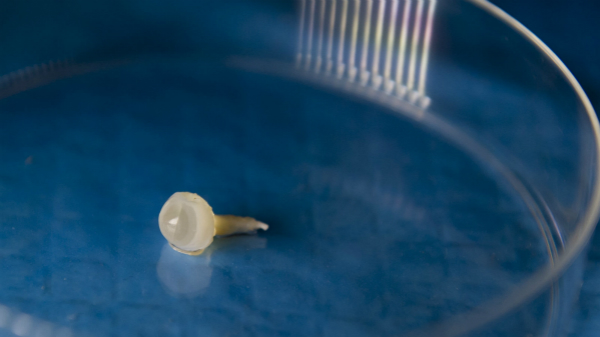
For centuries, scientists have attempted eye transplantation surgeries. Early experiments seemed as fantastical as the diaries of Mary Shelley, the mother of science fiction: implanting a dog’s eyeball into a mouse’s groin, transplanting a mouse’s eyeball onto another mouse’s neck, and extracting an eyeball from one sheep and inserting it into the eye socket of another goat.
Unfortunately, there has never been a single successful case of whole-eye transplantation in living humans. After all, the eye’s muscles, blood vessels, and intricate neural network are directly connected to the brain, making it impossible to guarantee error-free surgical reconnection; this inherent complexity has destined past experimental attempts to fail.
A team of transplant surgeons in Pittsburgh is now aiming to challenge this unresolved situation, with the goal of using donor eyeballs to restore vision in patients with traumatic eye injuries within a decade. Leading the project is Dr. Kia Washington, a plastic surgeon and head of the research team at the University of Pittsburgh Medical Center. “I hope that in 10 years, we will be performing whole-eye transplants in humans,” she said. “Although some people are highly skeptical of such trials, deeming them an impossible moonshot.”
The Department of Defense, as the primary funder, has taken a particular interest in Dr. Kia Washington’s project. Traumatic eye injuries are among the most common combat-related injuries sustained by U.S. service members, and nearly one million Americans suffer from vision impairment due to eye damage, with military personnel constituting the vast majority of this population. With donated eyes, it is believed that many individuals may one day regain their sight.
The first reported attempts at animal eyeball transplantation date back to the 19th century, peaked during World War II—also driven by wartime factors—but yielded unsatisfactory outcomes. In 1977, a special working group of the National Eye Institute, after thorough laboratory investigations, concluded that whole-eye transplantation could not succeed. Immune rejection, inadequate blood supply, and lack of neural function have remained the three major obstacles hindering successful trials.
For a transplanted eye to regain vision, neural connection is an essential step and represents the most complex aspect of eye transplantation. The optic nerve connects the eye to the brain; as part of the central nervous system, it is directly linked to the brain and spinal cord. While nerves in other parts of the body, such as those in the fingers or scalp, can readily regenerate after injury, the central nervous system lacks such resilience.
Dr. Kia Washington’s team has begun to decipher the neural coding of the optic nerve, enabling retinal cells to survive in vitro and regenerate in animal models. In recent decades, significant advances in other areas of transplant medicine, including immunosuppressive drugs and microsurgical techniques, have laid the groundwork for what once seemed an impossible feat: whole-eye transplantation. Regarding the future of eye transplantation, she stated, “Much like hand transplantation 10 or 20 years ago, there was considerable skepticism and the supporting technologies were immature; eye transplantation currently faces similar challenges.”
Last month, the team made a significant breakthrough by transplanting a rat eye into another rat and successfully reconnecting the optic nerve. The transplanted organ remained healthy and viable for two years, and these findings have been published in a peer-reviewed paper. In the next phase, with funding from the Department of Defense, the team is committed to progressively restoring visual neural function in rodents, then primates, and ultimately humans.
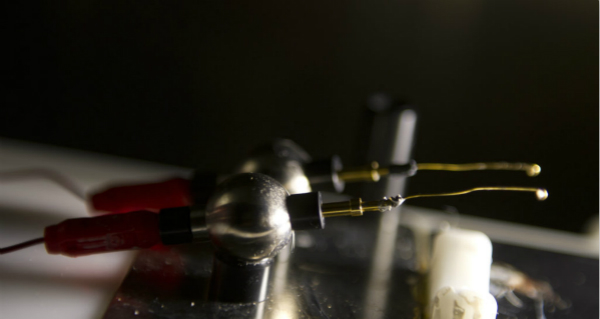
ERG Instrument Used to Assess Neural Viability in Transplanted Rat Eyes
“This rat model experiment on development (eyeball and partial facial transplantation) represents a major breakthrough. If the issue of neural connectivity is successfully resolved, she will be the first surgeon to accomplish this feat,” said Rob Nickells, Professor of Ophthalmology and Visual Sciences at the University of Wisconsin–Madison and collaborator of Kia Washington.
The key to eyeball transplantation lies in the delicate optic nerve; the first hurdle Kia Washington’s team needed to overcome was simply keeping the nerve alive. “Once the eyeball is removed from the donor, the optic nerve cells die rapidly,” said Nickells.
In mouse studies, Nickells focused primarily on the BAX gene, a key regulator of cell death. In 2010, he found that mice lacking this gene did not lose any optic nerve cells even years after injury, whereas in normal mice, all such cells died within three weeks.
Since then, Nickells has been dedicated to studying how gene expression affects neuronal survival, extending his research beyond the BAX gene. In the future, he plans to begin searching for drug candidates that can block BAX, which could theoretically be added to preservation solutions for donor eyes until they are transplanted into recipients.
The second hurdle is stimulating nerve growth after keeping the cells alive. Donor nerves cannot simply be connected to the residual ends of recipient nerves; instead, they must regenerate from the eye to the brain along the optic nerve. In adults, nerve cells lack this regenerative capacity, but Zhigang He, a Professor of Neurology at Harvard Medical School, and Nickells are attempting to reverse this developmental clock.
“We need to find a way to reprogram old neurons into new ones,” he said. “Adult neurons lack the capacity for growth; we must enable them to regenerate.” In January this year, Zhigang He and his team published a paper demonstrating that a novel drug cocktail could achieve this goal in mice. The drug inhibits tumor gene expression pathways and allows neurons to grow. When researchers severed the optic nerve outside the brain, the nerve regenerated within 28 days.
But can mice truly see? To investigate this question, eight weeks after injury, researchers presented the mice with a rotating drum coated with vertical black and white stripes. Normal mice naturally turned their heads to follow the stripes, whereas the mice with regenerated nerves showed no response, indicating that they were unable to see. He realized that the failure to restore vision was due to a key difference between the newly grown nerves and normal nerves: they lacked insulation, causing electrical signals from the eyes to diminish rapidly before reaching the brain.
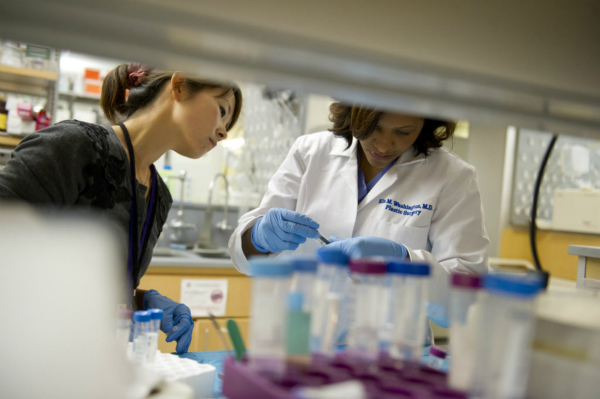
Dr. Washington (right) and Dr. Chiaki Komatsu (left) examining the eyes of mice in the laboratory
Soon, Zhigang He realized that this was identical to the neurological issues encountered by patients with multiple sclerosis. Consequently, the researchers administered the MS drug 4-AP to these same mice and retested them three hours later. Suddenly, the animals began moving their heads in response to the rotating drum. The blind mice could see again.
Andrew Huberman, Associate Professor of Neurobiology and Ophthalmology at Stanford University, also optimistically predicts that it is entirely feasible to conduct similar trials in humans within the next decade. “However, I do not believe that simply transplanting an eyeball from a recently deceased person into another individual would restore vision in the recipient,” Huberman stated. “This would require a combination of biologics and engineering, such as integrating the donor eyeball with neural stem cells.”
Huberman stated that if scientists could grow a new retina from stem cells in donor eyes, the fresh retinal neurons might more readily extend neurites capable of connecting to the brain.
Regardless of the approach adopted, numerous challenges remain. Nickells has been studying mice with damaged optic nerves; it remains to be seen whether the same principles apply when the nerve is severed. Zhigang He’s team has managed to induce regeneration of rodent optic nerves by up to 1 centimeter. By comparison, the distance from the human eye to the brain represents a much larger gap.
For Kia Washington, the primary task ahead involves identifying a non-invasive method to monitor potential rejection of donor eyes in rats and primates. Previously, she had to rely on biopsies from live animals to detect rejection, as this is the standard approach for monitoring other types of transplants. Once rejection is detected, she aims to examine how the eye responds to standard immunosuppressive drugs.
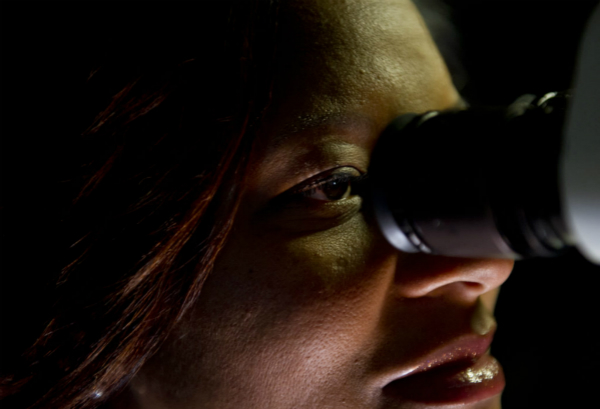
Dr. Kia Washington, in the laboratory at the University of Pittsburgh Medical Center
Washington predicts that the first candidates for whole-eye transplantation will be individuals who have undergone facial transplantation. Many of these patients are blind and already require immunosuppressive therapy, thereby rendering the risk-to-benefit ratio of eye transplantation more favorable. Despite existing challenges, she contends that transplantation represents the optimal approach for treating vision loss due to ocular injury, particularly in traumatic settings, as it holds genuine potential for functional restoration.