

Opportunities and Challenges for the Health Industry Under China's Medical Insurance Cost Control: Insights from Shangguan Yongqiang, Vice President of Sino-Sciences Holding
Since 2000, Haihong Holdings has supported healthcare reform by conducting centralized bidding and procurement for pharmaceuticals. With the launch of the new healthcare reform in 2009, the company shifted part of its focus to controlling health insurance expenditures. In 2012, Haihong Holdings launched its first pilot program in Hangzhou. To date, it assists health insurance funds with cost containment efforts in more than 200 prefecture-level cities across approximately 24 provinces in China.
Amid the cost-containment measures of medical insurance, VCBeat (WeChat ID: vcbeat) has compiled, without altering the original meaning, the speech delivered by Shangguan Yongqiang, Vice President of Haohong Enterprise (Holdings) Co., Ltd., at the Second Hengqin Forum, highlighting the crises and opportunities facing the broader health industry.
Shangguan Yongqiang
When discussing broader health and healthcare reform, policy cannot be overlooked. Policy plays a decisive role in shaping healthcare system reform and the development of the medical industry. This is followed by the participation of non-governmental forces. The Director of the Medical Insurance Department under the Ministry of Human Resources and Social Security once addressed the issue of social forces participating in healthcare reform or public health affairs, proposingWithout incentives, social forces will not get involved.。
Whenever the healthcare system or the broader health industry is discussed, medical insurance is invariably mentioned. Since the launch of the new round of healthcare reforms in 2009, medical insurance has become the largest payer, with a coverage rate reaching 95%. Therefore, the development and success or failure of medical insurance are critical to the overall success or failure of China’s healthcare reforms.
Regarding the most significant change in China’s healthcare reform or the entire healthcare system, President Xi mentioned in a speech,The overarching direction of the reform is not merely to regulate drug prices and standardize clinical practices, but to elevate the effort to a systemic restructuring centered on health.
The core issue in China’s healthcare system reform regarding medical insurance is the insufficient funding and the contradiction between ever-growing demand and basic medical security. Through practices in more than 100 prefecture-level cities across China, Haihong Holdings has found that there is indeed a risk of deficit in China’s medical insurance funds, and this risk is increasing.
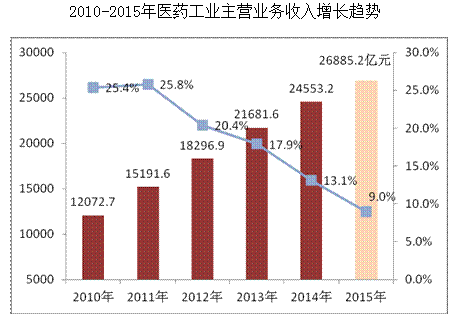
Image source: MIIT
An analysis of the growth trend in the main business revenue of the pharmaceutical industry from 2010 to 2015 reveals that, starting in 2012, the growth rate of drug sales across China underwent a shift. Previously standing at approximately 20%, the growth rate declined to 9% by 2015. The primary driver behind this change was the containment of irrational drug expenditures by medical insurance programs.
Another long-term risk is China’s irreversible population aging. Under the current medical insurance policies, this demographic shift will lead to a rapid depletion of medical insurance funds, potentially culminating in a fiscal crisis.
Under current fiscal constraints, cost-control reform is an inevitable path for the sustainable development of China's medical insurance system.
Healthcare Insurance Cost Control: To be precise, cost containment is only one aspect of it. Healthcare insurance cost control should be divided into three aspects. The first is cost containment measures that yield short-term effects—how to make expenditures more reasonable and align spending with revenue levels;
The second category, which yields results in the medium term, concerns how to establish a multi-tiered security system so that healthcare coverage is not borne solely by basic medical insurance.
Third, health management. At the national strategic level, China is advancing the Healthy China initiative. If the general public becomes moreHealth...medical insurance expenditures will naturally decrease. Therefore, the third point is to achieve the long-term sustainable development of medical insurance.
Initially, medical insurance cost containment relied on manual processes, where experts conducted reviews and random audits of claims, with penalties imposed for discrepancies. This approach gave rise to certain issues, such as corruption. In 2009, Hailong Holdings partnered with a U.S. company to introduce intelligent claim review systems to China. By applying specialized analytical methods to diagnose each claim, this logic assisted medical insurance agencies in assessing the rationality of physicians’ prescriptions.
Intelligent audits have primarily identified issues in three areas. First, fraudulent insurance claims, involving actions by individuals, hospitals, and physicians. Fraudulent claims are currently subject to the most stringent enforcement, as they involve criminal offenses, and malicious intent must be rigorously controlled. Second, regulatory violations, which may stem from financial incentives or inadvertent non-compliance with certain rules. Third, overutilization of medical services.
Following this round of cost-containment measures, the pharmaceutical companies hit hardest are those that rely on marketing and illicit practices to expand their development pipelines, while lacking sufficient product uniqueness. In recent years, the growth rate of essential medicines has fallen to below 10%, with some even declining by 30–40%. In contrast, other enterprises have achieved rapid growth; these companies primarily focus on funding R&D and producing proprietary drugs. ThereforeIn the past, the distribution of pharmaceuticals in China was primarily marketing-driven; it will gradually shift toward being driven by independent research and development., this is an inevitable trend.
After cost containment has reached a certain level in the early stage, the next step is to undertake someEvaluation of Medical Diagnosis and Treatment, such as the patient's designated hospitals and physicians, the quality of diagnosis and treatment, and whether the patient's expenses are economically reasonable. Currently, this project has been rolled out nationwide.
Once the evaluation system is basically established, the next step is to carry out someMedical Insurance Payment Standards, Since last year, the Ministry of Human Resources and Social Security and the National Health and Family Planning Commission, among other departments, have engaged in extensive consultations, and the basic draft for public comment has now been finalized.
Haihong Holdings is currently assisting medical insurance authorities in seven cities across China with the development of clinical treatment standards, including big data mining. What impact will this have? First, while companies involved in the previous bidding process tended to focus excessively on price, the upcoming medical insurance payment standards will prioritize, first, active ingredients and, second, therapeutic efficacy.
If a drug is of high quality and commands a high price yet offers good cost-effectiveness, it should be assigned a higher reimbursement standard under the national medical insurance scheme. Conversely, if a drug has a low price, limited efficacy, and poor cost-effectiveness, its reimbursement standard will be reduced. The medical insurance reimbursement standards are designed to guide the market toward the survival of the fittest in pharmaceutical products.. Such policies are imperative and are expected to be rolled out in most regions across China in the first half of next year.
Value-Based Healthcare Is the Core of Health Insurance Cost Control, medical insurance should pay for valuable healthcare, rather than simply reviewing prices and procedures before making payments. This is also a significant shift.
The most rational approach to healthcare insurance reform is to establish a multi-tiered security system. This issue may not have been prominent a few years ago, as basic medical insurance had just achieved universal coverage and was experiencing rapid annual growth. However, last year, the growth rate of medical insurance funds declined to 4%–5%, raising a critical question: what should be covered, and what should not be covered, by basic medical insurance? We believe that commercial insurance should be introduced to supplement the shortcomings of medical insurance, while basic medical insurance should return to its core principles of public welfare and providing fundamental coverage.
Health management has become a hot topic. Evidence from policy directions, industry trends, academic literature, and international experience all indicates that effective early-stage health management can lead to substantial savings in future healthcare expenditures. Data show that for every yuan invested in health management, future medical costs can be reduced by 30 yuan.
In fact, the benefits of health management are obvious, but so far most efforts have remained at the level of slogans or small-scale initiatives. The core issue is actually who pays for health management. Abroad,Health management is basically shared by insurance companies and customers., because insurance companies have a strong incentive to improve customer health, thereby reducing future claim costs. However, no insurance companies in China currently cover health management expenses for their clients, presenting significant commercial opportunities.
Currently, health management has not been implemented on a large scale. There are still some technical and policy issues, but these challenges will inevitably be resolved in the end.