

Can China's Rapidly Advancing Single-Port Surgical Robots Give Rise to a Domestic 'Da Vinci'?
Global sales of the da Vinci Surgical System have reached approximately 3,000 units, with over 2 million procedures performed. The surgical success rate exceeds 99%. According to the project lead for the da Vinci system, the rate of surgical errors is lower than the probability of an airplane crash.
The da Vinci surgical robot is already highly advanced, yet it faces two prominent challenges. First, its multi-port operation makes it inconvenient or even difficult to access many confined anatomical spaces during surgery. Second, the da Vinci system typically employs a multi-incision approach; although postoperative recovery time is shorter than that of conventional surgery, there is still room for improvement. Single-port robotic systems can effectively address these issues.
Therefore, the development of single-port robots has become a new market demand and hotspot. The R&D gap between China and foreign countries in this field is not significant, so entering this field may provide an opportunity for Chinese surgical robots to “overtake on a bend.”
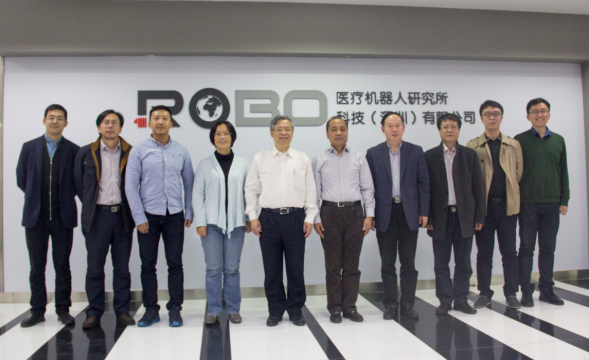
Group Photo of the First Single-Port Surgical Robot Symposium
Single-port surgical robots are widely recognized as the future direction for next-generation surgical robot platforms in the field of medical robotics. The difference between single-port surgical robots and the multi-port surgical robots currently on the market can be explained simply as follows: during surgery with a multi-port system, multiple incisions (typically four) must be made in the patient’s abdominal cavity to allow minimally invasive instruments to enter and perform procedures.
Single-port surgical robots require only a single incision to accommodate all instruments during the procedure. Therefore, compared with multi-port approaches, single-port surgery offers advantages such as reduced spatial requirements within the operative field, minimized trauma, and faster postoperative recovery. Furthermore, single-port surgical robots utilize fewer disposable consumables, resulting in lower costs and greater potential for market adoption.
In 2015, the Hainan Branch of the Chinese PLA General Hospital performed China’s first single-incision robotic gynecological surgery. Through a 2.5 cm umbilical incision, surgeons successfully removed a fist-sized teratoma. The entire treatment cycle, including preoperative preparation, surgical intervention, and postoperative recovery, required less than one week of hospitalization. Due to minimal surgical trauma and low blood loss, both hospital stay and recovery time were further reduced, with both patients discharged the day after surgery. Although the procedure utilized the da Vinci Surgical System with a single-port platform, it demonstrated the advantages of single-incision robotic surgery.
Every development has its dual aspects. Taking single-port laparoscopic surgery as an example, let us discuss the limitations of single-console robotic systems. Single-port laparoscopic procedures are constrained by the limited number of ports, resulting in restricted access to the surgical site and difficulty in retracting adjacent organs. Furthermore, the concentrated entry points of the instruments make it challenging to establish an operational triangle, leading to mutual instrument interference that compromises maneuverability and the surgical field of view. Additionally, the coaxial alignment of the instruments and the light source can impair the surgeon’s judgment of depth and distance, thereby increasing the technical difficulty of the procedure.
Furthermore, patient body habitus significantly impacts surgical procedures; for instance, surgeries are more challenging in obese or tall patients. Practical experience has demonstrated that the use of retractors and effective tissue dissection can expand the surgical field to some extent, thereby reducing operational difficulty for the surgeon. Robotic surgery also represents an effective solution, particularly highlighting its "precision" advantage when surgeons perform delicate maneuvers.
Additionally, there are concerns regarding incision-related complications. Currently, although the incidence of incision-related complications in single-port laparoscopic surgery has decreased, issues such as incisional hernia and surgical site infection still persist. Therefore, effective protection of the incision should be maintained intraoperatively, and postoperative closure of the incision must be secure and watertight.
As a global leader in the fields of robotics and healthcare“Lunar Exploration Project,” the next-generation research field for single-port surgical robots, already includesROBOA small number of domestic and international enterprises and research institutions, including the Medical Robotics Institute, have conducted research in this area.
The ROBO Medical Robotics Institute is a professional research institution dedicated to the global fields of medical robotics and artificial intelligence, jointly established by Professor Hannes’ team from the Robotics Laboratory at École Polytechnique Fédérale de Lausanne (EPFL), Professor Sun Lining’s team of leading experts in China’s robotics sector, and ROBO Medical. The institute is committed to scientific research and applications of robotics and artificial intelligence in healthcare. Its primary research areas include minimally invasive surgical robots, diagnostic and testing robots, rehabilitation and nursing robots, AI-integrated healthcare, the Internet of Things for health, and medical big data.
It is reported that the ROBO Medical Robot Institute is currently developing China’s first single-port surgical robot, a project that has drawn upon technical expertise from institutions such as the École Polytechnique Fédérale de Lausanne (EPFL) in Switzerland, as well as partners in the United States and Hong Kong.
Reporters have learned that in the high-tech field of medical robotics, the technological gap between China and developed countries in Europe and the United States is not significant. While most products are still in the clinical stage, China’s extensive clinical application data can serve as an advantage during the research and development phase.
In addition to the efforts of mainland Chinese enterprises, Hong Kong is also researching single-arm robotic systems. The Hong Kong Polytechnic University has successfully developed the world’s first motor-integrated surgical robotic system (NSRS, Novel Surgical Robotic System). This research leveraged the clinical surgical expertise of the Li Ka Shing Faculty of Medicine at the University of Hong Kong and has been successfully applied in animal trials. The technology is expected to enter clinical testing within two years, with a potential market launch as early as 2019.
The NSRS can access the human body through a single incision or natural orifices (incision-free), with capabilities covering various abdominal or pelvic surgeries. With micro-motors within the robotic arms positioned close to the end effectors (surgical tools), the arms can not only perform high-precision movements but also provide highly sensitive haptic or force feedback.
Health insurers clearly favor low-cost surgical procedures. Single-port robotic surgical systems can accelerate patient recovery, thereby reducing hospitalization costs, while also lowering the costs of the surgery itself. Consequently, health insurers will pressure medical centers to accelerate the adoption of robotic equipment, and may even refuse coverage for surgeries performed using robotic systems. Suppliers of single-port robotic surgical systems should fully leverage the influence of health insurance companies by obtaining insurance certification and even marketing their robotic surgical systems through insurance channels.
In an interview with Professor Sun Lining of the ROBO Medical Robot Institute, he pointed out that in the field of single-control robots, China is most likely to catch up with Europe and the United States. The number of papers and R&D investment are not much different from those in Europe and the United States.

Professors Engage in Lively Discussion on the Development Direction of Single-Port Surgical Robots
Professor Huang Jian, President-Elect of the Urology Branch of the Chinese Medical Association, pointed out that while the advantages of multi-port medical robots are undeniable, they still have many drawbacks and are relatively cumbersome to operate. Single-port surgical robots offer significant advantages in procedures involving confined spaces, making them particularly well-suited for urological surgeries, such as prostatectomies. Professor Yu Peiwu from Southwest Hospital of the Third Military Medical University, who has performed over 1,200 da Vinci surgical procedures—the highest number of clinical robotic surgery cases in China—emphasized that the most critical advantage of robots over humans is their intelligence; therefore, integration of intelligent capabilities should be prioritized in clinical applications.