

Jinzi Ham Acquires 43% Stake in Zhongyu Capital for RMB 430 Million to Enter the Healthcare Sector
Amidst a favorable policy environment and growing consumer emphasis on pharmaceutical spending, the healthcare sector has become a highly sought-after target for capital. According to VCBeat’s 2016 annual review, investment in the healthcare industry had already reached tens of billions of RMB by that point in the year. Investors included a diverse range of industry players such as healthcare-focused funds, angel investors, pharmaceutical manufacturers, pharmaceutical distributors, pharmaceutical e-commerce platforms, and internet healthcare companies, along with numerous listed companies venturing into the sector from other industries.
On November 30, Shenzhen-listed company Jinzi Ham (002515.SZ) announced the completion of the transfer and registration of equity interests. The company stated that the industrial and commercial registration changes related to the equity transfer from Zhongyu Capital had been finalized, with 43% of Zhongyu Capital’s equity now registered under the company’s name, and a new business license issued by the relevant authorities had been obtained.
Jinzi Ham’s latest acquisition initiative began three months ago. On July 25, Jinzi Ham convened its board of directors, which reviewed and approved the acquisition of equity interests from Zhongyu Capital. The key terms are as follows: the listed company intends to use its own funds to pay RMB 430 million to acquire a 43% stake in Zhongyu Financial Holdings and Zhongyu Asset Management, implying a valuation of RMB 1 billion for Zhongyu Capital.
According to the announcement released by Jinhua Ham on the following day, Zhongyu Capital, the target company in this equity transfer, was established in 2005. Its legal representative is Yu Bo, and its registered capital amounts to RMB 109 million. The company’s core business activities include asset management, corporate consulting, and economic and trade services, with its subsidiary operations encompassingZhongyu Doctor Group, Medical Industry Platform, and Industrial Investment Fund: Three Major Platforms。
According to disclosures, Zhongyu Capital aims to leverage the Zhongyu Doctor Group as a platform to develop an acquaintance-based healthcare system and an internet-based diagnosis and treatment model connecting renowned physicians with patients, thereby establishing a chain of hospitals and clinics. Currently, Hunan Zhongyu Medical Alliance and Zhongyu Medical Alliance Health Management have commenced operations. Specifically, Hunan Zhongyu Medical Alliance has contracted 853 experts and renowned physicians at the level of associate chief physician or above, along with 148 hospitals and 262 clinics, and has acquired six clinics. Zhongyu Medical Alliance Health Management (Chengdu) Co., Ltd. has contracted 585 experts and renowned physicians at the level of associate chief physician or above, along with 82 hospitals and 107 clinics. Doctor groups in Henan, Jiangsu, and Hebei provinces are currently undergoing registration, while those in Zhejiang, Liaoning, Guangdong, and Hubei provinces are in the preparatory stage.
The healthcare industrial platform will focus on controlling investments and industrial integration, striving to build a closed-loop ecosystem of internet-plus pharmaceutical and medical enterprises centered on precision medicine, primarily genetic testing, and featuring significant technological innovations. Currently, it has acquired controlling stakes in companies such as Beijing Chunwei Technology Co., Ltd., Wuhan Yiji Biotechnology Co., Ltd., and Chengdu Andikang Biotechnology Co., Ltd., establishing a complete closed loop serving children, women, and infants. Beijing Chunwei Technology Co., Ltd. was established on August 30, 2013. The company developed the world’s first intelligent, wireless fetal heart rate monitor (a Class II medical device approved by the CFDA), precisely entering the internet-plus healthcare sector and securing extensive, stable, and precise resources across four key groups: mothers, hospitals, doctors, and infants. Its remote fetal heart monitoring system has been deployed in 500 core hospitals nationwide, including 41 in Beijing, 123 in North China, 163 in East China, and 134 in South China.
Yiji Wuhan Biotechnology Co., Ltd. leverages advanced technologies originating from Silicon Valley, USA, bringing together international clinical molecular geneticists from top-tier U.S. institutions such as Stanford University, as well as elite professionals from China’s pharmaceutical and business sectors. The company has officially introduced independently developed, globally leading DNA biosensing technologies and products into the Chinese market. Its core business areas include genetic testing for neonatal hereditary diseases and pharmacogenomics, personalized genetic testing, detection of circulating tumor cells (CTCs) and circulating tumor DNA (ctDNA), and genetic testing for cancer risk assessment.
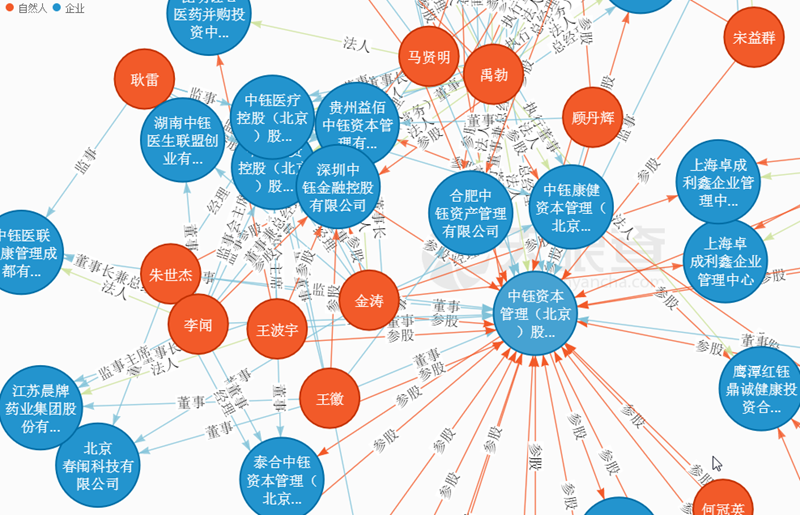
Zhongyu Capital Corporate Map
Jinzi Ham stated in its announcement that the company is engaged in the health food industry and is highly optimistic about the development prospects of the health sector. Meanwhile, Jinzi Ham strongly endorses Zhongyu Capital’s philosophy, strategic layout, team strength, and growth potential. Through this investment, Zhongyu Capital will serve as Jinzi Ham’s platform for entering the broader health and wellness industry, enabling resource integration and synergistic development. This move aims to expand business scopes and models, optimize industrial layout, implement a coordinated development strategy for the health and wellness industry, enhance the company’s overall competitiveness, and achieve the strategic goal of sustaining healthy corporate growth.
Although Jinhua Ham announced that it is highly optimistic about Zhongyu Capital’s development strategy, the merger and acquisition case is not merely a matter of ideological alignment; a key factor is that Zhongyu Capital still demonstrates strong profitability and continues to grow.
Data shows that,Zhongyu Capital reported annual revenue of RMB 38.44 million and net profit of RMB 10.59 million in 2015, with revenue reaching RMB 59.12 million and net profit amounting to RMB 26.49 million in the first half of 2016. In contrast, Jinzi Ham’s net profit was only RMB 19.22 million in 2015 and RMB 17.46 million in the first half of this year. This indicates that Jinzi Ham, as the acquiring entity, has lower net profitability than its acquisition target.
Furthermore, according to the performance commitments made by Zhongyu Capital, the target company’s net profit attributable to shareholders of the parent company, after deducting non-recurring gains and losses, shall be no less than RMB 110 million in 2016, and no less than RMB 250 million, RMB 320 million, and RMB 420 million in each of the subsequent three years (i.e., 2017–2019). Simply put, Jinhua Ham could recoup its M&A costs within two to three years, making this deal a guaranteed profit with no risk of loss.
Moreover, performance compensation and share repurchase clauses have been established for the counterparty in case the target company fails to meet its performance targets. According to the performance compensation agreement, if Zhongyu Asset Management’s audited net profit by Jinzi Ham during the three-year performance commitment period falls below 70% of the committed amount, Zhongyu Asset Management is required to provide cash compensation to Jinzi Ham, which amounts to approximately 1% of the committed profit. After the expiration of the commitment period, if Zhongyu Asset Management’s cumulative net profit is less than the total committed amount, an alternative compensation plan will apply. Calculations indicate that this compensation amount is relatively small compared to the difference between the actual cumulative net profit and the actual committed net profit.
Meanwhile, to ensure Zhongyu Asset Management’s performance of its obligations, its controlling shareholder Zhongyu Financial Holdings and individual shareholders Yu Bo, Ma Xianming, Jin Tao, et al. shall pledge their remaining equity interests in Zhongyu Asset Management after the transaction to Jinyi Ham. Such pledge procedures shall be completed within 10 working days following the completion of the industrial and commercial registration.
Upon closer examination, this performance commitment and compensation agreement can be described as “inverted.” Why, then, was Jinzi Ham willing to enter into such an unreasonable M&A agreement? Previously, the Board Secretary of Jinzi Ham disclosed to the public that, based on the development prospects of the industry in which Zhongyu Capital operates and Zhongyu Capital’s strategic layout for its business while fully leveraging its competitive advantages, the performance commitments made by Zhongyu Capital were reasonable and achievable. However, the growth rate implied by these performance commitments was dozens of times higher; calculating solely based on the 2017 committed net profit attributable to the listed company entity of RMB 250 million,This represents more than a 20-fold increase from the 19.22 million recorded in 2015, undeniably constituting a high-stakes gamble.
In response, there are two prevailing speculations: first, that Zhongyu Capital’s development prospects are indeed promising; and second, that its capital maneuvering techniques are highly sophisticated. These two points can essentially be attributed to a single factor: Yu Bo, the actual controller of Zhongyu Capital. Publicly available information indicates that Yu Bo was formerly a partner at JD Healthcare. After falling out with internal stakeholders, he left to establish another medical investment institution, adopting a “PE + Listed Company” model. His approach is known for its speed and precision, featuring short investment cycles and rapid exit strategies to realize gains.
It was also reported that in January 2015, Zhongyu Capital obtained controlling interest in the NEEQ-listed company Huaxin Yuanda (i.e., “Zhongyu Medical”) through a private placement and renamed it Zhongyu Medical. In December 2015, Zhongyu Medical suspended trading to plan a major asset restructuring. Various indications at the time suggested that Zhongyu Capital was planning to inject its private equity (PE) assets into Zhongyu Medical. At the end of that year, Zhongyu Capital was restructured into a joint-stock company and increased its capital through share expansion.
In November and December 2015, Zhongyu Capital completed a series of capital operations, including capital increase and share expansion, as well as conversion into a joint-stock company, seemingly paving the way for the asset restructuring of Zhongyu Medical. However, at that very moment, the regulatory landscape shifted abruptly, with the China Securities Regulatory Commission (CSRC) halting the listing and financing activities of private equity (PE) firms on the National Equities Exchange and Quotations (NEEQ). On June 25 this year, Zhongyu Medical announced the termination of the asset restructuring, citing that “the parties involved did not meet the conditions for restructuring.”
This has left several institutions that increased their stakes—confident at the end of last year that the asset restructuring would certainly succeed—with no viable exit route. Zhongyu Capital must therefore find alternative exit strategies for these institutions, and seeking acquisition by a listed company has emerged as the most favorable option. Indeed, a review of Jinyi Ham’s public announcements reveals direct evidence of these institutions’ exits.
Institution Name | Pre-Transaction Shareholding | Shareholding Ratio | Number of Shares Held After Transaction | Shareholding Ratio |
Jiuwu Top Investment Management Co., Ltd. | 50 | 0.459 | 0 | 0 |
Shenzhen Jiuyou Juyi Investment Management Co., Ltd. | 75 | 0.688 | 0 | 0 |
Shenzhen United Venture Capital No. 10 Investment Partnership (Limited Partnership) | 50 | 0.459 | 0 | 0 |
Shenzhen Hongtao Puxin Equity Investment Partnership (Limited Partnership) | 27 | 0.248 | 0 | 0 |
Prior to the transaction, these four institutions held 2.02 million shares in Zhongyu Capital, representing a 1.854% equity stake, with a transaction consideration of RMB 18.54 million. It is also worth noting the related party, Shenzhen Zhongyu Financial Holding Co., Ltd. (hereinafter referred to as “Zhongyu Financial Holding”), which was established in October 2015. Yu Bo held a 67% equity interest in the company. Under this acquisition plan, Zhongyu Financial Holding received a transaction consideration of RMB 218 million, resulting in a personal gain of RMB 146 million for Yu Bo.
Institution Name | Number of Shares Held Before Transaction | Shareholding Ratio | Post-Transaction Shareholding | Shareholding Ratio |
Chongqing Kuimu Enterprise Management Consulting Co., Ltd. | 30 | 0.275 | 17.1 | 0.157 |
Shenzhen Zhongyu Financial Holdings Co., Ltd. | 5562.5 | 51.032 | 3185.265 | 29.222 |
Hebei Rongjin Investment Co., Ltd. | 950 | 8.716 | 541.5 | 4.968 |
Nanjing Gaoke Xinchuang Investment Co., Ltd. | 300 | 2.752 | 300 | 2.752 |
The head of the healthcare division at a certain investment institution told reporters that Jinhua Ham’s acquisition of Zhongyu Asset Management alone does not reveal clear trends in healthcare investment; this round of M&A is still primarily driven by speculative investment. However, it is not common for listed companies to engage in “cross-industry” acquisitions of healthcare businesses. One reason is that, against the backdrop of comprehensive healthcare reform, the healthcare sector has become a new engine for economic growth, with hotspots concentrated in primary care and medical devices. In the previous period, pharmaceutical listings demonstrated significant financing and investment capabilities. In the next phase, industries such as primary healthcare and health management are expected to experience explosive growth and become prime targets for mergers and acquisitions.
Jinzi Ham has a total share capital of 611 million shares, with a free-float share capital of 362 million shares. Its total market capitalization stands at RMB 10.48 billion. As of press time, the stock price was RMB 17.13 per share, representing a decline of 4.03%.