

Southwest China's First Doctor Group Launches with Endorsement from Zhang Qiang
Physician groups, an imported concept, have become one of the most central topics in healthcare reform. Amid ongoing discussions, pilot initiatives, and evolving policies, no definitive consensus has emerged. Since Zhang Qiang, recognized as the “pioneer” of physician groups, debates over the advantages and disadvantages of physicians leaving the public system to practice medicine independently have never ceased.
On the afternoon of December 1, the first physician group in Southwest China was officially established in Chongqing, marking a new step forward in the exploration of the physician group model. Jiang Jinyan, formerly an oncologist at Southwest Hospital, initiated this emerging force in the current exploration of physician groups.From advancing medical standards to serving patients with wholehearted dedication, the Hezheng Doctor Group, founded by Jiang Jinyan, aims to deliver a new answer sheet for the future of doctor groups.
“The Path to Cancer Rehabilitation” was the central theme of Jiang Jinyan’s speech at the founding conference of Hezheng Physician Group. This left attendees, who had expected to hear about the group’s business model, strategic planning, and development tactics, somewhat taken aback. Yet, in a sense, this reflects the benevolent spirit of healers and perhaps even the original intention behind establishing the physician group.
“‘He’ signifies the harmonious relationship between doctors and patients, while ‘Zheng’ represents professional integrity rooted in moral uprightness.” Jiang Jinyan explained the origin of the name Hezheng Doctor Group in this manner. Since joining the Department of Oncology at Southwest Hospital in 1996, Jiang Jinyan has encountered countless cancer patients and their families suffering from the disease. However, within the public healthcare system, the heavy burden of clinical responsibilities prevented her from providing adequate care to every patient. This situation once led her to develop depression, ultimately prompting her decision to resign.
After leaving the public healthcare system, Jiang Jinyan did not abandon her medical career; instead, she chose to establish a general practice clinic in the community. Meanwhile, Jiang began contemplating how to leverage her medical expertise to better serve patients, ensuring they receive more professional and attentive care. It was from this reflection that the idea of founding a physician group first emerged.
Dr. Zhang Xiaoli, another co-founder of Hezheng Physician Group, has a similar background. With the support of the original team, Hezheng Physician Group took its initial shape, focusing primarily on oncology rehabilitation and treatment. Its aim is to provide precision medicine for cancer patients and help them regain social functioning. From the outset, this physician group—the first of its kind in Southwest China—established a cooperative intent with Tianjin University of Sport to promote exercise-based oncology rehabilitation; partnered with high-end private healthcare institutions in Europe to introduce overseas rehabilitation techniques; and integrated traditional Chinese medicine (TCM) wellness theories to implement nutritional interventions for cancer patients. By integrating mindfulness psychology, Yuexin therapy, and hypnotic immunotherapy, the group helps patients restore confidence and enhance their self-healing capabilities.
“Despair, Pain, Death“, are three key words following a cancer diagnosis. As physicians, we hope to alleviate patients’ suffering, provide them with the best possible treatment and rehabilitation plans to the greatest extent, and improve cure rates,” said Zhang Xiaoli, co-founder of Hezheng Medical Group.
According to the 2015 Chinese Cancer Statistics, there were an estimated 4.292 million new cancer cases and 2.814 million cancer-related deaths in China in 2015. Cancer threatens not only individual health and life but also devastates families.Oncology Rehabilitation Programs: While this field is not yet untapped in China, Hezheng Doctor Group aims to strengthen its presence in this area and provide a professional practice platform for physicians who share its vision.
In this regard, Jiang Jinyan stated, “The team at Hezheng Physician Group consists of professionals from the affiliated hospitals of the Third Military Medical University, boasting high levels of clinical expertise and medical service capabilities. Meanwhile, Hezheng Physician Group will continue to recruit more physicians who are committed to this mission.”
Multi-site practice was also a key topic of discussion with Hezheng Doctor Group. According to the introduction, Hezheng Doctor Group’s medical services are rooted in primary care, implementing tiered diagnosis and treatment. It effectively carries out the policy of dispatching physicians from large hospitals to grassroots levels, actively promotes the development of medical services at primary healthcare institutions, ensures the quality of primary care, and helps patients achieve optimal therapeutic outcomes close to home.
Meanwhile, Hezheng Medical has also made proactive efforts in the “Internet + Healthcare” sector by partnering with online medical platforms focused on oncology. By providing online services complemented by offline analysis, the company ensures that cancer rehabilitation and health management are rational, precise, effective, and convenient. This approach builds a robust bridge for doctor-patient communication, delivering higher-quality and more effective treatment to patients.
“My team and I aim to achieve two goals: first, to provide better rehabilitation services for patients, and second, to establish a platform enabling physicians to practice at multiple locations,” said Jiang Jinyan.
In fact, the goal of Hezheng Physician Group aligns with the aspirations of many physician groups: to provide dignity and value to medical practitioners while delivering better diagnostic and treatment services to patients. This is undoubtedly the original intention behind the establishment of physician groups.
On a positive note, following the establishment of numerous physician groups across China, regulatory authorities have begun to pay attention to this sector and issued corresponding guidelines. The Outline of the “Healthy China 2030” Plan, released by the State Council in October this year, proposes to “innovate models for the utilization, mobility, and service delivery of medical personnel, and actively explore independent practice by physicians, contracted services between individual physicians and medical institutions, or the formation of physician groups.” This provides a highly promising development roadmap for physician groups such as Hezheng Physician Group.
Following the inauguration ceremony, a roundtable discussion moderated by Dr. Zhang Qiang, founder of the Zhang Qiang Doctor Group, was held under the theme “The Present and Future of Independent Practice and Physician Groups.” The session focused on independent practice and physician groups, with Dr. Wang Yu, founder of Yu Boshi Pediatric Chain Clinics, and Dr. Yang Yanchun, head of Happy Dentistry in Chongqing, joining the panel to share their personal experiences and insights on these topics.
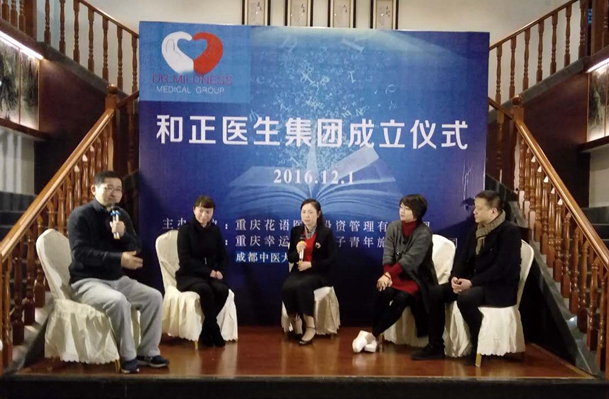
From left to right: Zhang Qiang, Zhang Xiaoli, Jiang Jinyan, Wang Yu, Yang Yanchun
“Leaving Because of Love” is the shared sentiment among the aforementioned physicians who left the public system to launch their own practices. “I spent eight years in public pediatric care. Due to the high patient volume, I felt immense pressure and deeply empathized with patients’ suffering. However, within the system, there was limited opportunity for extensive communication with patients. As physicians, we aspire to serve our patients to the greatest extent possible. We left the system out of love for our patients and for our former colleagues who fought alongside us,” said Wang Yu. Practicing independently allows for optimal use of time, enabling more attentive care for patients while also alleviating the burden on former colleagues. This is the greatest advantage of independent practice.
After leaving the public healthcare system, the foremost challenge was brand identity. “When I left the public hospital, more than 200 patients were registered and waiting for me to perform surgery; yet not a single patient followed me after my departure,” Zhang Qiang said half-jokingly. Previously, with the endorsement of a public hospital, patients had choices. After leaving, however, he could no longer leverage the reputation of a public institution. Consequently, building the brand of his physician group became critical. This involved operational and technical considerations, compounded by the fact that patient and physician acceptance was still relatively low. As a result, the pressure was greater than it had been within the public system.
“Regarding liability, ‘previously, department heads and hospital directors bore the responsibility; practicing as a physician in public hospitals was essentially a proceduralized operation. However, once physicians leave, the full burden of liability falls on the individual doctors and their physician groups,’ said Zhang Qiang. The Zhang Qiang Physician Group addresses this by purchasing insurance coverage of a certain amount for its physicians, while Hezheng Physician Group is also actively engaging in insurance-related arrangements.”
In addition, the source of business is also an issue that must be considered: either collaborate with hospitals or establish self-owned clinics or diagnostic and treatment centers.Therefore, Hezheng Medical Group may collaborate with Southwest Hospital.
As the founder of Dr. Zhang Qiang’s Doctor Group, it was quite surprising that Zhang Qiang endorsed Hezheng Doctor Group. During a break in the conference, we took the opportunity to chat with him. In addition to discussing Hezheng Doctor Group, Zhang also shared some new ideas and strategic layouts regarding doctor groups.
“We came here because we hold a small stake in Hezheng Physician Group.” Zhang Qiang, who had just arrived the previous day and visited several tertiary hospitals in Chongqing, expressed strong optimism about the city’s medical investment environment. According to him, he has already identified several potential sites and is considering investing in clinics and diagnostic and treatment centers in Chongqing. In light of this, a reporter from VCBeat (WeChat ID: vcbeat) asked Zhang Qiang whether physician groups should adopt an asset-heavy or asset-light business model.
“The hospital’s architecture is quite impressive, but a sound healthcare model should prioritize people over buildings. The funds spent on construction could be used to train several physicians. Our doctors personally finance their overseas studies to enhance their diagnostic and therapeutic capabilities as well as service quality, which is the primary objective of our physician group. Physicians should remain the core of such groups.” Zhang Qiang’s implied message was self-evident.
Physician training is a topic of significant importance to physician groups, as it directly impacts their sustainability. The leaders of Yubo Pediatric Clinic and Happy Oral Care, mentioned earlier, also addressed this issue. Having served in public hospitals for many years, they deeply understand how the vast volume of clinical cases in public hospitals enhances physicians’ technical and professional competencies. From undergraduate medical education through standardized residency training, public hospitals have established a comprehensive talent development system. For physician groups to emerge as a healthcare force on par with public hospitals, cultivating talent is a critical component. Currently, both the Zhang Qiang Physician Group and the Hezheng Physician Group are striving to identify sustainable pathways for physician training.
Discussing near-term plans, Zhang Qiang expressed strong confidence. “We will soon host an annual conference on hernia surgery. In addition, we will partner with the Shouldice Hernia Hospital in Canada to fully replicate their model, and we will also establish two clinical diagnosis and treatment centers.”
Regarding internet healthcare, Zhang Qiang stated that the sector is still in an exploratory phase. The Zhang Qiang Doctor Group is actively leveraging internet technologies, but currently treats them merely as tools; for instance, it acquired a VR company to facilitate medical training. As the industry matures, the group plans to increase its investment in this area.
Although physician group pioneers like Dr. Zhang Qiang are still continuously exploring the paths of physician groups and independent practice, we have reason to believe that physician groups will achieve better development in the long run. A former president of a Grade III Class A hospital who later became a partner in a private medical asset management firm also noted that physician groups can only make breakthroughs by working diligently and pragmatically. In an era characterized by significant uncertainties and a need for innovation, intellectual exchange is essential, as the development and future direction of physician groups require collective exploration rather than reliance on individual judgment. Whether it is the Zhang Qiang Physician Group or the newly established Hezheng Physician Group, only through continuous exploration will physician groups have the opportunity to occupy an important position in the future healthcare landscape.