

Medical Internet Enables Grassroots Healthcare Institutions to Attract Patients and Solidify Tiered Diagnosis Implementation
Currently, although the tiered diagnosis and treatment system enjoys policy support, with medical insurance serving as a guiding mechanism, tens of thousands of physicians registered on internet platforms, dozens of Grade III Class A hospitals participating, and robust hardware and software systems for telemedicine, the overall effectiveness remains suboptimal.
Consequently, many companies engaged in tiered diagnosis and treatment have adjusted their business strategies, with some even predicting that China’s tiered diagnosis and treatment system is destined to fail. Those who make such statements have failed to identify the root cause: primary care hospitals lack patients. The fundamental key to realizing tiered diagnosis and treatment lies in empowering primary care hospitals and physicians, enabling them to attract and retain patient volume.
Medical World Interconnect is a tiered diagnosis and treatment organization that focuses on helping county, township, and village-level primary healthcare institutions acquire patient sources. VCBeat (WeChat ID: vcbeat) has conducted follow-up reporting on Medical World Interconnect, aiming to understand why their project is welcomed by various primary hospitals?
MedConnect (Beijing) Technology Co., Ltd., established in September 2014 with a registered capital of RMB 20 million, is a high-tech enterprise providing integrated solutions for “Internet of Things (IoT) + Tiered Diagnosis and Treatment.” Its holding company, Beijing Zhongze Shidai Technology Co., Ltd., is a high-tech enterprise specializing in telemedicine and healthcare informatization. The company has obtained more than 20 software copyrights and intellectual property certificates, established remote consultation networks in over 500 hospitals across China, facilitated more than 50,000 patient consultations, and achieved a service satisfaction rate of up to 99.97%.
The founding team of Yijie Hulian comprises seasoned professionals from the healthcare industry. Founder Zhang Jianqiang serves as a committee member of the Health Engineering Branch of the Chinese Society for Biomedical Engineering. Li Zhi, founder of Zhongze Shidai, brings over a decade of experience in telemedicine. Other team members also possess more than ten years of background in the medical sector.
According to the national plan, by 2017, 95% of China’s primary healthcare institutions were expected to meet construction standards, and their patient visits were to account for more than 65% of total medical consultations. This was the national target; however, what is the reality? While we have indeed fulfilled the infrastructure development goals—with health clinics now visible in rural areas and communities—the actual utilization patterns tell a different story. Currently, outpatient visits at community health service centers account for only 21.3% of total consultations in Beijing and 36.6% in Shanghai, still far from the national target.
To boost outpatient visits at primary healthcare institutions and effectively implement tiered diagnosis and treatment, the government has introduced various policies, such as increasing reimbursement rates for outpatient services at the primary level through medical insurance, restricting the expansion of tertiary hospitals, and forming medical consortia through administrative measures. However, the vigorously promoted tiered diagnosis and treatment system has not been successfully implemented, primarily because primary hospitals are unable to retain patients.
Now, village clinics and community health service centers are basically deserted, with most of them even closed. The public does not visit primary care hospitals; indeed, many rural residents believe they can simply tough out minor illnesses. By the time symptoms manifest, the conditions have often progressed to severe stages, necessitating treatment at large hospitals, which has led many families into poverty due to medical expenses.
Implementing free, proactive health checkups and disease screening at the primary care level is highly valuable for early disease detection and control. Following screening, coordination between primary and higher-level hospitals—through triage and referral systems—can effectively manage most common and high-incidence diseases. This approach significantly reduces healthcare expenditures for both individuals and the state. By providing proactive and collaborative services, primary care institutions help patients save money and access medical treatment, thereby capturing patient flow at the source and achieving the goals of tiered diagnosis and treatment.
Yijie Hulian Company extends its reach to the very last mile of medical services through a new model integrating devices, systems, and operational services. By establishing a three-tier linkage among county, township, and village levels, it retains the majority of patients at primary care institutions. Meanwhile, it addresses complex and critical cases through telemedicine services provided by experts from major tertiary and specialized hospitals, such as PLA General Hospital (301 Hospital), PLA Fifth Medical Center (302 Hospital), and Dongzhimen Hospital of Traditional Chinese Medicine, truly ensuring that patients with serious illnesses can receive treatment within their home counties. The following figure illustrates Yijie Hulian Company’s interpretation of achieving the goals of tiered diagnosis and treatment by leveraging its own resources and solutions:
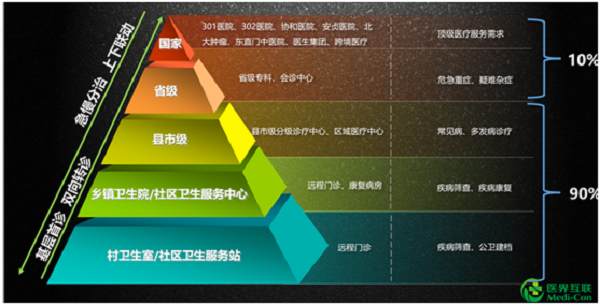
By implementing comprehensive upgrades to the equipment, systems, and services of primary hospitals, these facilities are transformed into extended outpatient clinics and inpatient wards of county-level hospitals. County-level hospitals collaborate with primary hospitals to conduct proactive disease screening, while effectively establishing national public health records. This approach eliminates the previous issue of fabricated records at the grassroots level due to a lack of appropriate equipment and methods.
In addition, a software system with an extremely simple interface was designed for grassroots healthcare workers, complemented by hardware devices such as all-in-one health kiosks, point-of-care testing (POCT) devices, ambulatory ECG monitors, ambulatory blood pressure monitors, and general practitioner workstations. These devices automatically upload data to the system, significantly reducing the operational complexity and workload for village doctors. For example, when measuring body temperature, a simple scan of the forehead automatically uploads the reading to the patient’s electronic health record in the system.
If primary care physicians have questions or require assistance during diagnosis and treatment, they can initiate real-time audio-video consultations with specialists at higher-level hospitals and share the patient’s medical records with the consulting physicians to obtain timely and precise clinical guidance. If referral is necessary, they can also directly assist patients in making free appointments for registration and examinations online. This approach significantly improves patients’ healthcare experience, making the choice of primary care institutions a natural one.
Conducting disease screening at the primary care level enables a more precise understanding of local disease profiles. By evaluating the county hospital’s capacity to manage diseases based on their classification and prevalence, a targeted departmental enhancement plan can be developed. This approach aims to establish a benchmark for local technical expertise, brand reputation, and financial performance through comprehensive upgrades in equipment, systems, and medical technology, thereby positioning county hospitals as a true cornerstone of the healthcare system.
As the initiative is driven by data-enabled services, this departmental improvement program has gained significant favor among county-level hospitals. Li Qianqian, Marketing Manager at Yijie Hulian, told VCBeat (WeChat ID: vcbeat) that the company’s project proposals achieve an 80% signing success rate at promotional events held in county-level hospitals. Many county-level hospitals hope to leverage such comprehensive service solutions and collaborations with national-level hospitals and leading experts to achieve the goals of tiered diagnosis and treatment while building their local influence and brand, thereby transforming the previously awkward situation of “underutilized capacity.”
The revenue of Yijie Hulian (Medical Community Interconnect) derives not only from the establishment of public health records but also from initiatives and services aimed at strengthening primary care hospitals. These efforts retain patients who would otherwise seek care elsewhere, ensuring they receive diagnosis and treatment at the grassroots level. The resulting increase in hospital revenue is distributed to benefit hospitals, physicians, patients, and service providers alike. In the future, additional related industry services, such as commercial insurance and pharmaceuticals, will be integrated into the platform. This fosters collaboration, symbiosis, and mutual success among all stakeholders, representing a new ecological model for healthcare created by Yijie Hulian.