

How Pharmaceutical Companies Can Sustain Success in China’s Evolving Market
China’s pharmaceutical market is undergoing significant transformation. Over the next decade, the market for off-patent originator drugs and generics, which accounts for 90% of pharmaceutical sales, will be reshaped for both multinational corporations and domestic enterprises. Although the long-term direction is clear, the transitional phase over the next three to five years will be fraught with challenges. The impending changes require pharmaceutical companies to commercialize their products in China in new ways, as they must navigate increasingly stringent tendering and bidding processes.process, adjust sales and marketing approaches, and develop new market access strategies. For pharmaceutical companies, understanding the impact and timing of future changes will help them begin to take measures to adapt, enabling them to maintain profit levels while sustaining or even growing sales volume and market share.
In the foreseeable future, two factors will continue to drive the growth of healthcare spending in China: first, demographic shifts, including population aging and the expansion of the middle-class and affluent segments; second, the Chinese government’s commitment to assuming a larger share of national healthcare costs—notably through the establishment of a universal health insurance system funded by the government (see the BCG Focus report “New Rules for Winning in China’s Pharmaceutical Market,” published in January 2014). Driven by these factors, China’s total healthcare expenditure is projected to achieve a compound annual growth rate (CAGR) of 5%–10% from now until 2020.
However, for pharmaceutical companies, the complexity of the issue lies in the evolution of the market and shifts in government policy priorities. With basic medical insurance coverage in China expanding to 95% of the total population, policy focus has shifted accordingly. The current emphasis is on cost containment. Healthcare expenditure accounts for approximately 6% of China’s annual GDP, and overall, its growth rate has exceeded that of the economy. Current government measures prioritizing cost control include implementing a series of policies to curb the costs of medical services and pharmaceuticals, reducing hospitals’ reliance on drug sales, and imposing stricter compliance requirements across the entire healthcare industry. In the future, quality, efficiency, and innovation will join cost containment as central government policy objectives. We believe this policy mix will lead to significant adjustments in the share of pharmaceutical sales across various channels, as well as major changes in procurement models within each channel. We predict that the pharmaceutical market will transition from a hospital-centric system to a more diversified one.
Overall, we predict that the pharmaceutical market will shift from today’s hospital-centric model of prescription and dispensing to a more diversified system. In the future, three major channels will emerge: hospitals, primary care institutions, and retail pharmacies. This transition will progress gradually over the next 3–5 years and accelerate thereafter. During this process, hospitals will ultimately become institutions primarily providing specialized and emergency care, while primary care institutions will serve as providers of basic medical services. Furthermore, we estimate that outpatient dispensing will increasingly shift from hospitals and primary care institutions to retail pharmacies. Pharmaceutical companies need to adapt to these market changes.
Meanwhile, the central and provincial governments, hospitals, and primary healthcare institutions will all control drug expenditures through more stringent tendering and negotiation processes. Decision-making authority regarding market access and medical insurance reimbursement is increasingly being decentralized to the provincial level, and even to municipal governments and hospitals. Pharmaceutical companies need to engage with a greater number of agencies involved in tendering, negotiations, and medical insurance reimbursement.
At the national level, in addition to formulating guidelines for tendering and pricing, the government is organizing national price negotiations for certain categories of pharmaceuticals, with oncology drugs—typically high-cost therapies—as the initial focus. Meanwhile, over the next decade, provincial healthcare authorities will play an increasingly significant role in shaping provincial drug procurement policies, including issuing guidance on secondary price negotiations, alongside their existing responsibilities of establishing provincial tendering rules, conducting tenders, determining lists of drug suppliers, and setting drug prices. Consequently, pharmaceutical companies must tailor their strategies to the specific circumstances of each province, taking into full account their current market position and the market prospects in each respective province.
Furthermore, provincial-level healthcare security administrations may ultimately be responsible for formulating and implementing policies on medical insurance payment prices—a plan that has been announced but not yet finalized. The draft guidance explicitly states that the government’s objective is to manage drug prices and control drug-related expenditures by establishing compound-specific medical insurance payment caps through these payment prices. Under the medical insurance payment price policy, provincial bidding platforms are likely to evolve into procurement platforms, playing a minimal role in determining drug prices. Meanwhile, hospital consortia and Group Purchasing Organizations (GPOs) will negotiate drug price discounts with pharmaceutical companies under the framework of the medical insurance payment price guidance. Over the next decade, pharmaceutical companies will face a more complex and volatile market.
Municipal governments will participate in price negotiations, whereby hospital consortia organized by municipal authorities will conduct secondary price negotiations to secure price reductions and discounts based on procurement volume requirements. Consequently, pharmaceutical companies will need to navigate an additional layer of negotiation. Hospitals themselves may also request secondary price negotiations with pharmaceutical companies.
Overall, over the next decade, pharmaceutical companies will face a more complex and volatile market. They will confront challenges in three key areas:
1. In the critical hospital channel, where the share of drug sales is continuously declining and pressure on drug profits is mounting, pharmaceutical companies need to strengthen their market access capabilities and maintain profitability;
2. The market share of primary healthcare institutions will grow, but due to economic constraints, achieving coverage will be extremely challenging; pharmaceutical companies need to develop commercialization strategies tailored to primary healthcare institutions;
3. The importance of the pharmacy channel to pharmaceutical companies’ revenue and profits will continue to rise, necessitating that pharmaceutical firms build corresponding sales and marketing capabilities, with particular emphasis on key accounts.
Hospitals: Declining Market Share and Mechanism Transformation
Currently, hospitals account for 80% of pharmaceutical sales and will remain the largest market for drug sales over the next decade, although their market share is expected to decline significantly. We predict that by 2021, hospitals’ share of pharmaceutical sales will decrease by 5–8 percentage points, driven by the government’s “zero markup” policy on drug sales and stricter controls on the drug-to-revenue ratio.
Naturally, hospitals will resist this change. Currently, many hospitals in China still maintain a 15% markup on pharmaceuticals, with drug sales accounting for 40% of hospital revenue (an even higher percentage of operating income). Healthcare reform policies have attempted to replace pharmaceutical sales revenue with government subsidies and higher fees for medical services, but these efforts have not yet succeeded. Therefore, we estimate that changes in this area will occur gradually. Over time, fees for medical services will continue to rise, the share of hospital revenue from drug sales will decline, and prescription and dispensing channels will become more diversified (although hospital channels will remain dominant for inpatient medications and injectables).
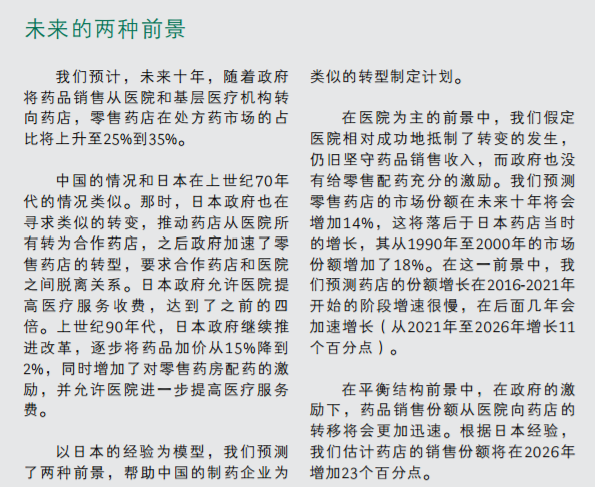
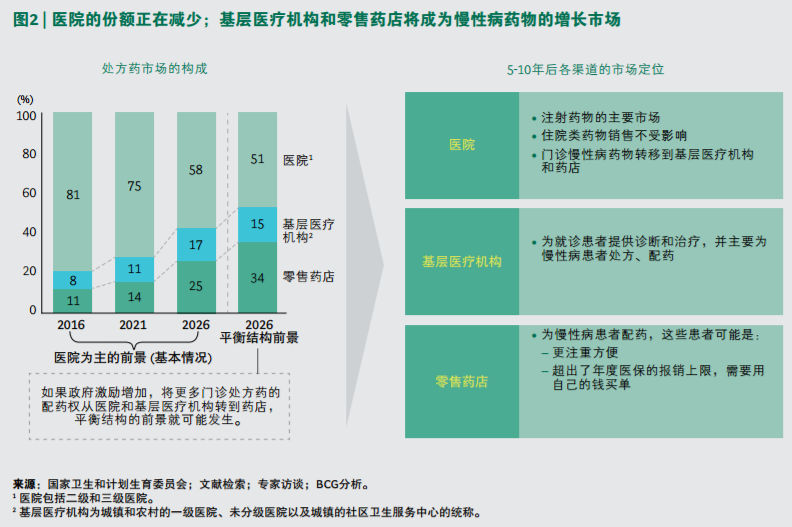
We believe that channel development over the next decade will follow one of two possible scenarios: a hospital-dominated structure or a more balanced structure. The determining factor will be the speed and magnitude of the shift in pharmaceutical sales from hospitals to primary healthcare institutions and retail pharmacies (see Figure 1 and the Appendix “Two Future Scenarios”). We estimate that in the hospital-dominated scenario, the share of total pharmaceutical sales accounted for by hospitals will drop to below 60%, whereas in the balanced-structure scenario, this proportion will decline to around 50% (see Figure 2).
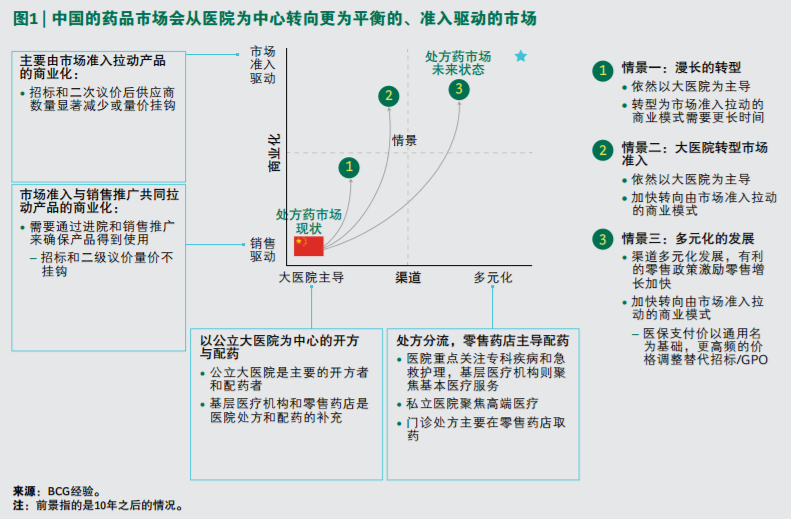
Nevertheless, over the next decade, hospitals will remain a critical sales channel for pharmaceuticals, owing to their substantial volume and market share, as well as the fact that the majority of hospitals are still key accounts. However, pharmaceutical companies choosing to compete in this channel will face evolving tendering and negotiation processes, which will ultimately create barriers to market access and exert pressure on profits. During this transitional phase, we anticipate a significant rise in the influence of Medical Consortia and Hospital Group Purchasing Organizations (GPOs). By 2017, procurement by these entities may have accounted for approximately 20% of hospital pharmaceutical sales; we estimate that by 2026, this proportion will increase substantially, potentially covering pharmaceutical procurement for all hospitals. These purchasing organizations will reduce the overall number of pharmaceutical suppliers and re-evaluate the vast majority of them. For pharmaceutical companies, this implies a reduction in the number of players within the hospital channel, accompanied by a significant reshuffling of the competitive landscape. This transitional period poses particularly formidable challenges for pharmaceutical enterprises, as they must contend with shrinking profit margins due to declining drug prices while simultaneously maintaining sales coverage to hospitals to sustain revenue.
Complicating matters further, government control over qualifications for generic drug production will become stricter. Under current policy regulations, if more than three suppliers of the same drug pass the Quality Consistency Evaluation (QCE), tendering processes are restricted to selecting only those enterprises that have ultimately passed the QCE. This approach will reduce competition and increase the market share of the remaining pharmaceutical companies. Due to the currently limited capacity for clinical trials, the completion of quality consistency evaluations for oral medications will be delayed. At present, it appears that tendering based on QCE results will likely be implemented gradually in 2020 or thereafter.
Furthermore, to further reduce drug prices, generic drugs that have passed the quality consistency evaluation will be placed in the same quality tier as off-patent originator drugs. This will lead to a decline in the prices of off-patent originator drugs and narrow the price gap between off-patent originator drugs and generics. For instance, the prices of oral off-patent originator drugs will become comparable to those of their generic counterparts, while the price differential between injectable off-patent originator drugs and generic injections will shrink. As profit margins for both off-patent originator drugs and generics diminish, pharmaceutical companies need to establish sales and marketing models with higher return on investment.
If the medical insurance payment price is implemented (which is highly likely to occur after the bioequivalence evaluation process for oral drug products is largely completed), it is foreseeable that, in the long term (after 2021), drug prices will decline more rapidly and significantly, leading to a substantial transformation of business models. For drugs with large market sizes and high profit margins, such as atorvastatin or clopidogrel, competition will intensify as more pharmaceutical manufacturers that have passed the bioequivalence evaluation enter the market. Under the compound-based medical insurance payment price policy, fierce annual drug price negotiations will take place, continuously squeezing the pricing power and profit margins of pharmaceutical companies. Coupled with the continuous entry of generic drug manufacturers that have passed the bioequivalence evaluation, this will promote the formation of a market-oriented pricing mechanism. As product prices fall and gross margins continue to compress, the sales-driven business model of pharmaceutical companies will become increasingly unsustainable once gross margins drop below 50%.
Conversely, if compound-based medical insurance payment prices cannot be implemented due to insufficient governmental resolve in policy enforcement or inadequate payer capacity, the current tendering process—occurring on average once every two years—will persist and continue to play a pivotal role in drug pricing and market access. Medical consortia, hospital groups, and group purchasing organizations (GPOs) will negotiate actual prices after tender prices are determined. Price reductions will continue, albeit at a slower pace.
We project that drug sales at primary care institutions will nearly double by 2026, accounting for approximately 16% of the total market share. The exact proportion will depend on whether a hospital-centric outlook or a more balanced structural model ultimately prevails. Primary care institutions will be permitted to expand their formulary lists, and an increasing number of patients with chronic diseases will obtain prescriptions from these facilities, both of which will drive sales growth. In the long term, primary care institutions will become the main channel for chronic disease patients to access treatment, prescriptions, and medication dispensing.
Several factors will influence the pace and extent of development in this channel.
First, on a national scale, can it be ensured that primary healthcare institutions have sufficient varieties and quantities of medications? From 2016 to 2021, 40–45 cities will join the pilot program, enabling primary healthcare institutions and hospitals to offer the same drug varieties and quantities. After 2021, the program will expand to more than 200 cities.
Another factor is how to ensure that primary healthcare institutions have an adequate supply of competent general practitioners. In the coming years, only a few cities will be able to meet the government’s targets for the number of general practitioners, while other regions will still need to make concerted efforts to attract physicians to work in primary care settings. Taking Shanghai as an example, it will take at least five years to fill the shortfall in the number of general practitioners in primary healthcare institutions. In the long run, more cities’ primary healthcare institutions will have the capacity to recruit and retain a sufficient number of qualified general practitioners, thereby attracting more patients to seek care.
For pharmaceutical companies, the growth in drug sales at primary healthcare institutions is a mixed blessing, as achieving cost-effective coverage of this channel is challenging. The factors driving down hospital drug sales profits also apply to primary healthcare institutions, including the introduction of consistency evaluations for drug quality, the consolidation of bidding quality tiers, secondary price negotiations, and the future implementation of medical insurance payment prices. Although the growth prospects are promising, most primary healthcare institutions are small in scale, with the exception of a few large ones, making it difficult for pharmaceutical companies to cover them in a cost-effective manner. For most pharmaceutical companies, building a sufficiently large sales team to cover numerous primary healthcare institutions is not cost-effective. Pharmaceutical companies that choose to pursue this channel will rely heavily on distributor networks.
Currently, retail pharmacies represent a relatively small sales channel for prescription drugs. However, in the long term, they offer the greatest growth opportunities. Driven by both government policies and commercial forces, dispensing channels will become increasingly diversified. Over the next decade, in a hospital-dominated scenario, the share of drug sales accounted for by pharmacies will rise from the current 11% to 25%, while in a balanced-structure scenario, this proportion will increase to nearly 35%. As more pharmacies are included in the designated medical insurance network, the short- to medium-term annual sales growth rate for pharmacies is expected to reach 10%–12%.
The pace at which prescription dispensing shifts from hospitals to pharmacies depends on how quickly hospitals can raise fees for medical services. Furthermore, market-oriented cost-control mechanisms, such as Pharmacy Benefit Management (PBM), need to be introduced to fully integrate pharmacies into the national health insurance payment system. Both of these trends have already begun, but it will take several more years for them to accelerate.
As the transition toward retail pharmacies gradually takes place, pharmaceutical companies will face new challenges in drug marketing and pricing strategies. We anticipate that in the future, when multiple suppliers are available for a given drug, physicians will prescribe by generic name rather than by brand name. Retail pharmacies will then determine which specific brand to dispense to the purchaser. Even if physicians prescribe by brand name, pharmacists can assist patients in choosing among different brands. These decisions will be largely influenced by reimbursement levels, specifically the difference between the retail price of the drug and the amount covered by medical insurance.
Therefore, for pharmaceutical companies to achieve success, they must effectively manage the economic relationships among their products, pharmacies, and patients. The key to relationships with pharmacies lies in profits and discounts. Key account strategies and models between pharmaceutical companies and major pharmacy chains are essential (see the following section). The relationship between pharmaceutical companies and patients depends on the formulation and execution of brand marketing and pricing strategies. Pharmaceutical companies require a considerable amount of time to build brand influence, which determines whether patients and Pharmacy Benefit Managers (PBMs) (for patients covered by such service plans) are willing to pay a premium for medications—specifically, the out-of-pocket portion exceeding the insurance reimbursement price—and how high that premium can be.
Pharmaceutical companies segment and prioritize their target markets based on the short-, medium-, and long-term change roadmap we have outlined. While circumstances vary from one company to another, we believe that, in general, most enterprises will formulate their strategies and approaches through the following three channels:
Hospitals and large primary healthcare institutions.Despite pricing and profitability pressures, companies must still prioritize this channel above all others. In 2026, it continues to account for more than half of the market share, with large accounts comprising the vast majority; many pharmaceutical companies have already established mature sales models in this channel.
Other primary healthcare institutions.For most companies, despite the strong growth prospects, this channel remains a low priority due to constantly changing market conditions, the small scale of primary healthcare institutions, and their dispersed and diverse geographic distribution.
Retail pharmacies.This channel will serve as a long-term growth engine, particularly for pharmaceutical companies that can formulate and implement effective measures while developing key account management capabilities.
Hospitals and large primary healthcare institutions.To address this channel, pharmaceutical companies need to develop long-term transformation strategies, shifting from a previously sales-driven model to one that first focuses on maintaining market access eligibility (in priority markets), and secondly serves this market in a cost-effective manner during the transition phase (see Figure 3). This will be a significant change for many enterprises.
Market access strategies primarily involve setting priorities and allocating resources, both of which are easier said than done. Companies need to evaluate the markets they wish to enter, matching the market size and growth potential of each province with their own market position. Higher priority should be given to markets where the company holds a strong position and sees promising development prospects. Subsequently, companies must allocate sufficient resources to maintain communication with government departments responsible for tendering policies, analyze draft policies and their implications, and leverage their expertise to assist in governmental decision-making and policy formulation (such as helping define quality tiers during the tendering process), thereby gaining competitive advantages. Additionally, companies need to dedicate adequate resources to execute tendering activities, including preparing bid documents, collaborating with distributors to develop tender implementation plans, and engaging in secondary price negotiations. This requires companies to undertake new tasks, such as interpreting procurement policies of hospital group purchasing organizations, making pricing decisions, and conducting negotiations. Reallocating resources will be an essential step.
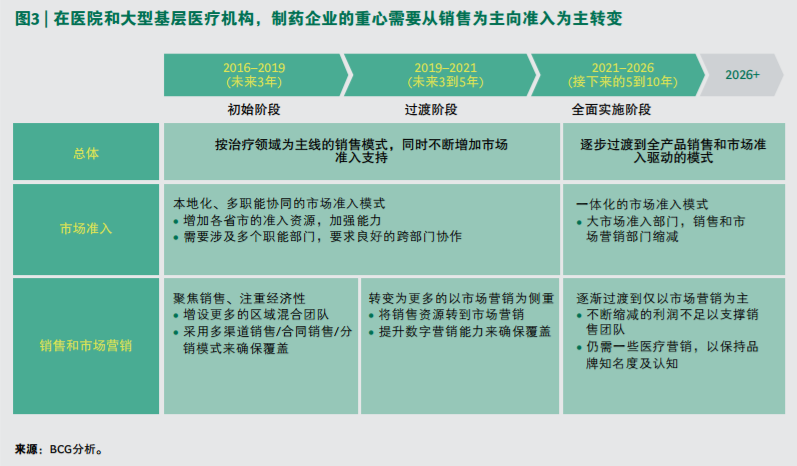
The second critical step is for pharmaceutical companies to make efficient and timely decisions in tendering and pricing, based on effective analysis of business logic, including a clear assessment of the impact of different price points on sales volume. This requires companies to streamline processes, enhance cross-functional collaboration, clearly define the roles and responsibilities of all participating departments, and possess greater analytical capabilities than those currently employed by most pharmaceutical firms. As business models continue to evolve, the need to integrate various market access functions will become increasingly pronounced.
The evolution of the market will also compel pharmaceutical companies to transform their sales models in provincial and local markets. Companies need to redesign their sales approaches based on product market potential, profit margins, and the economic profiles of hospitals at various tiers. Sales teams may need to adopt a regionalized structure and sell bundled product portfolios to enhance organizational flexibility and better cope with declining per-hospital revenue and profitability. In response to shrinking profits, pharmaceutical firms must reduce selling, general, and administrative (SG&A) expenses and rebalance spending between sales and marketing. We estimate that in ten years, pharmaceutical companies’ SG&A expenses will decline from the current 35%–40% of revenue to 25%. The ratio of sales to marketing expenditures will also shift: whereas currently two-thirds is allocated to sales and one-third to marketing, this ratio will reverse in the future as the importance of whole-product sales models—which typically emphasize disease education and consistent quality messaging—continues to grow.
Other primary healthcare institutions.Although sales through this channel will continue to grow, primary care medical institutions hold limited long-term appeal for pharmaceutical companies. Most primary care institutions are small in scale, making it difficult for pharmaceutical companies to provide the services these institutions require. Coupled with market access restrictions similar to those faced by large hospitals, profit margins in this channel are also being squeezed. Furthermore, the vast number and wide geographic distribution of primary care institutions make it challenging, if not impossible, for companies to establish large sales teams to achieve comprehensive coverage.
Apart from large primary healthcare institutions, pharmaceutical companies need to rely heavily on distributor networks to access primary healthcare facilities and provide sales support. During the transition period, companies may consider negotiating directly with municipal and district-level governments to secure inclusion in the procurement lists of municipal or district-level primary healthcare institutions; however, in most cases, they must depend on distributors to get their products included in the medication formularies of various primary healthcare institutions. In the long run, as more primary healthcare institutions join medical consortia and hospital joint procurement organizations, procurement negotiations will become the most critical channel for market entry. Over the long term, sales coverage will be almost entirely handled by distributors.
Retail pharmacies.Retail pharmacies will offer pharmaceutical companies a significant advantage, as they represent a market-driven channel that does not require bidding processes or multiple rounds of price negotiations. However, for companies to succeed in the retail pharmacy market, they must continuously build their commercial capabilities in this sector. In the short term, this means pharmaceutical companies need to establish and strengthen partnerships with rapidly expanding large chain pharmacies (those with at least 500 retail outlets, ranking among the top 20 or 30) as well as regional distributors. As the market evolves, the largest chain pharmacies will become key accounts for pharmaceutical companies; here, government-organized bidding processes are no longer required, and prices are determined almost entirely through commercial negotiations. Pharmaceutical companies need to adopt key account management approaches to serve these increasingly important customers.
Forward-thinking companies will adopt the Contract Sales Organization (CSO) model to sell low-volume, tail-end products. In the medium to long term, CSOs will become increasingly vital for sales and distribution, covering individual stores (alongside distributors), while pharmaceutical companies’ key account managers will focus primarily on the largest pharmacy chains. This approach will be the most effective way for pharmaceutical companies to maximize revenue.
For pharmaceutical companies, China will remain a high-growth market. At the same time, it is clear that the market is continuously evolving, with changes expected to become even more dramatic over the next five to ten years. To seize growth opportunities, pharmaceutical companies need to rethink and adjust their strategies, capabilities, and organizational structures to adapt to market evolution. While most pharmaceutical companies will have to undergo transformation, those that act quickly will gain a significant competitive advantage.
If you wish to discuss this report further, please contact the author.
About the Author:
John Wong is a Senior Partner and Managing Director at Boston Consulting Group (BCG), and he also serves asChairman, BCG Greater China, based in the Hong Kong office. For inquiries, please email wong.john@bcg.com.
Chen Baiping is a Partner and Managing Director at Boston Consulting Group (BCG), based in the Beijing office. For inquiries, please contactTo chen.baiping@bcg.com.
Yan Yuan is a Managing Director at Boston Consulting Group (BCG), based in the Shanghai office. For inquiries, please email yan.eric@bcg.com。
Yan Huiwen is a Project Manager at Boston Consulting Group (BCG), based in the Shanghai office. For inquiries, please email yan.jade@bcg.com。