

Dutch Researchers Develop Wearable Suit with 41 Sensors to Monitor Stroke Patients’ Daily Activities
Monitoring the daily activities of stroke patients poses a challenge for physicians. However, a research team at the University of Twente in the Netherlands is developing a wearable tracker suite that closely monitors patients’ daily movements during their rehabilitation and recovery. The system accurately monitors and analyzes patient activity, supplemented by infrastructure for transmitting, storing, and processing all collected data. This technology holds significant promise for improving rehabilitation outcomes and reducing healthcare costs.
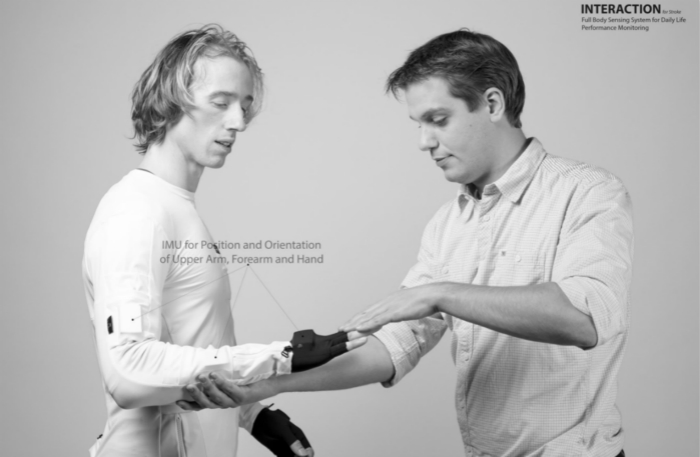
In the Netherlands, approximately 45,000 people suffer a stroke each year. In 2010, as many as 33 million people worldwide experienced a stroke. With the aging of the population, these numbers are projected to increase further in the coming years. The greatest challenge for stroke survivors is coping with various physical limitations and participating in rehabilitation programs to improve flexibility in daily physical activities.
Under the European FP7 research project, PhD candidate Bart Klaasen collaborated with an international team of healthcare professionals and engineers to develop an embedded INTERACTION suit for stroke survivors, aiming to monitor their activity progress outside clinical settings. The suit incorporates 41 sensors, including those measuring muscle strength, stretch sensors for the back and hands, and in-shoe pressure sensors. Designed to be worn for three months, the suit tracks the wearer’s strength, flexibility, and gait.
“Stroke patients often have to cope with physiological limitations caused by the disease. They typically participate in rehabilitation programs to move as effectively as possible in their daily lives,” Klaasen said in a statement. “However, rehabilitation currently takes place primarily in clinical settings. Our understanding of how patients manage their physiological limitations in daily life after completing rehabilitation programs is insufficient. Gaining insight into the daily lives of these individuals would facilitate the development of more cost-effective and efficient rehabilitation strategies.”
The outfit is also equipped with a portable transmitter that wirelessly sends data to the server at the University of Twente. For the data processing component, the team successfully modeled all relevant movements and cleaned the therapist-related data by filtering out extraneous information. As the project advances, the plan is to transmit data directly to patients’ medical teams, potentially even for clinical use.
Klaassen stated, “There has long been a pressing need for such a system, but the technology was not yet ready. Rapid advancements in battery technology, smart electronic textiles for wearable devices, and big data analytics have now made the development of this system a reality.” The system has demonstrated robust performance during his doctoral research. However, this wearable suit is currently limited to research purposes, and it remains uncertain when it will be available for clinical application.
During the development of this system, Bart Klaassen and his team adopted a user-centered design approach. This enabled them to continuously incorporate patient feedback into the system’s development. Other stakeholders, such as insurance companies and healthcare professionals, were also involved in the design and research efforts from an early stage.
“We have been able to demonstrate that all information transmission processes are highly successful and efficient,” said Klaassen. “Our project provides new technologies and methods for long-term monitoring of patients at home, enabling the identification of any discrepancies compared with structured clinical measurements. We are currently conducting further research to ultimately validate whether these methods represent an ideal approach for supervised rehabilitation.”