

Chongqing Implements 'Two-Invoice Policy' Closest to National Medical Reform Blueprint
On April 26, the State Council officially issued a document mandating the promotion of the “Two-Invoice System” in pilot provinces for healthcare reform. Amidst widespread uproar within the industry, the primary concern among stakeholders is when the policy will be implemented.
In accordance with the provisions of State Council Document No. 26, the “Two-Invoice System” must be fully implemented within the year in national healthcare reform pilot provinces. Following Anhui and Shaanxi, Chongqing’s Two-Invoice System policy has been unveiled and is scheduled to take effect on December 30, 2016.
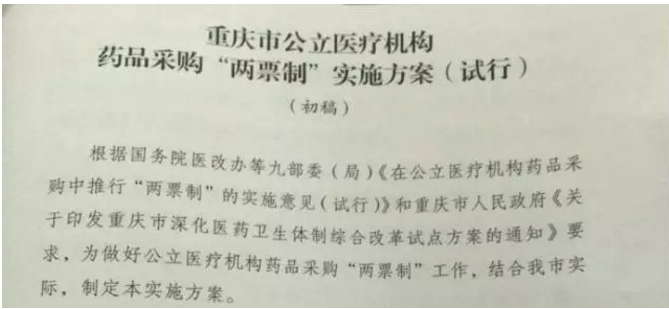
According to the disclosed portions of the document, Chongqing’s “Two-Invoice System” was formulated in accordance with the “Implementation Opinions (Trial) on Promoting the ‘Two-Invoice System’ in Drug Procurement by Public Medical Institutions,” issued by nine ministries and commissions including the State Council’s Office of Healthcare Reform. This indicates that the national policy document on the Two-Invoice System has been disseminated to localities nationwide, the implementation in pilot provinces for national healthcare reform has been completed before the end of this year, and the rollout of Two-Invoice System reforms in various provinces will commence successively in the near future.
From another perspective, the national "Two-Invoice System" policy varies slightly across regions, as it is formulated based on the actual conditions of each province. Chongqing’s "Two-Invoice System" document was developed in accordance with the latest national implementation guidelines and should therefore align most closely with the national-level policy.
It is reported that the "Implementation Plan for the 'Two-Invoice System' in Drug Procurement by Public Medical Institutions in Chongqing Municipality (Trial)" will soon be published, with an official launch date of December 30, 2016. The period until May 31, 2017, serves as a transition phase. During this transition, manufacturers should fully consider factors such as the existing distribution channels of medical institutions to determine their primary commercial agency relationships in Chongqing Municipality. They must update this information on the Pharmaceutical Exchange Platform and sign and publicly disclose letters of commitment before April 1. After April 1, they should promptly adjust and optimize distribution channels based on the trial performance of drug procurement. Starting June 1, 2017, all public medical institutions across the municipality will fully implement the "Two-Invoice System."
Meanwhile, the “Two-Invoice System” policy documents in Chongqing Municipality clearly define the categories of pharmaceutical manufacturers and distributors. The documents stipulate: “Wholly owned or controlled commercial companies established by drug manufacturing enterprises or integrated industry-trade-research groups that sell only their own (group’s) products, as well as domestic general agents for overseas pharmaceuticals, may be treated as manufacturing enterprises; for drugs produced under compliant contract manufacturing arrangements, wholly owned or controlled commercial companies established by the commissioning enterprise (group) that sell only their own (group’s) products may also be treated as manufacturing enterprises. The above provisions are limited to one commercial company and one domestic general agent.”
“Within pharmaceutical distribution group enterprises, the transfer of drugs between the headquarters, branches, and wholly-owned or holding subsidiaries may not be regarded as a single-invoice transaction, but such transfers are permitted only once. For public medical institutions implementing pharmacy trusteeship, operating enterprises may entrust the trustee with distribution services; however, no purchase or sales transactions shall occur, meaning no invoices shall be issued.”
On April 26, 2016, the National Health and Family Planning Commission issued Document No. 26, titled “Key Tasks for Deepening the Reform of the Medical and Healthcare System in 2016,” which ushered in the implementation of the “Two-Invoice System.” The document explicitly required eight provinces to pilot the “Two-Invoice System” in the pharmaceutical distribution sector.
Fujian Province
Since the seventh round of bidding for essential medicines in May 2010, nearly six years have passed, making it the first province in China to truly implement the “Two-Invoice System.”
Anhui Province
On October 8, 2016, the Anhui Food and Drug Administration issued the "Implementation Opinions on Promoting the 'Two-Invoice System' for Drug Procurement by Public Medical Institutions in Anhui Province," requiring all public hospitals to implement the "Two-Invoice System" starting from November 1, 2016.
Shaanxi Province
On October 17, 2016, the Health and Family Planning Commission of Shaanxi Province officially issued the “Notice on Deepening the Reform of the Drug and Medical Consumable Supply and Guarantee System,” marking the formal implementation of the “Two-Invoice System.” Effective January 1, 2017, all urban public medical institutions in Shaanxi Province adopted the “Two-Invoice System” for the procurement of drugs and medical consumables.
Zhejiang Province
In July 2015, the Zhejiang Provincial Drug and Medical Device Procurement Platform released the “Opinions on Reforming and Improving the Centralized Procurement Mechanism for Drugs in Public Hospitals,” specifying that 15 hospitals would implement the “three-flow integration” distribution policy, with the new platform becoming operational in May 2016.
Sichuan Province
On July 5, 2016, the Sichuan Provincial People's Government released the "Pilot Program for Comprehensive Reform of the Medical and Healthcare System," in which the State Council’s requirement for pilot provinces to implement the "Two-Invoice System" was revised to "implementing the Two-Invoice System in areas where conditions are ripe." Recently disclosed documents indicate that, effective December 31, 2016, Sichuan Province will implement the Two-Invoice System in selected public medical institutions across the province (excluding grassroots medical institutions in ethnic minority areas and other specified regions).
Apart from the aforementioned provinces and municipalities, the “Two-Invoice System” policies in most other regions are currently in the public consultation phase. It is anticipated that individual provincial policies will be rolled out successively before the end of the year. The impact of the “Two-Invoice System” on the industry is evident; it significantly drives the elimination of irregular practices such as affiliation and invoice passing, while also leading to greater commercial concentration in the distribution sector. This consolidation facilitates the establishment of a national drug price traceability system.
“The Two-Invoice System” was introduced with the original intention of reducing drug prices by streamlining distribution channels. However, it is unrealistic to expect drug prices to drop solely through this policy. A comprehensive approach is required, including measures such as replacing business tax with value-added tax (VAT), auditing pharmaceutical companies’ costs, lowering the proportion of drug expenditures in healthcare spending, reforming medical insurance payment mechanisms, implementing nationwide price linkage, and promoting tiered diagnosis and treatment. These combined efforts aim to reshape the relationship between medical services and pharmaceuticals, thereby driving down drug prices.