

How Will Direct Commercial Insurance Reimbursement Reshape the Competitive Landscape Among Tier-3 Hospitals?
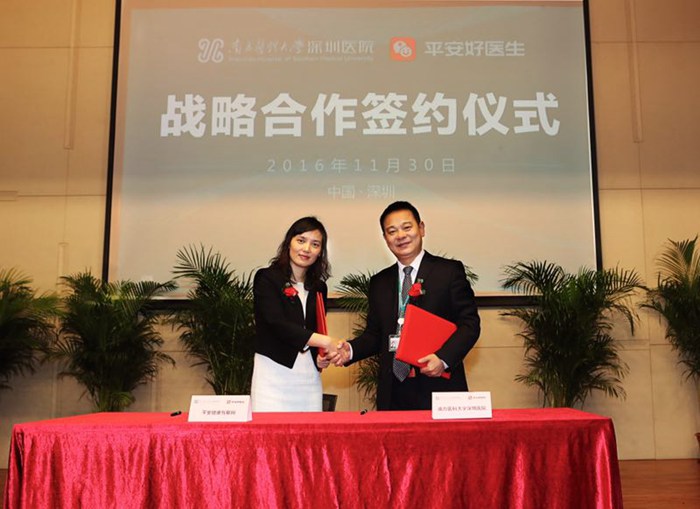
Ping An Good Doctor’s Chief Operating Officer Bai Xue and Liao Sizhao, President of Shenzhen Hospital of Southern Medical University
Recently, Ping An Good Doctor, the O2O healthcare service platform under Ping An Group, signed a strategic agreement with Shenzhen Hospital of Southern Medical University. The two parties will collaborate across the pre-hospital, in-hospital, and post-hospital stages to jointly create an innovative “Internet + Insurance + Hospital” model. They will also pioneer the launch of a direct billing system for commercial health insurance, initially covering 2.5 million Ping An Life Insurance customers in the Shenzhen region, thereby comprehensively optimizing the medical care experience.
This represents both a novel exploration of the “Internet + Healthcare” model by Shenzhen Hospital of Southern Medical University, as a public hospital in Shenzhen, and a new endeavor to build a tiered diagnosis and treatment system.
In fact, this is not the first time “direct billing by commercial insurance” has been introduced.
On August 24 this year, China’s first “Online Direct Claim and Direct Payment System for Commercial Health Insurance” was officially launched at Wuhan Central Hospital. Users of commercial health insurance can enjoy one-stop comprehensive payment covering “basic medical insurance + commercial insurance + out-of-pocket expenses” when receiving treatment at the hospital, with instant “second-level claims settlement” for commercial insurance, meaning that online direct claim services are available during outpatient fee payments and discharge settlements. At that time, Ping An and Taikang, two insurance companies, were simultaneously integrated into the system at Wuhan Central Hospital.
In the past, commercial insurance policyholders had to pay out-of-pocket upfront and then navigate a confusing process of shuttling back and forth to gather a stack of documents for reimbursement claims. Even after submitting all required materials, it typically took 3 to 30 days to receive the reimbursement decision. Now, with direct billing at hospitals, commercial insurance can be reimbursed instantly, significantly streamlining the medical care process.
It was revealed that since the “direct billing with commercial insurance” service was first launched at Wuhan Central Hospital in August, it has now expanded to 46 cities.
Of course, compared to simple “direct billing by commercial insurance,” the collaboration between Ping An Good Doctor and Southern Medical University Shenzhen Hospital carries implications beyond mere payment. As Ping An Group’s strategic entry point into mobile healthcare, Ping An Good Doctor has introduced critical internet-based health management and online tiered diagnosis and treatment processes to the direct billing model for commercial insurance.
In 2015, premium income from commercial medical insurance in China reached RMB 241 billion, a year-on-year increase of 51.87%, marking the fastest growth rate among all types of insurance products. The premium scale for commercial health insurance is projected to reach RMB 600 billion by 2020.
However, industry insiders point out that a positive healthcare experience and comprehensive medical coverage are also important catalysts for the sustained growth of commercial insurance.
Taking the collaboration between Ping An Good Doctor and Southern Medical University Shenzhen Hospital as an example, after the integration of the systems of Southern Medical University Shenzhen Hospital, Ping An Life Insurance, and Ping An Good Doctor, users of Ping An Good Doctor and Ping An Life Insurance can benefit from real-time fund allocation and settlement through the backend system during outpatient visits or hospitalization, shifting from delayed reimbursement to instant payment.
Li Wenming, Assistant General Manager of Ping An Life Insurance, who attended the signing ceremony, stated,The newly implemented direct billing system for commercial health insurance has established an industry benchmark for public hospitals directly interfacing with commercial insurers, serving as the first pilot project for a Chinese-style HMO managed open platform.
Ping An Good Doctor, which has consistently emphasized and strategically built a closed-loop healthcare service ecosystem, has also underscored the concept of openness in its long-term strategic positioning centered on the “Internet + Insurance + Hospital” model.
Bai Xue, Chief Operating Officer of Ping An Good Doctor, revealed in an interview with reporters that the company plans to integrate more hospitals and insurance enterprises in the future to further enhance its replicable, open “managed care” platform. She stated that as China’s largest mobile healthcare gateway, Ping An Good Doctor is building a health management platform that connects both hospitals and insurers. Reportedly, Ping An Good Doctor currently handles an average of 300,000 online consultations per day, with cumulative consultations reaching 100 million.
Leveraging its proprietary online services, the platform operates on two fronts: first, it provides online consultation services through a self-employed full-time physician team of thousands, collecting user health information to deliver targeted health guidance and management services; second, it establishes a multi-tiered hierarchical diagnosis and treatment system by integrating its internal self-employed full-time physician team with external renowned specialists, thereby achieving precise matching for patient medical care.
Bai Xue stated that the online tiered diagnosis and treatment process can help tertiary hospitals focus on the diagnosis and treatment of symptomatic patients. Risk control measures implemented by the platform, such as health education and preventive care for the insured, will effectively reduce the incidence rate among the insured and lower medical expenses. This will encourage insurance companies to transform from passive post-event claims processing to comprehensive health management services throughout the entire process, thereby establishing a health security system that benefits patients, hospitals, and insurance companies alike.
Xiao Liehui, Secretary of the Party Committee at Shenzhen Hospital of Southern Medical University, stated that this collaboration represents a bold exploration and attempt in the hospital’s healthcare reform journey. It puts into practice the hospital’s patient-centered service philosophy, innovates medical service models, meets patients’ diverse healthcare needs, and enhances their medical experience. By leveraging Shenzhen Hospital of Southern Medical University’s high-quality medical resources, Ping An Good Doctor’s robust internet technology and online operational solutions, and Ping An Life Insurance’s extensive base of insurance users, the three parties combine their respective strengths to create a new ecosystem of internet-based medical services centered around the hospital. This ecosystem encompasses online consultations, e-prescriptions, referral treatments, and chronic disease management. “This tripartite collaboration will undoubtedly strengthen and improve the tiered diagnosis and treatment system of Shenzhen Hospital of Southern Medical University and its medical consortium, thereby providing patients with a novel one-stop ‘Internet + Insurance + Healthcare’ experience.”
Ping An Group Chairman Ma Mingzhe designed Ping An’s grand healthcare strategy, which comprises three key components: patient, provider, and payment (encompassing the management of medical insurance expenditures and commercial insurance expenditures). Ping An aims not only to act as a payer but also to integrate sufficient high-quality medical resources.
A fundamental and core rationale for the implementation of Health Maintenance Organizations (HMOs) is cost control. However, this objective does not fully align with the interests of current holders of high-quality medical resources. When it comes to reforms in medical costs or payment models, hospitals such as Shenzhen HKU Hospital and Southern Medical University Shenzhen Hospital are few and far between.
Zhang Dan, Party Secretary of the Shenzhen Hospital Administration Center, once stated that diagnosis-related group (DRG) payment has taken its first step in Shenzhen, with 10 medical conditions currently reimbursed under this model at The University of Hong Kong-Shenzhen Hospital.
The collaboration between Ping An Good Doctor and Shenzhen Hospital of Southern Medical University also involves joint efforts to control healthcare expenditures. For instance, the two parties will pilot different payment models for various types of medical costs, such as capitation and diagnosis-related group (DRG) based payments.
The advantages of the HMO model are evident, and direct billing by commercial insurers is also an industry trend. However, there are still many barriers to entry. For instance, the wide variety of health insurance products and technical issues such as hospitals’ internal IT systems may slow down the development of direct billing services for commercial insurance. Currently, 53 insurance companies hold qualifications for health insurance products. Although only a few insurers have integrated with hospital systems at present, in the future, as more and more insurers connect to hospitals, it will place significant pressure on the security of hospital information systems.
However, in the long run, entering the market through payment solutions can foster a large ecosystem and exert a significant impact on the existing landscape of the healthcare industry.
According to industry insiders, health insurance’s entry into hospitals through payment mechanisms represents a relatively viable channel. However, hospitals must understand that the integration of insurance and healthcare is not based on payment, but rather on patient-centric care. The development of commercial health insurance and tiered diagnosis and treatment will inevitably lead to adjustments in the patient source structure of tertiary Grade A hospitals, which in turn will necessarily drive changes in hospital revenue structures.
As insurance companies increasingly adopt payment models such as diagnosis-related groups (DRGs) to control costs, hospitals will be incentivized to engage in health management. Cost containment without health management is merely rhetorical; controlling costs solely within the treatment phase fails to address the root causes. By purchasing medical services, insurance companies will create numerous opportunities for hospitals. However, given that many large tertiary Grade A hospitals are currently overwhelmed with patients, they lack sufficient motivation to prioritize health management.
In recent years, numerous new pan-healthcare technologies based on the internet and smart hardware have emerged. However, due to the immaturity of these technologies themselves and the marginal—sometimes even imperceptible—benefits they offer, they have largely been ignored by the mainstream forces in the healthcare industry.
These so-called breakthrough technologies or models—such as the HMO model—have indeed given rise to some emerging markets. However, at their inception, these new markets are invariably too small or even fragmented. Consequently, the dominant players in the existing industry—large tertiary Grade-A hospitals and even well-capitalized private hospitals preparing for public listings—show little interest, engaging with them merely as conceptual narratives for promotional or storytelling purposes.
Industry insiders believe that for general prefecture-level Grade A tertiary hospitals, effectively engaging in deep exploration and cooperation with insurance companies under the HMO model will significantly improve their competitive position.