

Tianxing Instrument to Acquire Berry Genomics for RMB 4.3 Billion via Share Issuance, Paving Way for NGS Market Leader’s Backdoor Listing

On the evening of December 4, listed company Tianxing Instruments proposed to acquire Berry Genomics by issuing A-shares privately to all shareholders of Berry Genomics.100%Equity. Upon completion of this transaction, Tianxing Instrument will hold Berry Genomics100%Equity.
It is reported that the issue price for the shares issued to purchase assets in this transaction is RMB 21.14 per share., based on this calculation, Tianxing Instruments to BeiTotal Number of Shares Issued to All Shareholders of Ruihekang203,405,865shares, valued at RMB 4.3 billion, to acquire 100% equity interest in Berry Genomics.
If the transaction is completed, it will mean that Berry Genomics has successfully achieved a back-door listing, beating BGI Genomics to become the first publicly traded company in the NGS sector.。
According to the announcement, the audited consolidated financial statements of Berry Genomics, the target asset proposed to be acquired in this transaction, as of December 31, 2015Total assets, net assets attributable to owners of the parent company, net asset value, and2015Annual Operating Revenue, Net Profitof the net profit after deducting non-recurring gains and losses, as a percentage of the relevant indicators in the audited consolidated financial statements of the listed company for the same periodratio, as well as for purchasing Berry Genomics100%The shares issued in the equity offering account for the proportion of the listed company’s shares held by Berry Genomics’ shareholders and theirThe shareholding percentages held by related parties as of the trading day preceding the announcement date of the Board of Directors’ resolution on asset acquisition are as follows:
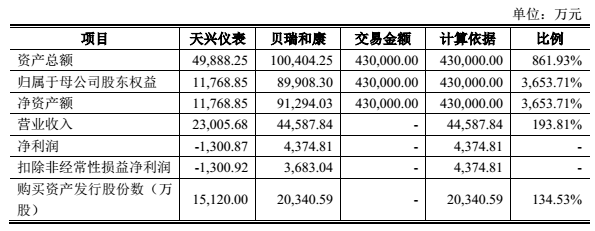
Prior to this transaction, the controlling shareholder of the listed company was Tianxing Group, and the actual controller was Mr. Wu Jinliang. ThisFollowing the completion of this transaction, Mr. Gao Yang, the controlling shareholder and actual controller of Berry Genomics, will become the controlling shareholder of the listed company.shareholders and the actual controller. In this transaction, the aforementioned indicators of the assets proposed to be acquired exceed those of the listed company as of100% of the relevant indicators as of December 31, 2015 and for the year 2015, and this transaction will result in the listed company’s principalA fundamental change has occurred in the core business operations; in accordance with the provisions of the Administrative Measures for Material Asset Restructurings, this transaction constitutes a material asset restructuring under the Administrative Measures for Material Asset Restructuringsbackdoor listing as stipulated in Article 13 of the Measures.
In 2013, 2014, 2015, and the first half of 2016, Berry Genomics' revenue from core operations amounted to RMB 258 million, RMB 334 million, RMB 445 million, and RMB 385 million, respectively, demonstrating a robust growth trajectory.During the same periods, the gross profit contributed by the medical products and services business amounted to RMB 160 million, RMB 208 million, RMB 238 million, and RMB 243 million, respectively, accounting for 90.51%, 89.04%, 88.63%, and 97.29% of Berry Genomics’ gross profit from its core operations, thereby constituting the primary source of the company’s profits. The parties liable for performance compensation committed that the net profits for 2017, 2018, and 2019 would be no less than RMB 228.4 million, RMB 309.2 million, and RMB 404.5 million, respectively.
It is reported that Beijing Berry Genomics Biotechnology Co., Ltd. (hereinafter referred to as "Berry Genomics") was established in May 2010. It is an R&D-focused biotechnology company dedicated to applying high-throughput gene sequencing technology to provide "non-invasive" comprehensive solutions for clinical disease screening and diagnosis.
Berry Genomics’ R&D team is led by Dr. Zhou Daixing, who previously participated in the design and development of high-throughput sequencers. The team comprises top-tier experts in experimental research, product development, and bioinformatics analysis within the fields of high-throughput sequencing and clinical genetic testing, and has established collaborative partnerships with globally renowned research institutions in these domains.Berry Genomics has become a globally leading research center for high-throughput sequencing technologies and applications.
In March 2015, the China Food and Drug Administration (CFDA) approved the medical device registration for the gene sequencer (NextSeq CN500) and the fetal chromosomal aneuploidy (T13/T18/T21) detection kit (reversible terminator sequencing method) produced by Hangzhou Berry Genomics Co., Ltd., marking Berry Genomics’ successful entry into the upstream sector of the genetic testing industry.
Furthermore, Berry Genomics has partnered with internet giant Alibaba Cloud to launch the “Shenzhou Genomic Data Cloud” project. Leveraging Berry Genomics’ extensive data accumulation in gene sequencing over the years, the project is led by Professor Yu Fuli, formerly of Baylor College of Medicine in the United States and currently serving as Chief Information Officer (CIO) at Berry Genomics, along with a professional bioinformatics team. By employing the company’s independently developed Verita Trekker® variant detection system and Enliven® variant annotation system, the project delivers reliable variant results, thereby assisting researchers and clinicians in advancing research and formulating precision medicine strategies.
With the successful implementation of these projects, Berry Genomics, in its fifth year since establishment, has developed into an industrial landscape headquartered in Beijing, with medical laboratories in Shanghai, Qingdao, Chengdu, Changsha, and Hangzhou, as well as a production base in Hangzhou. The company has also partnered with Professor Dennis Lo of The Chinese University of Hong Kong (CUHK) in the Hong Kong Special Administrative Region to establish Xcelom Limited (Hong Kong Yashineng Gene Technology Co., Ltd.). Leveraging patent licenses from CUHK, Xcelom provides more secure genetic testing services to Hong Kong and surrounding areas. Its market network covers more than 2,000 hospitals across over 30 provinces, municipalities, and autonomous regions in China. The company boasts high-standard systems for R&D, marketing, sales, and customer service, and employs more than 1,000 staff members.
Previously, Zhou Daixing, CEO of Berry Genomics, stated to reporters: “Currently, more than 100 medical institutions across China have obtained pilot qualifications for NIPT. Seventy percent of them use Berry Genomics’ sequencers and reagents. Over the past year, these hospitals and clinical laboratories have generated nearly 500,000 samples.”
Products under Berry Genomics:
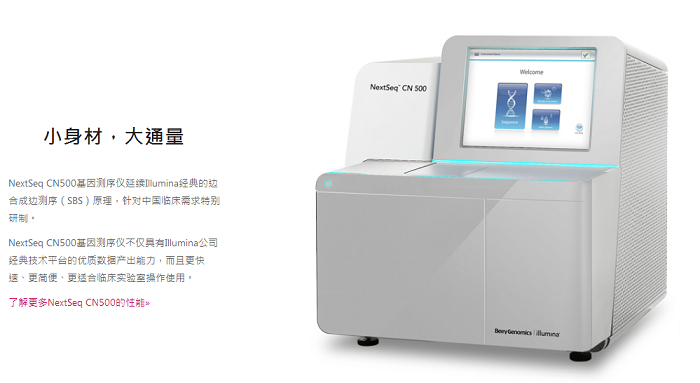
The NextSeq CN500 Gene Sequencer employs Illumina’s Sequencing by Synthesis (SBS) technology, delivering highly accurate sequencing data with quality scores reaching Q30 (a single-base error rate of 1/1,000). Furthermore, its data quality remains unaffected by homopolymer regions, ensuring precise and reliable clinical testing.
Since 2009, sequencing technologies based on the SBS (Sequencing by Synthesis) principle have been cited more than 3,800 times in peer-reviewed publications. Globally, leading NIPT service providers prefer sequencers utilizing this sequencing principle. With over 1,000,000 clinical cases performed both domestically and internationally, NIPT stands as a prominent and successful example of the widespread clinical application of high-throughput sequencing technology. NIPT requires only a 10 mL venous blood sample from the pregnant woman; plasma DNA is extracted and analyzed via high-throughput sequencing to determine whether the fetus has Down syndrome (T21), Edwards syndrome (T18), or Patau syndrome (T13), with an accuracy rate exceeding 99%.
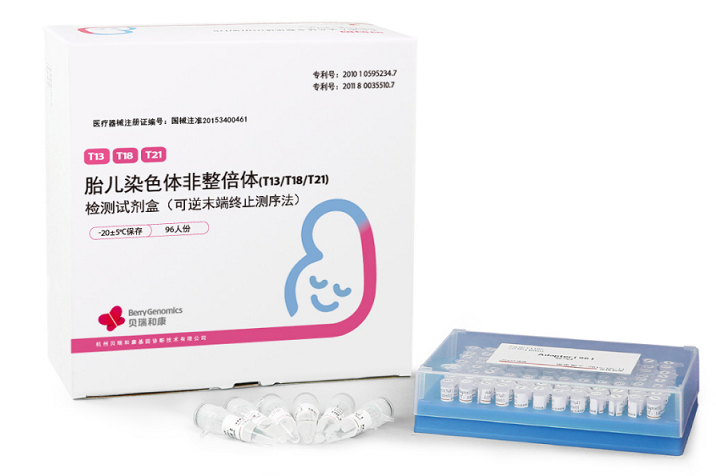
Fetal Chromosomal Aneuploidy (T13/T18/T21) Detection Kit (Reversible Terminator Sequencing Method) has been delivered and put into use in dozens of large prenatal diagnosis centers across more than 20 provinces, municipalities, and autonomous regions in China, achieving a library construction success rate of over 99.5%. It is suitable not only for high-throughput processing in factory-scale sequencing centers but also for busy clinical laboratories. Requiring only trace amounts of DNA, the procedure involves two-step sample loading and one-step purification, with a total turnaround time of 3 hours, making it ready for sequencing on the NextSeq CN500 genetic sequencer.
If the transaction is successfully completed, Tianxing Instrument will sell off its existing motorcycle and automotive parts-related businesses, while injectingenter the highly profitable gene sequencing-related business with broad development prospects, thereby achieving the company's core businessTransformation, Fundamentally Improving the Company's Operational Performance。
For Berry Genomics, a successful listing on the A-share market will enable the company to connect with China’s domestic capital markets and further propel Berry Genomics...to drive Kang's business development and enhance its comprehensive competitiveness and industry standing. By leveraging the capital market platform,Berry Genomics to Broaden Financing Channels, Providing Momentum for Future Development。
With continuous innovations in next-generation sequencing (NGS) technology, the cost of whole-genome sequencing has dropped rapidly from over $100 million to the current $1,000, while the turnaround time has been reduced to three days. As costs decline, the market size is poised for rapid growth. According to institutional forecasts, the global precision medicine market reached nearly $60 billion in 2015, with a projected compound annual growth rate (CAGR) of 15% over the next five years. Within this sector, the global gene sequencing market grew from $8 million in 2007 to approximately $4.5 billion in 2013, and is expected to maintain a growth rate exceeding 20%, reaching around $11.7 billion by 2018.
China has also increased its support for precision medicine. On March 11, 2015, the Ministry of Science and Technology convened the nation’s first expert meeting on precision medicine strategy and decided to invest RMB 60 billion in the field of precision medicine by 2030. In January 2015, the government announced pilot institutions for high-throughput sequencing in prenatal screening and diagnosis, followed by the announcement in April of pilot institutions for high-throughput gene sequencing in tumor diagnosis and treatment, demonstrating the government’s determination to promote the development of precision medicine.