

Mvisioner Becomes China's First Company to Apply VR Technology in Clinical Practice, Files IPO Prospectus
When it comes to introducing tech products, text descriptions can be somewhat abstract. Let’s start by viewing a few animated GIFs to experience the cool technology of MiaoZhi Tech.
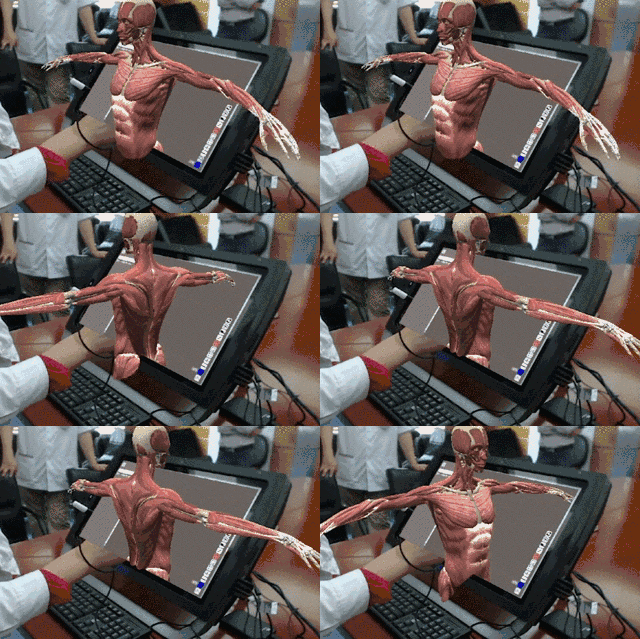
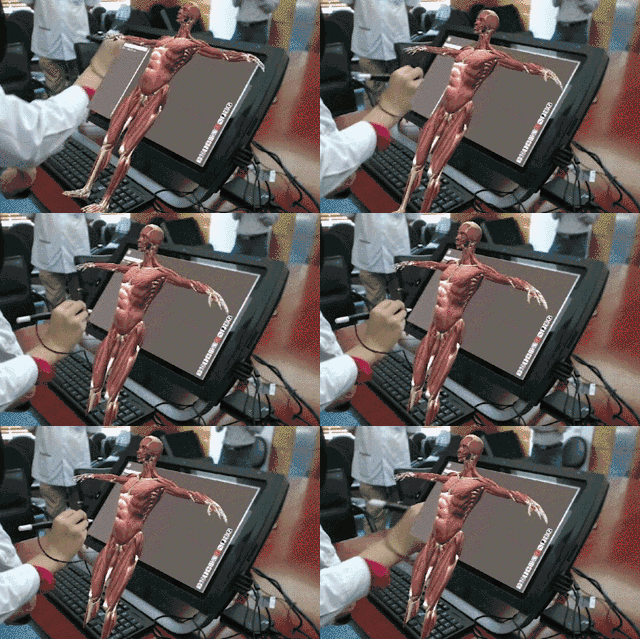
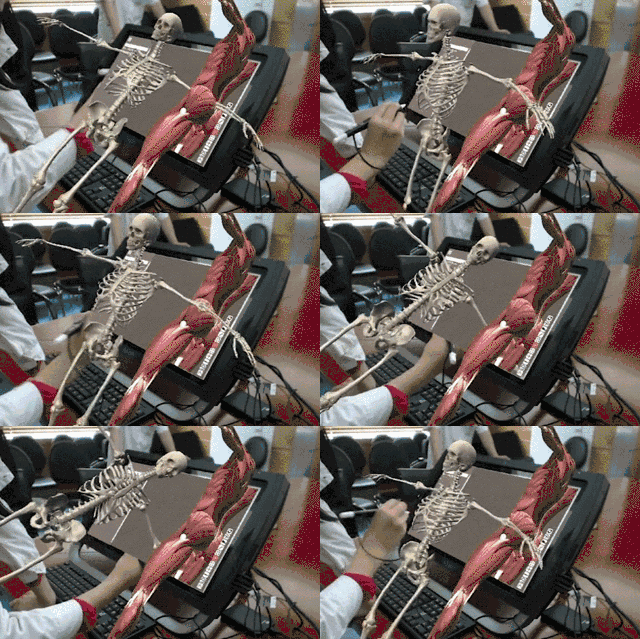
This is not a scene from a science fiction movie, nor is it a setting in an American laboratory; rather, it is footage from trials of MiaoZhi Technology’s VR Medical Imaging Platform at the Second Affiliated Hospital of Sun Yat-sen University. MiaoZhi Technology is the first company in China to apply VR technology to clinical practice, bringing significant convenience and breakthroughs in areas such as precise surgical planning, doctor-patient communication, and medical education, thereby unlocking endless possibilities for the advancement of healthcare through VR technology.
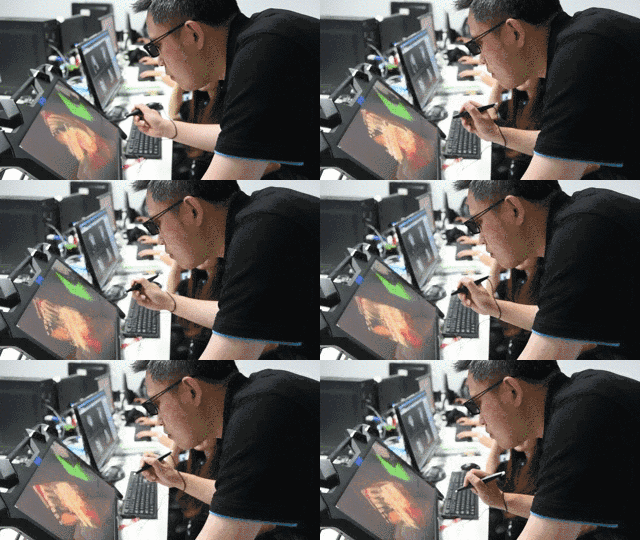
Xie Zhiheng at Work
The individual conducting the experiment is Xie Zhiheng, founder of MiaoZhi Technology. He holds a master’s degree in Electronic Engineering and Biomedical Engineering from The Chinese University of Hong Kong. Although he is from Hong Kong, he speaks fluent Mandarin. After graduating in 2008, Xie initially joined OOCL (Orient Overseas Container Line). A few months later, he resigned to join another company focused on the research and development of MRI systems. Within a year, the system was successfully developed, leading to a steady stream of orders.
While studying MRI scans, he found that although the image quality was sufficiently clear, physicians still struggled with interpretation due to a lack of intuitiveness. He believed that presenting these images using VR technology would yield better results. As VR technology had gradually gained public awareness by 2015, he planned to integrate VR with medical imaging to address challenges in medical image processing—a venture that aligned perfectly with his professional aspirations.
In February 2016, it received millions in angel investment from Yi Meng Capital.
Choosing to launch a startup in Shenzhen not only provided access to capital support but also offered an entrepreneurial ecosystem with a complete industrial chain, making it easier to find partners. Meanwhile, Xie Zhiheng’s team did not disappoint. In February 2016, the product prototype of Miaozhi Technology was successfully deployed at the Second Affiliated Hospital of Sun Yat-sen University. Moreover, everything from model design to every line of code was developed in-house by Miaozhi Technology, making it a fully independent, domestically produced product with proprietary intellectual property rights.
To grasp the true power of this technology, consider the following scenario: In doctors’ offices, we often see numerous black-and-white CT scans, the clinical significance of which is frequently incomprehensible to patients.
If MiaoZhi Technology’s VR medical imaging platform presents 360-degree color stereoscopic images that reconstruct the patient’s lesion site right before your eyes, you will immediately understand what is wrong without needing a doctor’s explanation. For professional physicians, accurate visualization of the affected area facilitates diagnosis, precise lesion localization, and meticulous surgical planning, making surgeries highly efficient and precise.
Precision Surgical Planning: To illustrate this point, consider the following example. In February 2016, MiaoZhi Technology’s VR medical imaging platform was successfully deployed at the Second Affiliated Hospital of Sun Yat-sen University. This June, a male patient in his forties suffered a comminuted fracture of the ankle. Leveraging this new technology, Professor Li Chunhai, Director of the Center for Minimally Invasive Spine Surgery at the hospital, along with his students, donned VR headsets to “pull out” the 3D skeletal images of the fractured bone from the computer screen.
This is a core technology of the product: intelligent segmentation, which can separate bones, blood vessels, and muscles, allowing doctors to extract and view the required areas at will.
By leveraging VR imaging technology, Professor Li Chunhai not only visualized the patient’s bone fragments but also simulated fracture reduction preoperatively, designed a personalized plate, and delivered precise treatment. The patient was highly satisfied with the postoperative outcome.
Medical Education: With the aid of virtual reality (VR) medical imaging technology, students can use a stylus to rotate, zoom in on, and dissect constructed 3D models of human muscles and bones, thereby gaining a better understanding of each anatomical component. Physicians can also clearly visualize and assess the location and severity of injuries.
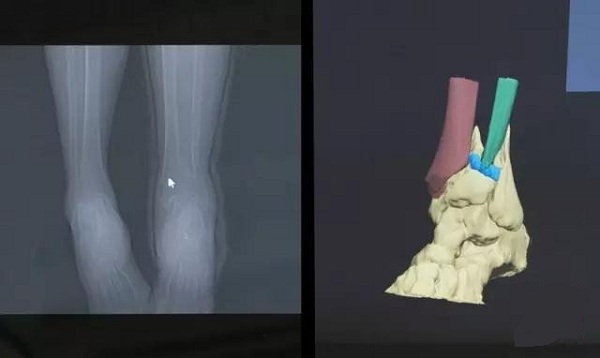
Color-Render the Affected Area
Doctor-Patient Communication: Traditional medical imaging is two-dimensional, making it difficult for patients to fully understand the extent of tissue damage and the surgeon’s operative strategy without specialized knowledge. This has changed with virtual reality medical imaging technology, which allows doctors and patients to view three-dimensional models. With the addition of color coding, various anatomical structures become easily identifiable.
This is attributable to another core technology of the product.: Virtual reality rendering model, which can perform color rendering on the areas required by doctors, clearly presenting the damaged regions.
Regarding future development, Xie Zhiheng stated that in addition to its current focus on orthopedic surgery, Miaozhi Technology plans to extend its VR medical imaging technology to clinical departments such as neurosurgery and cardiology/cerebrovascular care, with the aim of improving surgical outcomes. The company also intends to expand the adoption of this technology to a broader range of hospitals.
Xie Zhiheng believes that there is still significant room for imagination in the integration of VR and healthcare. He is confident that life sciences will experience explosive growth over the next 10 to 30 years, and that VR technology brings infinite possibilities to the development of medical care.