

NVIDIA Awards $400,000 to Two Cancer Research Teams to Advance Compute-Based Therapies
NVIDIA (Chinese name: Yingweida), founded in January 1993, is a manufacturer of computer graphics chips, with more than half of all discrete graphics cards for computers using NVIDIA chips. Today, NVIDIA is an artificial intelligence computing company that has long extended its business into supercomputing chips, artificial intelligence, deep learning, and autonomous driving.
Recently, NVIDIA’s “Computational Therapeutics” project team awarded $400,000 in prizes to two cancer research institutions, engaging in close-quarters combat against cancer—a fitting description for two pioneering research teams at the forefront of oncology. A group of NVIDIA employees, with support from researchers at the National Cancer Institute, selected these two winning teams from 20 proposals submitted worldwide.
One of them is the team from the Translational Genomics Research Institute in Phoenix, Arizona, led by Seungchan Kim. Their goal is to understand why some cancer cells respond to treatment while others do not. Their findings will drive the development of differentiated cancer therapies.
Another team, led by Andrés Cisneros of the University of North Texas, is searching for relevant variants that can trigger abnormal changes in DNA damage repair proteins. These variants are likely key factors in cancer diagnosis. By leveraging accelerated computing, both teams are investigating approaches to combat cancer at the most fundamental level of human biology.
Each of the two teams will receive a $200,000 grant from the NVIDIA Foundation to further research how to create newer and more targeted therapies. The NVIDIA Foundation is an employee-led charitable organization, and these two rounds of grants are part of the foundation’s “Computational Therapeutics” initiative. This initiative aims to support projects that achieve breakthroughs in cancer diagnosis and treatment using parallel computing.
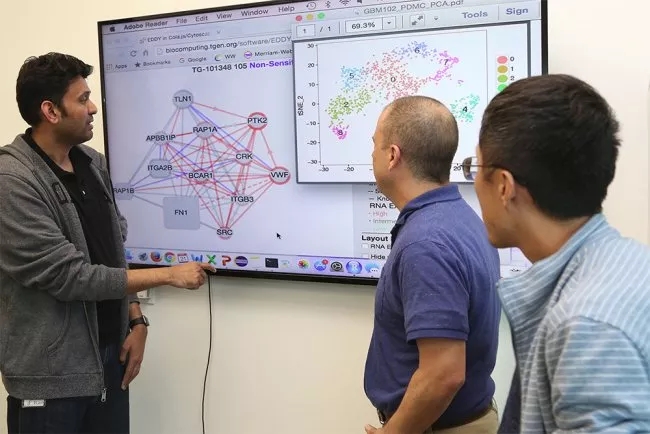
Researchers at the Translational Genomics Institute Discuss Data Analysis Tool—EDDY
Kim and his team’s research could lead to precision cancer therapies, such as treatments targeting specific cells within a patient’s tumor.
To this end, they developed a GPU-accelerated data analysis tool that enables detailed investigation into how cancer cell DNA regulates protein production, as well as how these proteins interact with each other and with other molecules. By using this tool, researchers can identify differences between distinct cell populations within the same tumor.
This study paves the way for personalized cancer therapy in the future, enabling the use of different drugs to target distinct regions of a tumor.
Kim said, “There may be a cell subpopulation that responds only to Component A, and another subpopulation that responds only to Component B.”
This tool, called EDDY-GPU (EDDY stands for Evaluation of Differential Dependency), enables researchers to rapidly analyze data from large volumes of tumor cells. In contrast, the earlier CPU-based version of EDDY failed to complete the analysis of 4,754 samples even after two months.
Kim said, “If you have a cancer patient hanging by a thread, you certainly would not be willing to wait even a moment for the diagnostic and treatment results.”
He intends to use the funding from the “Computational Therapy” project to improve his algorithm, thereby achieving faster analysis speeds.
Kim and his team also plan to conduct a trial with the University of California, San Francisco. They obtained tissue samples from two brain cancer patients, performed detailed analyses of their tumors, proposed recommended therapies, and further investigated these treatments using patient-derived models.
DNA is frequently damaged by ultraviolet radiation, carcinogens in cigarette smoke, and other substances. Fortunately, DNA repair proteins produced by the human body can typically resolve such damage.
However, DNA repair proteins themselves sometimes undergo cleavage or mutation. Andres Cisneros of the University of North Texas and his team aggregated extensive data from the U.S. National Institutes of Health to identify mutations in DNA repair proteins associated with cancer.
Upon identifying these mutations, researchers used GPU-accelerated computer simulations to determine how these mutations alter DNA repair proteins and their functions.
Cisneros stated, “If we know that mutations affect these proteins and are associated with cancer, researchers can use this information to repair these proteins or treat the disease using drugs or other therapies.”
Cisneros’s broader goal is to identify more biomarkers that can indicate high-risk signs for specific types of cancer. The team has already identified variants associated with several cancers, including biomarkers for prostate cancer in African Americans.
Scientists are using genetic data to assess the risk of certain cancers and guide their treatment. For instance, surgeons can identify high-risk variants associated with breast cancer, while testing for estrogen and progesterone receptors helps physicians determine which therapy is more effective.
By identifying additional biomarkers, Cisneros can provide new diagnostic tools for a wider range of cancer types. Furthermore, his analysis of DNA repair protein variants can help scientists develop more personalized genetic anti-cancer therapies.
The “Computational Therapeutics” project can be described as one of NVIDIA’s initiatives to advance parallel computing research in oncology. In fact, NVIDIA has long been focused on cancer treatment. Last month, NVIDIA entered into a new collaboration with the National Cancer Institute and the Department of Energy to develop an artificial intelligence framework designed to accelerate cancer research. This new framework is called the “Cancer Distributed Learning Environment,” abbreviated as CANDLE. NVIDIA stated that it aims to help achieve the goals of the “Cancer Moonshot” initiative announced by President Obama earlier this year, which seeks to accomplish in five years what would typically take ten years in cancer research.
NVIDIA stated that its engineers and computer scientists will collaborate with cancer researchers to develop and refine the artificial intelligence framework. CANDLE will focus on three major cancer research initiatives:
First, to enhance scientists’ understanding of gene signatures in DNA and RNA, thereby helping them predict which therapies will be effective for patients;
Next is to accelerate the simulation process of protein interactions, which plays an important role in the early formation of cancer;
Finally, it will organize data from millions of cancer patients to build a comprehensive database for monitoring cancer metastasis and recurrence. To protect patient privacy, this process will be conducted under semi-supervised conditions.
Jensen Huang, founder and CEO of NVIDIA, stated, “GPU-based deep learning has provided us with a novel tool to tackle significant challenges that have proven too complex even for the most powerful supercomputers to date. Through collaboration with the National Cancer Institute and the Department of Energy, we have developed this artificial intelligence supercomputing platform specifically dedicated to cancer research.”