

Shedding the Pseudoscience Label: Therapeutic Video Games Poised to Emerge as a New Market
It sounds like a plot from a science fiction novel: Alzheimer’s disease can be treated simply by playing games, without taking any medication.
A study released this summer suggests that this may indeed be as promising as it sounds. In a 10-year study, researchers followed 2,800 participants, assigning a subset to play a specially designed video game. They ultimately found that long-term players of this game had nearly half the risk of developing Alzheimer’s disease or other forms of dementia.
Subsequently, the game was acquired by a U.S. company called Posit Science, which upgraded and revamped it, rebranding it as Double Decision and incorporating it into its BrainHQ brain training suite of applications.

Study Shows Double Decision Training Game Can Effectively Reduce the Risk of Alzheimer's Disease
In the game, players are asked to identify a series of objects located in the center or periphery of their visual field, and the system gradually requires them to increase their identification speed. “Training the brain is like training muscles; if done correctly, it will become stronger over time,” said Henry Mahncke, Chairman of Posit Science.
Many people consider the notion of using games for therapeutic purposes to be an ambiguous pseudoscience, and this view is not without merit. The aforementioned study, known as the “Active Study” (Study on Brain Activity), stands as the largest research effort on brain-training games to date. However, for most such games currently available on the market, there are no rigorous standards comparable to those used for evaluating pharmaceuticals or medical devices to substantiate their medical efficacy.
This year, Lumos Labs, a neuroscience research company that offers brain training programs online, paid a $2 million fine to the U.S. Federal Trade Commission (FTC) for exaggerating the efficacy of its “Lumosity brain training game” in its advertising. Lumos claimed that the game improved users’ job performance and could even alleviate the symptoms of Alzheimer’s disease. The FTC, however, determined that these advertising claims lacked scientific substantiation.
Mahncke stated that one way to regain public recognition for medical functional games is to establish rigorous industry standards. “There are too many charlatans passing off simple mini-games as therapeutically effective interventions. I believe that professional research support and appropriate regulatory frameworks can help further advance this field.”
Posit also plans to submit to the U.S. FDA a study on the efficacy of Double Decision, the game mentioned at the beginning of this article, to seek medical market access approval for the dementia prevention and treatment module of its BrainHQ product. Meanwhile, the company has another game designed for individuals experiencing “chemo brain,” aimed at helping cancer patients undergoing chemotherapy recover their memory function. Posit stated that it will conduct a future study on this product as well to demonstrate its clinical efficacy.
Another company, Akili Interactive—a biotech firm under PureTech—is also developing mobile games for the treatment of neurological disorders and is busy distancing its product from other apps on the market with questionable therapeutic efficacy.
In July, Amgen, a major U.S. biopharmaceutical group, invested $11.9 million in Akili, with Germany’s Merck KGaA also participating in the funding round. Combined with the financing secured in January, Akili Interactive’s total Series B funding for the year reached $72.9 million.
The company’s flagship product, the Project Evo game, is designed to train children with ADHD to prioritize large volumes of information, thereby enhancing their attention span.

Project Evo Game for Training Attention in Children with ADHD
Eddie Martucci, CEO of Akili, stated that the company would channel its prior financing into rigorous clinical trials to determine the efficacy of its brain-training technology. Furthermore, Akili will not prematurely launch any product until the trials are completed and regulatory approval is obtained.
If Akili’s products succeed, it will mean they are taking business away from companies developing ADHD medications, such as Shire Pharmaceuticals (which has also invested in Akili). “This is a $7 billion pharmaceutical market, and most parents are reluctant to have their children take Ritalin, a central nervous system stimulant with significant side effects. If there were better alternatives to medication, I believe they would gain considerable support from parents of children with ADHD,” said Zack Lynch of Jazz Venture Partners, one of Akili’s investors.
Jazz Venture also invested in a company with a similar rationale—Pear Therapeutics, whose model leverages digital technology to expand therapeutic options. Pear’s initial focus is on using a mobile app to assist patients with addiction or substance use disorders, a population that currently totals 22 million in the United States.
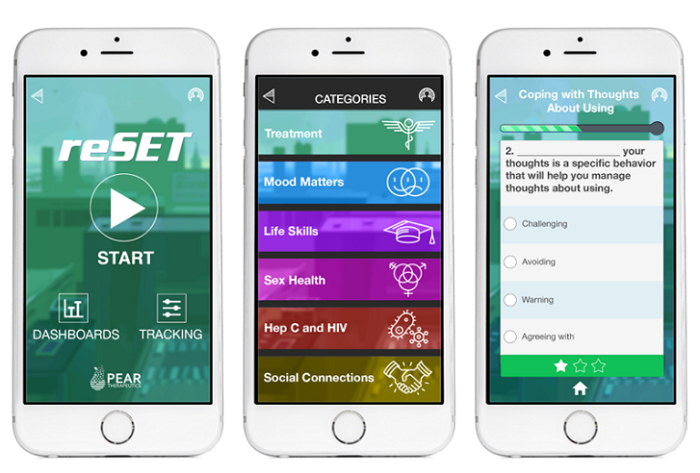
Pear's Addiction Treatment App
If companies such as Akili, Pear, and Posit can use data to demonstrate the efficacy of their products, they are likely to spur the growth of a thriving emerging industry. According to estimates by the Japanese market research firm MM Research Institute, the global market for cognitive assessment and training products is already worth $2.4 billion and is projected to more than triple to $7.5 billion by 2020.
Mr. Mahncke, Chairman of Posit, believes that the field of medical functional games has been held back by products of questionable quality and lacking support from reliable research. “Most such products fail to clarify whether they are primarily intended for entertainment or therapeutic efficacy, but our company is explicitly committed to developing them as high-tech medical solutions,” he stated. “In contrast, most companies create products they hope will have medical benefits; ultimately, the claimed effects in their marketing become mere slogans, with no substantial outcomes to show for it.”
Akili’s CEO has also stated that the consumer market for so-called “brain cognitive training” is rife with semi-finished products and offerings of unproven efficacy, which have entered the market without regulatory review. “This situation is markedly different from that of other digital health products, such as diagnostic apps.”
What these companies have in common is that they all regard themselves as serious medical technology firms, rather than half-hearted “brain-training” apps. The number of such companies is growing, and this has increasingly drawn scrutiny regarding their scientific validity. To address these concerns, it will take time to shift public perception: cognitive health, like physical health, can be enhanced through training with devices and software, supported by rigorous scientific evidence.