

Aier Eye Hospital Group Raises RMB 2.42 Billion to Acquire 9 Hospitals and Build a Comprehensive Eye Health Ecosystem

December 7, 2016,Aier Eye Hospital issued a public announcement,Proposed private placement to raise RMB 2.427 billion. Meanwhile,Aier Eye Hospital and Hunan Zhongyu Aier Eye Hospital Medical Industry Investment Partnership (LimitedPartnership) and Shenzhen Qianhai Oriental Aier Medical Industry M&A Partnership Enterprise (Limited Partnership) signed the "ConditionalEffective Equity Transfer Agreement》, planAcquisition of Assets from Nine Hospitals Incubated by Two Industrial M&A Funds。
Pursuant to the terms of this Agreement, Aier Eye Hospital Group acquires the equity interest in Dongguan Aier Eye Hospital Co., Ltd. held by Party B.Aier Eye Hospital75%equity interests of Tai'an Aier Guangming Hospital Co., Ltd. and Aier Eye Hospital58.70%equity interests in Taiyuan Aier Kangming Eye HospitalAier Eye Hospital Co., Ltd.90%equity of Foshan Aier Eye Hospital Co., Ltd.60%'s equity, Jiujiang AierZhongshan Ophthalmic Center, Aier Eye Hospital68%equity interests of Qingyuan Aier Eye Hospital Co., Ltd. (Aier Eye Hospital)80%equity, HuAier Eye Hospital75%equity.
Hunan Zhongyu Aier Ophthalmology Medical Industry Investment Partnership(Limited Partnership) holds Binzhou Hubin Aier Eye Hospital Co., Ltd.70%Equity, Chaoyang Eye HospitalAier Eye Hospital Co., Ltd.55%equity interests, with a total acquisition price of58,012.8010,000 yuan.
Aier Eye Hospital has consistently aligned itself with its overall strategic development goals, continuously expanding its network scale, enhancing operational standards, and strengthening its competitiveness. To date, Aier Eye Hospital has established a total of 65 hospitals (excluding the Hong Kong Special Administrative Region) through acquisitions and self-built facilities, thereby achieving a comprehensive layout in the medical services market.
In 2014, Aier Eye Hospital Group established industrial M&A funds with Oriental Financial Holdings and Zhongyu Venture Capital, respectively, effectively leveraging its investment capacity and rapidly expanding its pipeline of reserve hospital projects. Through this private placement, Aier Eye Hospital Group intends to acquire certain eye hospitals to optimize its market layout and consolidate and enhance its leading position. Meanwhile, the company plans to relocate and expand selected hospitals with constrained consultation capacity, thereby increasing patient throughput and upgrading its service system.
Aier Eye Hospital intends to raise no more than RMB 2,492,719,400 through a private placement of shares, with the proceeds to be used for the “Aier Headquarters Building Construction Project,” “Relocation and Expansion Projects of Eye Hospitals,” “Acquisition Projects of Eye Hospitals,” and “Information Infrastructure Upgrade and IT Cloud Migration Project.” The feasibility analysis of the investment projects funded by this private placement is outlined below:
The total amount of funds raised from this non-public offering of shares shall not exceed RMB 2,426,627,000. After deducting issuance expenses, the proceeds are planned to be invested in the following projects:
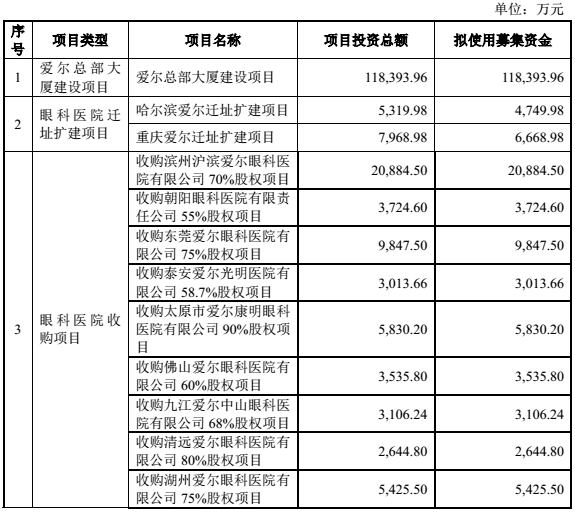

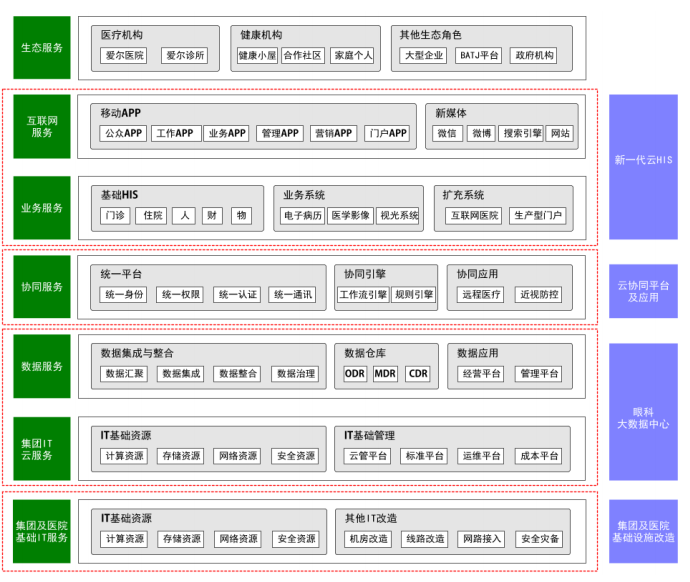
With the rapid expansion of Aier Eye Hospital’s chain network and business development, enhancing information technology capabilities has become an urgent priority. Aier Eye Hospital plans to implement an IT infrastructure overhaul and cloud migration project to deliver higher-quality medical services and more comprehensive eye health care solutions to patients. This initiative will provide robust support for the horizontal and vertical advancement of Aier Eye Hospital’s tiered chain system, while offering informational backing for business, management, and business model innovation. The main components of this project include:
(1) Upgrading of IT infrastructure: The network systems, security systems, disaster recovery systems, and other infrastructure at the headquarters and subsidiary hospitals are planned to be upgraded to meet the business development needs of Aier Eye Hospital and to prepare for the integration with cloud-based information systems.
(2) The new-generation cloud-based Hospital Information System (HIS), built on unified standards and architecture, establishes a specialized, professional, integrated information service platform tailored for Aier Eye Hospital’s chain of ophthalmic hospitals. Key components include the group-wide hospital information system, mobile internet hospital services, operational portals, and collaborative applications.
(3) Ophthalmology Big Data Center: Leveraging Aier Eye Hospital’s accumulated historical data and substantial business traffic, and guided by the concepts of full-lifecycle management and cloud service governance, the center has established a big data operations and management platform, an ophthalmology full-lifecycle management platform, and an ophthalmology single-disease management platform.
(4) Cloud Collaboration Platform and Applications: Build a technical platform based on unified communications, unified identity, unified data exchange, unified business exchange, and portal management. On this technical foundation, develop cross-hospital medical collaboration platforms, remote health collaboration platforms, optometry business collaboration platforms, and more.
1. Aligning with Aier Eye Hospital’s Development Needs to Enhance Back-Office Support Capabilities and Headquarters’ Centralized Management Capacity In recent years, Aier Eye Hospital has maintained a strong growth trajectory, with rapid expansion of its chain network, continuous growth in the business scale of affiliated hospitals, and an increasing volume and diversity of operations integrated under headquarters’ management.
Aier Eye Hospital’s existing IT infrastructure is unable to meet the needs of its further development. There is currently no unified, standardized, and comprehensive business integration system between the headquarters and its hospitals, hindering efficient information sharing and data exchange. The emergence of new technologies such as cloud computing, big data, and mobile internet has also presented Aier Eye Hospital with a new landscape. The company must seize this opportunity to achieve rapid growth in the internet era.
In the coming years, Aier Eye Hospital will continue to expand its network coverage and further penetrate lower-tier markets through its channel network. Enhancing interconnectivity, strengthening overall control, and improving operational efficiency have become prominent challenges that must be addressed for future development. This project aims to upgrade IT infrastructure and build a standardized, high-quality, and efficient information platform to effectively collect, categorize, transmit, analyze, and process various operational and management data. By doing so, it will achieve unified control, improve operational efficiency, enhance management capabilities, and strengthen risk management, thereby facilitating the smooth development of Aier Eye Hospital’s various business operations.
2. Enhance the hospital’s comprehensive service level and improve patients’ medical care efficiency and experience
With rising income levels and shifts in consumption patterns, residents’ expectations for the quality and efficiency of ophthalmic medical services have continued to grow. As a nationwide chain of ophthalmic healthcare institutions, Aier Eye Hospital needs to gain real-time insights into patient needs and promptly upgrade its business systems to enhance its comprehensive service capabilities. However, Aier Eye Hospital’s existing Hospital Information System (HIS) development is centered on hospital financial accounting, with functionalities primarily focused on department-level transaction management. This structure fails to meet the practical requirements of a patient-centered care model and subspecialty-oriented clinical management.
To enhance the comprehensive service level of the hospital, Aier Eye Hospital urgently needs to build a new-generation cloud-based Hospital Information System (HIS) tailored to the operational characteristics of chained eye hospitals. This system will cover all service stages—pre-hospital, in-hospital, and post-hospital—optimize existing hospital service processes, reinforce service-oriented concepts, and integrate online channels with offline services. By diversifying patient service methods, improving medical efficiency, and enhancing the patient experience, the system aims to further increase hospital business volume. Additionally, to improve the operational efficiency of medical resources and elevate clinical technical capabilities, the new-generation cloud HIS must enable collaboration in medical activities such as intra-hospital and inter-hospital consultations, image interpretation, and medical conferences.
3. Fully leverage and maximize the value of data to drive the rapid development of the ophthalmic healthcare industry. Aier Eye Hospital is China’s largest ophthalmic
Medical chain institutions recorded 3.2 million outpatient visits and 320,000 surgical procedures in 2015. As of September 30, 2016, Aier Eye Hospital Group operated a total of 65 chained ophthalmic hospitals, with this number poised for continued rapid growth. As its business continues to expand, the data accumulated by Aier Eye Hospital is characterized by large volume, diverse types, and rapid growth. This necessitates robust capabilities in storage, computing, and analytics to uncover data patterns and glean insights into data value, thereby driving the development of the ophthalmic healthcare industry.
Therefore, Aier Eye Hospital needs to leverage big data processing technologies to integrate internal and external data resources and establish an ophthalmic big data center. This will centralize data currently stored at individual hospitals into a unified data center, enabling seamless data interoperability between the headquarters and hospitals, as well as among hospitals themselves, thereby facilitating rapid, timely, and effective responses to data requirements.
4. Building an Eye Health Ecosystem and Establishing an Eye Health Ecological Service SystemAs the first medical institution listed on the A-share market, Aier Eye Hospital has actively responded to changes in the market environment and user demands since its IPO. By fully leveraging its own resources and the advantages of the capital market platform, and adopting a dual strategy of organic growth and inorganic expansion, it has established a leading position in the field of ophthalmic medical services.
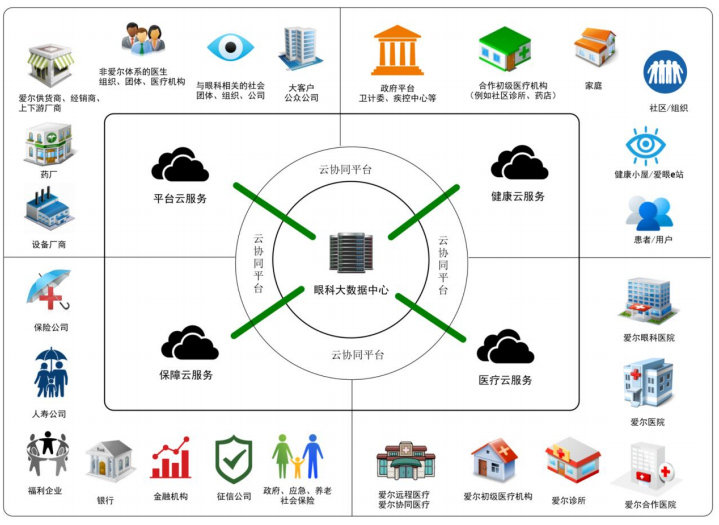
Aier Eye Hospital is committed to enhancing the efficiency of its internal resource utilization and integrating both internal and external resources to cultivate an eye health ecosystem characterized by horizontal breadth, vertical depth, and dense synergy, thereby contributing to China’s eye health initiatives. The eye health ecosystem proposed by Aier Eye Hospital involves the following stakeholders: Aier Eye Hospital’s own hospitals, Aiyan e-Stations, patients and members, suppliers, partner medical institutions, potential corporate clients, upstream and downstream enterprises within the ophthalmic industry chain, insurance providers, and government departments such as welfare agencies. To organically connect all parties within the ecosystem and generate a synergistic effect, informatization efforts must transcend Aier Eye Hospital’s corporate boundaries, achieving interconnectivity and data sharing with heterogeneous, multi-source, geographically dispersed, and diverse information systems associated with these various stakeholders.
Therefore, Aier Eye Hospital needs to build a cloud-based collaborative technology platform that enables all stakeholders within the Aier ecosystem to directly use or access this cloud platform, thereby achieving unified, high-quality, and efficient information flow and sharing. Building on this foundation, Aier can leverage network effects, promote cross-sector collaboration, and establish bilateral or multilateral synergies to foster deep connectivity and interaction among all parties in the ecosystem. This will facilitate coordinated efforts in clinical ophthalmology, myopia prevention and control among adolescents, resident eye health management, eye health insurance, and innovation by ophthalmic-related enterprises, ultimately driving Aier Eye Hospital’s innovation in services, business operations, and business models.