

Magic Leap Faces Scrutiny Over Alleged Demo Video Misrepresentation and AR Technology Delays
In the field of AR (augmented reality), there is a remarkable company—Magic Leap. Yes, it is the startup that raised nearly $1.4 billion based solely on its demo videos.
It is considered remarkable for two reasons. First, it has released multiple cool augmented reality video demos, each with a highly sci-fi aesthetic. Second, despite not launching a single product in the five years since its founding, it has accumulated $1.4 billion in investment based solely on these demos, reaching a valuation of $4.5 billion.
However, today, the foreign media outlet The Information reported that Magic Leap’s demo video was suspected of being fabricated, and its supposedly revolutionary augmented reality technology may in fact be several years behind that of its competitors, currently lagging far behind Microsoft’s HoloLens headset. Citing an interview with Magic Leap CEO Rony Abovitz, the report disclosed that the company released a misleading product demonstration showcasing the technology last year. Moreover, it has encountered difficulties in miniaturizing its AR technology, failing to transform the helmet-sized bulky device into everyday wearable glasses as Abovitz had previously claimed.
Magic Leap has repeatedly used YouTube videos to showcase its AR technology, featuring miniature elephants standing in people’s palms and massive whales leaping out of a virtual ocean to land on the floor of a stadium. However, at least one of these videos—depicting an alien from an aggressive game wearing a so-called headset or glasses made from real-world objects—was created by the visual effects studio Weta Workshop. Until today, it was believed that Weta had only produced virtual content for games. Yet The Information has revealed that the entire video originated from Weta Workshop.
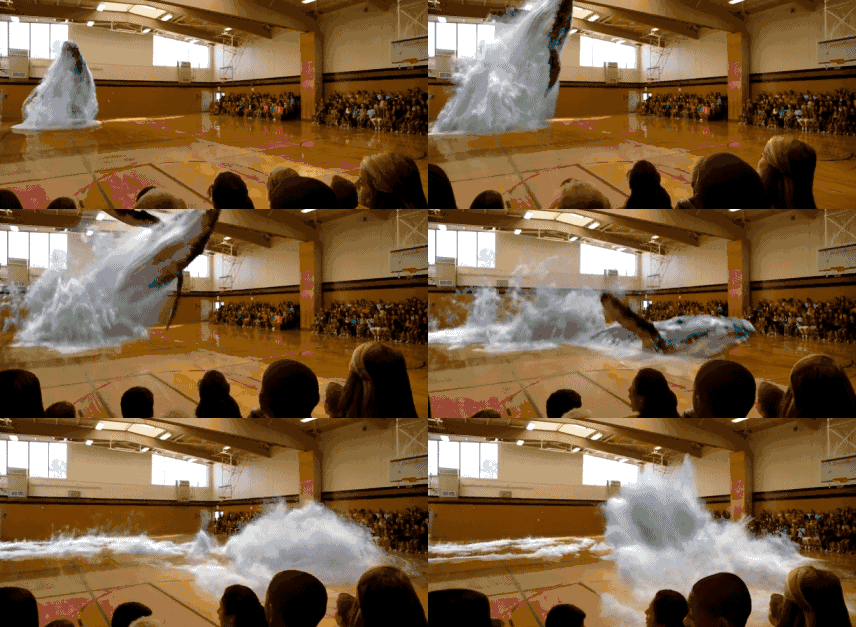
Magic Leap Dynamic Showcase: The Globally Viral “Whales” Demo
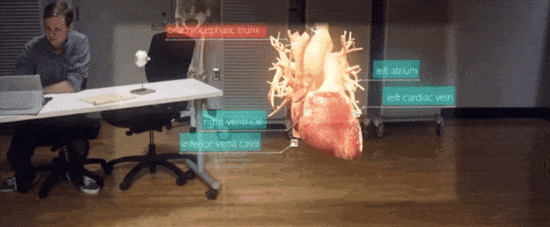
Magic Leap's Healthcare Demo
The Information obtained a rare demo unit of Magic Leap, whose documentation described the device as a bulky headset requiring multiple cables to connect to a desktop computer. The demo unit was reported to contain components similar to those in the HoloLens, but in some instances, the displayed images were blurrier and more unstable than those of Microsoft’s product prototype. Meanwhile, Microsoft’s HoloLens is now available for purchase in developer kits at a price of $3,000 and operates entirely without being tethered to a computer.
The crux of the matter appears to be Magic Leap’s much-hyped so-called fiber-scanning display, which projects laser light through optical fibers that rapidly oscillate back and forth to draw images. The company believes that fiber-scanning display technology could be Magic Leap’s breakthrough, enabling the integration of extremely expensive hardware into a refrigerator-sized device internally dubbed “the Beast.”
According to a report by The Information, Magic Leap has yet to get its fiber-scanning display to work, and it has been downgraded to a long-term research project. “You ultimately have to make trade-offs,” Abovitz said in an interview. However, the company’s latest product prototype appears to be only about the size of a standard pair of glasses. Internally referred to as PEQ, meaning “Product Equivalent,” Magic Leap declined to show it to The Information’s reporters. Abovitz claimed that it is slightly inferior in functionality to earlier products but denied that it employs technology similar to that of HoloLens.
Magic Leap previously demonstrated its AR applications in healthcare by projecting a floating, anatomically accurate heart into mid-air. While Magic Leap’s product launch faced delays, Microsoft’s HoloLens AR device rapidly evolved from an object of external curiosity into a practical tool across numerous professional fields. The latest real-world application involves holographic guidance for complex and high-risk spinal surgeries in orthopedics. With Microsoft’s support, orthopedic spine surgeons at a hospital in Santa Catarina, Brazil, created virtual 3D models of patients’ spines based on 3D CT scans. Using the Microsoft HoloLens, they were able to more precisely guide the placement of pedicle screws, thereby preventing complications such as nerve injury and prosthetic loosening.
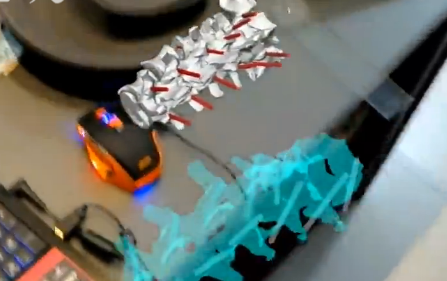
Microsoft HoloLens Begins to Be Applied in Orthopedic Surgery

Magic Leap CEO Rony Abovitz Demonstrates AR Glasses Lenses
Magic Leap was founded by Rony Abovitz, who previously established a medical robotics company. The medical robots developed by Abovitz incorporated technologies related to those used in Magic Leap. Specifically, these devices employ a miniature camera designed to penetrate the human body, featuring a mechanical structure akin to that of a laparoscope. Unlike conventional cameras, Abovitz utilized a single optical fiber that, through rapid helical oscillation and a transmission mechanism, projects two-dimensional images outward. This company was later acquired for $1.65 billion.
Gary Bradski, the Senior Vice President in charge of perception research, is a legendary figure in the field of computer vision and the founder of OpenCV. The expertise and technical prowess of these individuals, spanning hardware display technology, software-based image recognition, and image tracking, are poised to drive impressive performance at Magic Leap. Furthermore, Sundar Pichai, Google’s new CEO, has joined the board of directors; Richard Taylor from WETA Workshop (the company behind the special effects for The Lord of the Rings and The Hobbit); and science fiction author Neal Stephenson, who serves as the “Chief Future Officer.”
In summary, given Magic Leap’s personnel structure and its early investor base, the company appears highly credible. However, its opaque approach to information disclosure and its initial release of a purely CGI-based demo video are perplexing.
This report could deal an unimaginable blow to Magic Leap. Previously, the company had secured a substantial $1.4 billion in financing, reaching a valuation of $4.5 billion.
In February 2014, Magic Leap secured $50 million in Series A funding, with the investors remaining undisclosed.
In October 2014, Magic Leap secured $542 million in Series B financing led by Google, with participation from prominent investors including Qualcomm Ventures, K2 Global, Vulcan Capital, KPCB, Andreessen Horowitz, and Obvious Ventures. Meanwhile, Sundar Pichai, Google’s newly appointed CEO, joined the company’s board of directors.
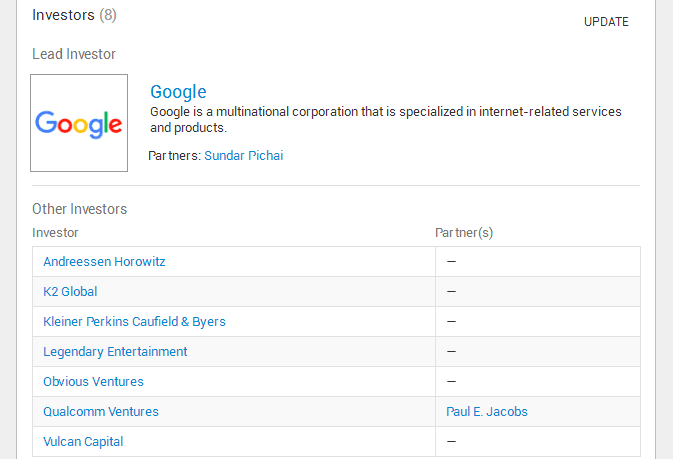
Series B round led by Google
In February 2016, Magic Leap completed its Series C financing round, raising $827 million. This round included participation from Chinese e-commerce giant Alibaba. Huace Film & TV, also from China, invested $3.5 million to acquire 217,108 shares of preferred stock in Magic Leap.

The Series C round was led by Alibaba, with continued participation from Google, as well as involvement from Morgan Stanley and Qualcomm.