

CRISPR/Cas9 Pioneer Feng Zhang Bets on Conquering Brain Diseases as His Flagship Venture Files IPO
Feng Zhang rarely grants interviews, but he seldom misses major academic conferences. The Shijiazhuang-born scientist is striving to become the rule-maker for CRISPR/Cas9, the most significant biotechnology of this century.
Shijiazhuang is just one of the many labels attached to him. From a strong contender for the Nobel Prize, to being listed in Forbes’ “40 Under 40,” and named one of Nature’s Ten People Who Mattered in Science, to being a new Chinese immigrant and part of the post-1980s generation. The otherwise unremarkable name of Zhang Feng has been thrust into the spotlight of the times and public opinion due to CRISPR/Cas9. VCBeat (WeChat ID: vcbeat) has compiled some of the stories behind this tech luminary, who is only 34 years old this year.
A steaming platter of Hong Yun Steamed Chicken Feet was served onto the table with a clatter, and a mischievous little girl picked up her chopsticks and began tapping them. A man dressed in a polo shirt and jeans was leading his multi-generational family through a bustling restaurant in Boston’s Chinatown, savoring delicious dim sum. Everything was perfectly ordinary.
No one could have imagined that Zhang Feng, at the age of 34, was the post-80s scientist with the most transformative power, posing a dual threat to other Nobel Prize candidates. No one could have imagined that his discoveries might help doctors cure some of the most devastating diseases, including autism, schizophrenia, cancer, and blindness. No one could have imagined that the genetic tools he developed would usher us into a dystopian era of designer babies, sparking widespread controversy around the world.
At that time, Zhang Feng was still a young father, husband, and son. He would sometimes leave the laboratory as late as 1 or 2 a.m., or even 3 a.m. He struggled to explain to his family what drove him to skip meals and lose sleep, leaving home early and returning late.
He invited a journalist to lunch and told him that he attached great importance to his current work. He not only enjoyed his job but also wanted to help the mentors who had once sponsored him continue their research... “I still remember those autumn leaves,” murmured Zhang Feng’s mother, Zhou Shujun.
At the age of 11, Zhang Feng left China with his mother and settled in Des Moines, Iowa. A few years later, while Zhang was still in high school, he would often work late in the gene therapy laboratory, leaving his mother to wait for hours in the car. On a hazy autumn night illuminated by moonlight, the two were deeply moved by the sight of falling leaves as they drove home. The vibrant green foliage that had thrived just months earlier was now scattered by the wind, reduced to dust. They could not help but lament the brevity of life and the ruthlessness of time. “From that moment on, I was determined to make something of myself,” Zhang said.
Like other scientists, he had already taken the first step in his life at that time.
Since this summer, STAT has followed Feng Zhang, attending his meetings, interviewing his mentors and lab members, and engaging in hours of in-depth conversations with him. The interviewer observed a scientist who is gentle in demeanor yet visionary in outlook, a striver determined to make history in a foreign land, and a researcher known for his decisiveness and efficiency.
To his colleagues, he has a keen eye for identifying promising opportunities, inspires creativity among the lab’s younger members, and is willing to forgo incremental breakthroughs with higher success rates in favor of pursuing higher-risk research. Whenever a lab member proposes a project, Feng Zhang asks, “Is this an ordinary study that can be accomplished with mere cleverness, or is it genuine innovation?”
Feng Zhang participated in research on two revolutionary genetic and neuroscientific technologies. As a graduate student and core team member, he collaborated with colleagues to develop methods for illuminating neurons in the brain, thereby helping scientists understand which neural circuits control specific behaviors and identify the roots of psychiatric disorders such as schizophrenia and bipolar disorder. Within just a few years, ZhangFengHis discovery propelled him to the forefront of global biology: he identified a method for rapidly, easily, and effectively editing the genomes of plants and animals, including humans.
They have used this tool to culture human cells resistant to HIV in the laboratory; cured muscular dystrophy, cataracts, and hereditary liver disease in mice; and improved crops such as rice, tomatoes, oranges, tobacco, and wheat. It can also be used to modify the genes of human eggs, sperm, and embryos, allowing parents to select their baby’s traits—such as personality, athletic ability, and appearance—with the same ease as choosing configurations for a Lexus.
The technology known as CRISPR/Cas9 quickly gave rise to three companies that have secured hundreds of millions of dollars in venture capital, ushering in a new era for molecular biology.
Phillip Sharp, a biologist at the Massachusetts Institute of Technology and one of the 1993 Nobel Laureates in Physiology or Medicine, stated that it is “changing the way we conduct scientific research.”
Gene-editing tools are so powerful—given their profound impact on the environment and human health—that scientific organizations from around the world need to convene a global forum next month to establish guidelines for the use of this technology.
At the Broad Institute in Cambridge, Massachusetts, ZhangFengHe is the youngest laboratory director. This well-funded genomics research center is affiliated with MIT and Harvard, where he is one of only eight “core faculty members.” Many of his postdoctoral colleagues and graduate students are older than him. He often bursts into the office of Eric Lander, the institute’s director, with a serious expression to present “cool” new data.
This arduous patent battle has thrust an issue into the spotlight: ZhangFengHow much did they actually contribute to the development of CRISPR technology? If the Broad Institute prevails in the lawsuit, ZhangFengwould become another wealthy scientist and entrepreneur from MIT. This was young ZhangFengUnthinkable as it may seem, after arriving in the United States, his mother, despite holding a degree in computer engineering, could only support him by taking on menial jobs such as working as a housekeeper at a motel. His father, who had been an administrator at a university of science and technology, joined them several years later.
Then, the most ordinary experiences in life changed his. ZhangFengWatched a movie.
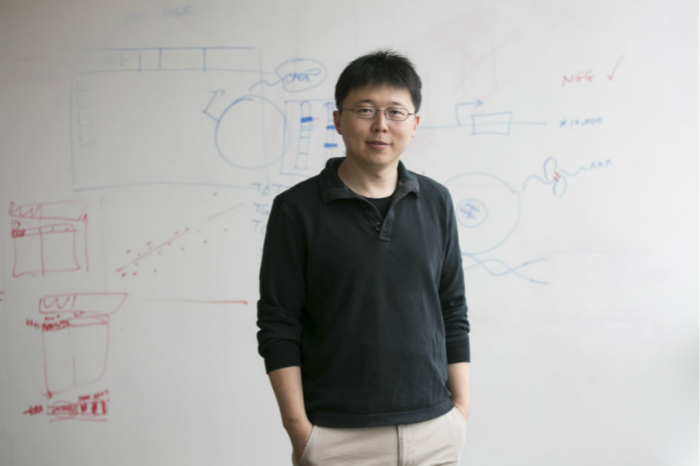
Feng Zhang, Broad Institute of MIT and Harvard, Cambridge, Massachusetts
Cell Engineering
In Des Moines, middle school biology class meant dissecting frogs that reeked of formaldehyde. Thus, the Saturday extracurricular activity in molecular biology became Zhang’sFenga paradise, where the teachers are clever enough to use the movie Jurassic Park to attract teenagers to their activities.
“My parents both work in computer science, so I’ve always been interested in programming,” ZhangFenghe recalled. In that 1993 film, arrogant researchers resurrected long-extinct reptiles by fusing dinosaur and frog DNA, “which made me realize that biology could also be a programmable system.”
An idea began to take shape in his mind. He realized that he could alter an organism’s traits by rewriting its genetic instructions, much like the computer code written by his parents.
In 1995, during his sophomore year at Theodore Roosevelt High School, he was given the opportunity to program living organisms for the first time. The director of a gifted student program asked ZhangFeng, whether I was willing to volunteer at the gene therapy laboratory of the nearby Methodist Hospital after school. “I said of course I was,” ZhangFengHe recalled that although he had “no knowledge” of advanced biology, Dr. John Levy, the laboratory director, was not concerned about his lack of experience.
Every afternoon, Levy would sit in the lounge, sipping tea and casually scribbling on a pad to explain concepts in molecular biology. ZhangFengHe quickly mastered several key technologies and successfully completed his warm-up project: using a virus to introduce the luminescent molecule known as green fluorescent protein, derived from jellyfish genes, into human melanoma cells.
This experiment does not bring dinosaurs back to life, but it has demonstrated the ability to modify the cells of one species to express genes from another, as evidenced by the eerie green glow emanating from the cells. “They’re glowing!” said Zhang.FengRecalling it, he remains thrilled by the scene from 20 years ago.
For the remainder of the year, ZhangFengThis study investigated whether ultraviolet (UV)-absorbing fluorescent proteins could protect DNA from UV-induced damage and carcinogenic effects. He found that fluorescent proteins indeed exert such protective effects, and this experiment subsequently became a project at the Iowa State Science Fair. “This attracted more quirky kids like me,” said Zhang.Fengsaid.
During his junior year, he completed another genetics project on viruses under Levy’s supervision and won third place nationally in the 2000 Intel Science Talent Search, along with a $50,000 scholarship.
“This sparked my interest in HIV treatment,” ZhangFenghe said. This seemed unlikely for a high school student; nevertheless, he halted his research on fluorescent proteins and did not pursue whether blocking ultraviolet radiation could help prevent melanoma. However, he learned a valuable lesson: intriguing scientific discoveries often come to nothing.
After enrolling at Harvard University, he received a full scholarship and conducted research on influenza viruses in the laboratory of Dr. Xiaowei Zhuang, a chemist with a background in chemistry and physics. In 2004, ZhangFengUpon completion of the study, a paper on the cellular infection mechanism of influenza virus was published in a top-tier journal. The key to this discovery was the luminescent jellyfish protein that Mr. Zhang had previously worked with in Iowa.
ZhangFengHis performance in the laboratory was somewhat reminiscent of Julia Child: he could achieve remarkable experimental results, but scenes of turkeys dropping to the floor were a frequent occurrence. In an organic chemistry experiment, he overlooked the prohibition against subjecting acids to thermal reactions. “Everything in the chemical fume hood foamed up and exploded,” he recalled. He and his colleague fled the scene.
There was another experience that had a more lasting impact. ZhangFengZhang once spent several hours helping a classmate with severe depression dissuade them from suicidal thoughts. However, the friend’s depression was so severe that they had to apply to Harvard for a one-year leave of absence. ZhangFengDeeply moved, he devoted himself to the development of psychiatric therapies.
Albert Einstein is renowned for publishing five bewildering discoveries within a single year. ZhangFengIt also entered a period of brilliance shortly thereafter. In June 2004, after graduating, ZhangFengUpon joining the graduate program at Stanford University, he became a member of the laboratory of Karl Deisseroth, a young professor of neuroscience. After graduate student Ed Boyden joined the team, the trio invented optogenetics—a technique that involves implanting light-sensitive proteins into neurons to activate specific neural circuits with light. During this process, ZhangFengA system was developed that uses viruses to deliver exogenous genes into neurons, enabling the expression of light-sensitive proteins.
In 2007, Deisseroth invited journalists to visit ZhangFengExperiments Cultivating Light-Sensitive Neurons in the Mouse Motor Cortex. As expected, after the neurons were activated by light, the mice began to circle. Today, optogenetics is regarded as one of the major achievements in the field of neuroscience, and researchers worldwide are using it to map neural circuits involved in schizophrenia, depression, and autism.
After obtaining his Ph.D., ZhangFeng“began to consider how to easily insert foreign genes into animals, similar to optogenetics,” but this approach needed to be applicable to all animal and plant genes. In 2009, he joined the Harvard Society of Fellows, a renowned haven for “exceptionally independent and highly creative scholars.” Steven Hyman, a neuroscientist at the Broad Institute and former Provost of Harvard University, said, “ZhangFeng“Possessing these two characteristics.”
However, this position did not come with a laboratory. He therefore implored senior scientists at Harvard University to lend him a portion of their lab space. He began researching the most advanced gene-editing technology of the time, which used proteins embedded with “zinc finger” structures to recognize and cut specific DNA sequences. Cells would automatically repair these cuts, incorporating the inserted foreign DNA. Presto: an edited genome. The trouble was that “zinc fingers are extremely difficult to work with,” ZhangFengsaid.
In 2009, scientists introduced another gene-editing technology, TALEs. However, like zinc finger nucleases, TALEs are proteins that are difficult to manufacture. “At the time, I was also teaching students how to construct TALEs, but they had to wait three months before they could actually use them,” said Zhang.Fenghe recalled. As the lead author, he explored, in a paper, TALE proteins that can target specific DNA sequences in human and mouse cells to turn genes on or off. But he was not satisfied with this. “We must come up with better methods for gene editing,” he said.
The term of office for the Scholars Association is coming to an end, ZhangFengHe had to find another job. One day, a neuroscientist at the McGovern Institute for Brain Research at MIT heard Deisseroth speak highly of “a brilliant scientist,” recalled Robert Desimone, director of the McGovern Institute. In collaborative settings like research institutions, a paper typically has only a few authors, “so you’re always curious about who did what,” Desimone said. The McGovern Institute pressed further and eventually learned that “ZhangFengplayed a key role in the development of optogenetics.” He added, “ZhangFeng“The published papers are unmatched by anyone at this stage of their career in the history of neuroscience.” He was hired simultaneously by MIT and the Broad Institute.
In February 2011, a visiting scientist presented his research on bacterial genomes containing immune systems, known as CRISPR, at a Broad Institute advisory committee meeting. “I was sitting in the back of the room, somewhat distracted,” ZhangFenghe recalled. But the unusual acronym immediately piqued his curiosity.
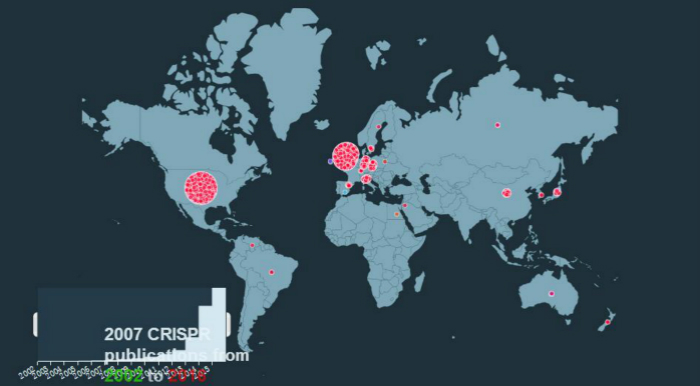
Colored circles indicate CRISPR research publication information.
“I didn’t know what CRISPR was, but after looking it up on Google, I immediately got excited. Fortunately, it was still a nascent field with relatively limited literature.” A few days later, during a scientific conference in Miami, he secluded himself in his hotel room to delve into CRISPR research papers.
He learned that microbiologists had discovered the CRISPR (Clustered Regularly Interspaced Short Palindromic Repeats) system in bacteria, which is used to defend against viruses. The CRISPR system consists of two mechanisms: search and destroy. Genetic material in the form of RNA targets specific DNA sequences, while an enzyme called Cas9 cuts the DNA. Since CRISPR can eliminate the viruses that “spoil the taste of yogurt,” “CRISPR is mainly used to improve the flavor of yogurt.” — ZhangFengsaid.
But Zhang Feng had even loftier ambitions. “We wanted to make CRISPR work inside human cells,” he recalled. In an email to his graduate student, Li Cong, he wrote, “Stay tuned for the show.”
This is a bold goal. Sticking with the more mature TALEs technology would have been a safer bet, but Li Cong wrote in his reply, “Risks are inevitable; we have decided to go all in.”

Zhang Feng Enters the Broad Institute, His Workplace
Crazy Work
“Upon returning to Cambridge, Li Cong ‘immediately understood why Zhang Feng was so excited,’ he said. TALEs had long driven them to frustration; after laboriously synthesizing large quantities of proteins, they discovered that TALEs failed to localize to their targeted DNA sequences. In contrast, CRISPR requires only RNA to recognize specific DNA sequences within the genome. If protein synthesis is likened to building a roller coaster with K’nex, then constructing RNA is as simple as threading beads onto a string.”
Compared with the CRISPR system in bacteria, we believe that the applicability of CRISPR in higher-order cells, such as human and mouse cells, holds greater medical significance. On the office whiteboard, ZhangFengThey listed out the independent experiments they would need to conduct one by one and refined them.
“At first, it was just Professor Zhang and me; we conducted experiments day and night,” said Li Cong. The scientists spent several months testing the Cas9 enzyme, primarily monitoring whether it would accumulate in the nucleus of human cells where the genes are located. Because the origin of the CRISPR system—bacteria—lacks a nucleus, it was essential to ensure that CRISPR could also function effectively in human cells. “We wanted to demonstrate that CRISPR is a revolutionary genome-editing system superior to TALEs,” said Li Cong.
They often work until 11 p.m. or later. ZhangFengWith teaching obligations every day, they only had time to conduct experiments in the evening. During breaks, they would eat ramen, Chinese takeout, or wraps. On one occasion, they even went to ZhangFengof the apartment building, crashing someone else’s party and drinking their first-ever tequila shot. (Each had only one drink, and they still returned to the lab that night.)
Scientists must prove at least two things: that CRISPR can edit genomes in mouse and human cells, and that the edited genomes can function normally. They used ZhangFengSince high school, my favorite approach has been to label genes with green fluorescent protein (GFP) and study the resulting green fluorescence using microscopy and high-end cameras: the more extensively CRISPR edits the fluorescent gene, the less green light the cells emit.
They completed the foundational work in the spring of 2012 and obtained sufficient data to write the paper, ZhangFeng“...he said. But such papers become mediocre as soon as they are published. ‘I don’t want to hastily submit a manuscript the moment I obtain publishable results,’ he said. ‘I aim to publish a paper that creates a splash, rather than racing to be first.’”
“We thought we had plenty of time,” Li Cong recalled. “We didn’t realize the competition would be so fierce.”
In fact, competition is ubiquitous. In June 2012, scientists led by Professor Emmanuelle Charpentier of Umeå University in Sweden, along with Jennifer Doudna from the University of California, Berkeley, proposed the use of CRISPR-Cas9 to cleave target DNA sequences in vitro. In their paper published in Science, they stated that this approach enhanced “the potential of RNA-programmable genome editing technology.”
ZhangFengHe did not feel that others had beaten them to it, as many biochemical techniques effective in vitro are not applicable to human cells. Li Cong still recalls that Charpentier and Doudna published their paper that June, while they had already devised another “completely independent Cas9 genome-editing approach” prior to that: “We had refined these details before publishing our paper,” said Li Cong. ZhangFengThey also included these details in their grant applications, which were submitted before June.
In addition, they also read papers from competitors. The two molecules described in the papers were associated with ZhangFengThe CRISPR-Cas9 system designed by the team is “significantly different” and lacks the “key components” required to construct a genome editing system in living cells.
Thus, they conducted additional work in late summer, collecting extensive data to demonstrate that their system is not only applicable to human and mouse cells but also capable of editing multiple genes simultaneously. In the final sprint phase, ZhangFengHe has recruited more researchers for the ever-expanding experimental team, a practice that colleagues liken to that of high-tech startups: he leverages a killer app to continually draw people into the fray like signalmen pulling troops onto the battlefield. ZhangFengHe emphasized the word “we,” indicating that only his team is capable of editing the human genome.
On October 5, they submitted their paper to Science. In early January 2013, Science published the paper online, along with a shorter article from George Church’s laboratory at Harvard University. ZhangFengDuring his tenure at the Harvard Society of Fellows, he worked in this laboratory. When asked whether he was aware that his mentor was also one of his competitors, ZhangFengStated that they were unaware.
ZhangFengMIT has already faced some negative publicity, becoming a temporary target of ridicule on Twitter after paying $70 to expedite the review of its CRISPR patent application. Rivals have characterized this move as crossing an ethical line, given that Doudna and Charpentier had filed their patent applications several months earlier; however, it remains unclear whether this will influence the final determination of patent rights.
At that time, the patent office employed a system that rewarded inventors who were the first to invent or conceive of novel innovations; ZhangFengThe laboratory notebooks had long been submitted, aiming to prove that his lab was indeed the first—a factor that would ultimately carry far more weight than expedited examination. Under the current “first-to-file” system, the patent might be awarded to Doudna and Charpentier. However, under the former “first-to-invent” regime, MIT obtained a key patent in April 2014 covering the use of CRISPR to edit plant and animal genomes, while ZhangFengListed as an inventor.
Berkeley appealed the decision. It argued that Doudna and Charpentier achieved the key CRISPR breakthrough—specifically, identifying the three critical molecules that enable CRISPR to function—while ZhangFengSuccess in animal cells is merely an extension of their work.
ZhangFengRejecting Berkeley’s argument, he contended that Doudna and Charpentier’s 2012 paper “demonstrated that DNA could be edited in vitro, and it was ‘obvious’ that this approach could be extended to plant and animal cells.” If, as Broad’s critics suggest, this were the case, “then why would the paper have been published in Science, one of the world’s top journals?” he asked. ZhangFengHe stated that in 2011, he sought to use Cas9 to edit animal genomes; however, in human cells, he employed a different RNA design rather than the one described by Doudna and Charpentier.
ZhangFengThis breakthrough helped to open the floodgates of research: the number of scientific papers with “CRISPR” in their titles increased from 90 in 2012 to 741 this year (by count). This is partly attributable to ZhangFeng: He has been using a non-profit tool called AddGene to distribute genes and other substances known as reagents by biologists around the world.
The intense interest reflects the astonishing power of CRISPR in both basic and commercial research. Rarely does any media mention CRISPR without including the term “designer babies.” This technology is inherently applicable to any cell, including human eggs, sperm, and embryos. Individuals born through such “germline engineering” will carry Genome 2.0, as will their descendants. It has also sparked fervent speculation about using gene editing to enhance personality, cognition, behavior, and physical traits.
In April, widespread debate erupted when Chinese scientists reported using CRISPR to edit the genomes of nonviable embryos created through in vitro fertilization. Next month, the U.S. National Academy of Sciences will convene an international summit on genome editing, addressing its prospects, risks, and regulatory needs.
October, ZhangFengHe described his work to the National Academy of Sciences, emphasizing that his laboratory and Editas Medicine, a company he co-founded, are developing CRISPR-based therapies primarily targeting somatic cells, such as editing genes in blood cells to cure sickle cell disease. This would be highly revolutionary, making it possible to instantly change a person’s life, he said.
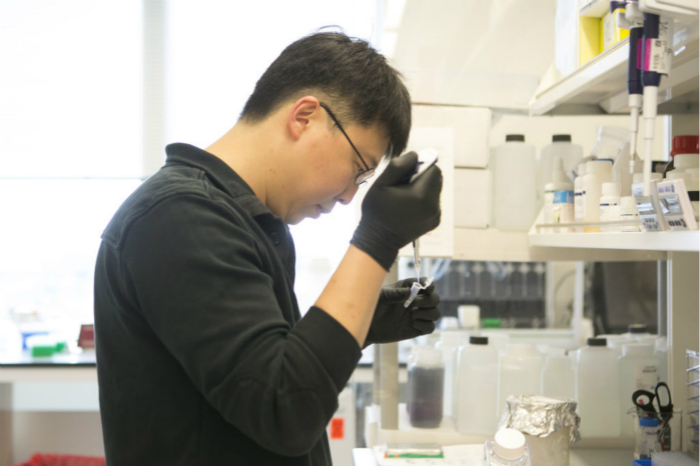
Feng Zhang is conducting an experiment in a laboratory containing DNA and RNA.
Everything in the lab happened quickly.
More than anything else, what stands out most about Feng Zhang is his prodigious output. Since his groundbreaking 2013 paper on CRISPR, he has published an additional 38 papers. Zhang often joyfully pipettes solutions alongside his young colleagues late into the night, then “returns to the lab after having dinner with his family.” His wife, toddler daughter, and parents share a small apartment located just one mile from the Broad Institute. Postdoctoral researcher Naomi Habib remarked, “He can hardly wait until morning to see the experimental results; he sets an example. He never monitors our hours, yet he inspires us with his passion.”
When Habib told ZhangFeng, when she became pregnant with her second child—a piece of news that typically elicits annoyance or even irritation from many laboratory leaders, regardless of gender—Zhang Feng arranged for a technician to take over her experiments, ensuring their continuation during her absence.
ZhangFengHe often praised other scientists, even those at the bottom of the laboratory hierarchy. In 2014, when he and his colleagues designed a new CRISPR-associated protein, he named it SAM, which literally stands for “Synergistic Activation Mediator,” but was actually an acronym derived from the first letters of the surnames of the three students who conducted the research. “We had to come up with a fancy name to please the reviewers,” said Zhang.Feng“and SAM is exactly that.”
He possesses an extraordinary ability to recognize the potential of an idea, as he did when he first heard about CRISPR. In May, a scientist attending a genetic engineering conference hosted by the Broad Institute mentioned that some bacteria might use DNA-cutting enzymes other than Cas9. Later, ZhangFengHe happened to walk over to one of his graduate students, Bernd Zetsche, and asked, “Are you busy?” Zetsche looked bewildered and stammered, “Uh, what?” Of course, this was because he was busy working on a project. But ZhangFengRedirected his focus to engage him in the latest brainstorming session.
In September, they published a paper describing a new member of the molecular scissors family that can be used to edit human and other genomes. “Somehow, everything in the lab happened so quickly.” Zetsche was still somewhat overwhelmed by the astonishing speed of this transformation.
Despite ZhangFengWidely recognized for his work on CRISPR, he views it merely as a means to achieve his true goal: leveraging genetics to understand and ultimately treat mental illness. ZhangFengHalf of the laboratory’s research is focused on brain studies. “What drives me is the possibility of truly transforming outcomes for autism, depression, schizophrenia, and other serious conditions,” said ZhangFeng“He said, ‘All the things that diseases of this kind take away—such as the ability to feel joy, to engage in meaningful social relationships, and to think clearly and deeply—are each a vital part of who we are.’”
At the most recent laboratory meeting, Habib presented experimental results via PowerPoint to more than thirty attendees seated around a long conference table. The experiment measured which genes among tens of thousands were active in which brain cells. Although ZhangFengHe did not dominate the conversation, but he was one of the focal points, as he needed to ensure that the significance of their experimental findings was fully disclosed to the public.
“To make it easier for the public to understand, some of the illustrations we created lack sufficient visual impact,” he suggested. “It would be ideal if they could accurately convey the message that ‘we can do this, and it is important.’ Always treat your audience as high school biology students rather than your peers,” said Zhang.Fengthe secret.
"If the world doesn’t know you’ve made a breakthrough, then in reality, you haven’t," he told his colleagues.Before achieving his ultimate goal, Feng Zhang will undoubtedly exhaust every possible approach. The fame and fortune brought by CRISPR technology may be merely one of the passing sights along his journey.