

Internet Hospital Revenue Hits 800 Million Yuan: Has WeDoctor Achieved a Viable Business Model?

Over the course of one year, national health news generated 15.3 billion headline impressions;
Within one year, a startup completed three rounds of financing;
In one year, a certain enterprise successfully transitioned from B2C to B2B;
In just one year, internet hospitals have evolved from a nascent concept into a completely new business model.

We are delighted by the emergence and growth of internet hospitals, yet concerned about the thorns and mud on the unknown road ahead. Since VCBeat and Tencent Research Institute jointly released“2016 China Internet Hospital White Paper”Subsequently, many people have been asking: What exactly is an internet hospital? Is there a standard definition? How can one establish an internet hospital? And furthermore, how can an internet hospital be operated effectively?
In the face of these challenges, how did WeDoctor, the pioneer behind the Wuzhen Internet Hospital, approach its thinking and practice?
Over the course of one year, growing from 1 to 17, the most fundamental change has been the shift from passive to proactive.
From the perspective of qualification acquisition, Wuzhen Internet Hospital, established on December 7, 2015, should be regarded as the first internet hospital in the true sense.
One year later, on December 8, 2016, the Ningxia Internet Hospital was launched as the 17th internet hospital, marking that WeDoctor’s “32+1” initiative had reached its halfway point, with coverage across China expanding at a rate of more than one hospital per month.
From the 1st to the 17th: What Changes Have Occurred in Internet Hospitals?
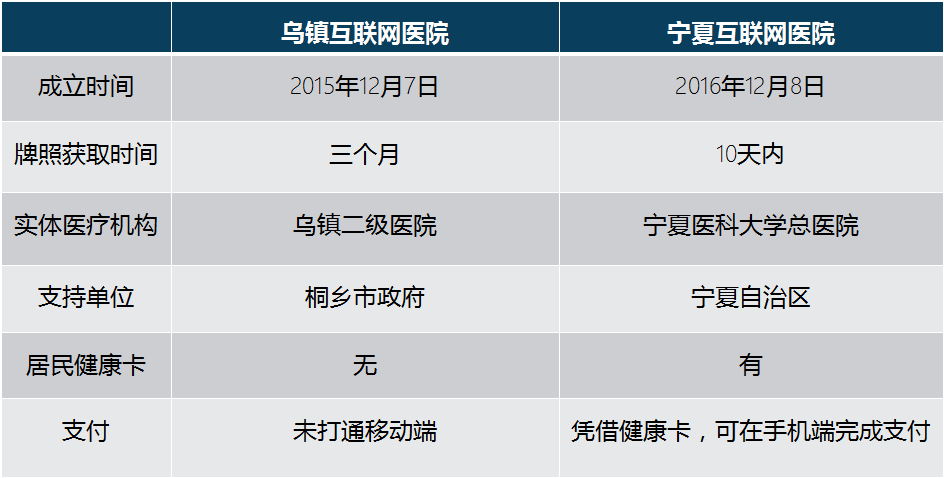
As can be seen from the table above,The licensing process for internet hospitals has been gradually liberalized, with governments and large hospitals shifting from a passive to a proactive stance as they actively explore the value and advantages of online healthcare. Meanwhile, internet hospitals have achieved further development in both the breadth and depth of their connectivity.
The Three Essential Hardware Components for Establishing an Internet Hospital: All Are Indispensable
Liao Jieyuan believes that,An internet hospital is essentially an online service platform built upon a physical medical institution.Merely offering a telemedicine service on a hospital’s official website does not qualify it as an “Internet Hospital” or “Online Hospital.” Therefore, an Internet Hospital must meet the following three mandatory criteria:
1. An internet hospital must be a compliant medical institution.
2. The establishment of an internet hospital requiresDedicated professional medical personnel and management team.
3. Internet hospitals mustTo have an ultra-strongSupported by an IT platform.
Understanding Core Values Is Key to Successfully Operating an Internet Hospital
Liao Jieyuan believes that mutualThe true core value of internet-based healthcare lies not merely in online consultation and diagnosis services; rather, its genuine contribution to the healthcare system should be to deliver efficient, continuous, and proactive health gatekeeper services via the internet, thereby facilitating the upgrade of efficacy and service models across the entire healthcare system.
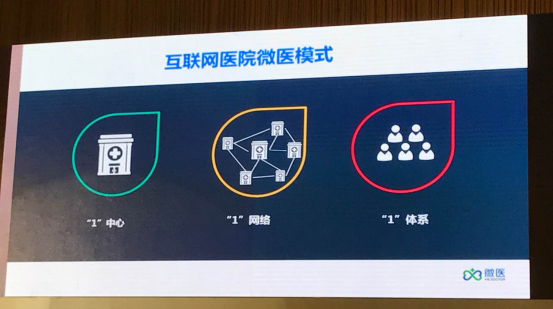
WeDoctor summarizes it as the “Three Ones” model:
The first oneI. That is,One Center, by leveraging the Internet to break down barriers, it integrates the medical resources of national and even international experts with those of this central hospital, and then extends these resources to primary healthcare institutions in the region where this medical facility is located.
Second"One," namelyOne Network. Each internet hospital collaborates with local governments to streamline network connectivity, enabling data interoperability between large and small hospitals through integrated digital networks.
Third"One," namelyA System. In layman's terms, it is“Health Gatekeeper” Service System. The state is currently vigorously promoting industry development, aiming to transition from the past model of passive medical care to proactive, outreach-based health management. Only by leveraging the internet can data be accumulated first, thereby enabling one-to-many communication and improving service efficiency.
Furthermore, to sustain the vitality of internet hospitals, it is essential to adhere to independent innovation. Currently, WeDoctor’s innovative practices in the development of internet healthcare include precise appointment scheduling, the “Find a Doctor” feature akin to an Uber-style medical service, the “Yi Yan Tang” platform for doctor-patient interaction, and its online pharmacy-consultation service that connects patients with a physician within 35 seconds.
The optimal model balances the interests of all stakeholders across the industry value chain.
As of now, WeDoctor has established a closed-loop system in its exploration of internet hospitals and achieved commercial monetization.
Currently, only Sichuan Internet Hospital has launched a pilot program for medical insurance payments, with certain restrictions on covered services. While WeDoctor appears to have established a closed-loop system and built extensive connections, further clarification is needed regarding the depth of integration across the three key segments—medical care, pharmaceuticals, and insurance—particularly concerning medical insurance payment methods and standards. Continuous exploration and trial-and-error are required to identify the optimal balance among these components, thereby creating the most effective model. Meanwhile, challenges such as cultivating the internet hospital market, addressing misdiagnoses arising from online consultations, and preventing medical data breaches still need to be resolved.

A reporter asked, “What will hospitals of the future look like?” Liao Jieyuan replied, “The Hospital of the Future Is a Hospital Without WallsIn the past, all hospital information circulated only within the hospital premises; interactions between doctors and patients occurred entirely within these walls, and physicians were limited to those on staff. The so-called “hospital without walls” refers to a model that integrates both in-house physicians and external practitioners. By leveraging various forms of remote consultation and referral services, external physicians can be seamlessly connected with in-house medical teams.
Perhaps the future definition of internet hospitals can be glimpsed from here.