

CMS Launches Public Drug Expenditure Data Initiative to Foster Value-Based Reimbursement
Recently, expenditures for various drugs covering specific treatments under the U.S. Medicare and Medicaid programs have become publicly accessible. The Centers for Medicare & Medicaid Services (CMS) has released this information to promote data transparency.
The Centers for Medicare & Medicaid Services (CMS) has released information on 2015 Medicare spending rates for Part B and Part D drugs to fulfill its new commitment to data transparency. Meanwhile, CMS is continuously updating its drug pricing files, which include 2015 drug expenditure data, as part of its efforts to enhance transparency in prescription drug spending data.
In the new online information table, the CMS provides prescription drug information for three categories within Part B and Part D drugs: drugs with high out-of-pocket spending by individual beneficiaries, drugs with high overall Medicare plan spending, and single-drug classes with increased consumption in recent years. This online information table allows users to query data on drugs prescribed by physicians in office or outpatient settings, as well as drugs typically purchased directly by patients.
The 2015 drug expenditure data table provided by CMS presents information on 80 drugs that met the criteria following review. Of these 80 drugs, 40 are covered under Medicare Part D prescription drug plans, while the other 40 are administered by physicians and other healthcare professionals under the Medicare Part B fee-for-service program. The online data table displays relevant expenditure, utilization rates, and trend data for these drugs, as well as consumer-useful information such as product descriptions, manufacturers, and clinical indications. Drugs may be selected in the corresponding categories if they meet any one of the following criteria:
a.Top 15 Drugs by Highest Total Expenditure;
b.The top 15 drugs with the highest average annual expenditure per patient among those on monotherapy (exceeding $10,000 per person per year), which also had the highest overall consumption across the entire plan (drugs meeting criterion A are excluded from criterion B);
c.Top 10 Drugs with the Highest Average Annual Growth in Consumption from 2014 to 2015 (If a drug meets criterion a or b, it is excluded from c).
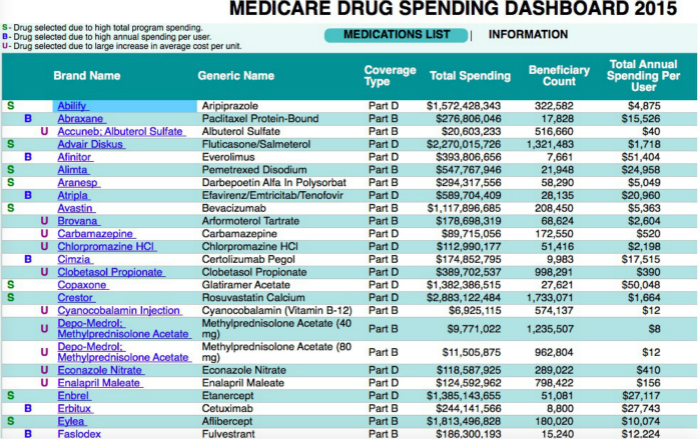
2015 Pharmaceutical Consumption Information Table (S - Planned High-Expenditure Drugs, B - High Annual Average Expenditure Drugs for Single-Patient Users, U - Single-Class Drugs with High Expenditure Growth)
One of the benefits of this information table is that it makes trends in drug spending for Medicare beneficiaries and plans managed by CMS fully transparent to healthcare institutions, consumers, and the public.
Although the drugs listed in the information table represent a relatively small portion, they account for a significant proportion of the total expenditure plan, comprising 34% of the total spending on Tier D drugs and 69% of the total spending on Tier B drugs. These figures are very close to the percentages reported in the 2014 drug information table.
Total spending on Part D drugs increased by $15.9 billion from 2014 levels, whereas total expenditures on Part B drugs rose by only $3.1 billion. Meanwhile, the prices of certain medications, such as metformin used for diabetes treatment, surged by hundreds of percentage points in 2015.
However, prices for Class B and D drugs—which have the highest overall expenditure rates and cover the largest number of Medicare beneficiaries—remained relatively stable, with average growth below 20%. In contrast, total spending on the top 15 Class D drugs, which accounted for nearly one-quarter of plan expenditures, rose from $29.1 billion in 2014 to $35.6 billion in 2015. By comparison, although the top 15 Class B drugs by total consumption represented 53% of plan spending, their expenditure increased by only $1.6 billion over the past year.
In 2015, the five Part D drugs with the highest total expenditures were Spiriva (tiotropium bromide, for chronic obstructive pulmonary disease), Advair Diskus (fluticasone/salmeterol, for asthma and chronic obstructive pulmonary disease), Crestor (rosuvastatin calcium, for high cholesterol), Lantus/Lantus Solostar (insulin glargine, for diabetes), and Harvoni (ledipasvir/sofosbuvir, for hepatitis C virus). Meanwhile, Advair Diskus and Crestor were also among the top five in total Part D expenditures in 2014, whereas Spiriva, Lantus, and Harvoni did not appear in the 2014 data table.
Harvoni is a medication used to treat chronic hepatitis C and is classified as a Tier 4 drug under Medicare Part D. The disparity in spending on this drug between 2014 and 2015 was the most significant. This was primarily because Harvoni was not launched until October 2014, resulting in relatively low expenditure in that year. However, due to its superior efficacy, it quickly gained favor among physicians, leading to cumulative sales reaching $7 billion in 2015. In contrast, Sovaldi, Harvoni’s main competitor, made headlines in 2014 for its high patient out-of-pocket costs and limited durability of treatment response. Its expenditure in 2015 amounted to $1.3 billion, representing a 1% decline.
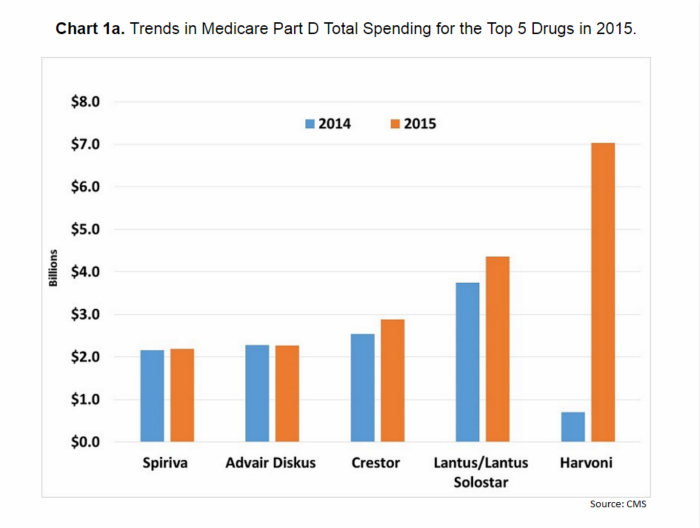
Trends in the Top Five Drugs by Total Part D Spending in 2015 (Compared with 2014)
Among Medicare Part B drugs, the top five by total spending were Lucentis (ranibizumab, for treating wet age-related macular degeneration), Remicade (infliximab, for treating rheumatoid arthritis), Neulasta (pegfilgrastim, a white blood cell stimulant used in cancer treatment), Rituxan (rituximab, for cancer treatment), and Eylea (aflibercept, for treating wet age-related macular degeneration). These five medications were exactly the same as the top five Part B drugs by total spending in 2014, with each accounting for more than $1 billion in expenditures under the Medicare Part B drug program.
Glumetza, Hydroxychloroquine Sulfate, Pennsaid, Econazole Nitrate, and Propranolol HCL were the five drugs with the fastest growth in per-class expenditure in 2015. Among them, Glumetza (metformin HCl, for diabetes treatment) saw the largest increase, exceeding 380%, with its total expenditure rising from $34.3 million to $153 million. The per-unit expenditure for all five of these Tier D drugs increased by more than 100%. Among Tier B drugs, expenditure on mitomycin (a generic chemotherapy drug) increased the most, by 163%, with total spending rising from $5.9 million to $15.8 million. The other four Tier B drugs experienced smaller growth, ranging from approximately 25% to 40%. Although EpiPen was not included in the data table (its expenditure peak occurred in 2016), CMS reports indicate that Medicare and Medicaid spending on EpiPens increased by more than 500% from 2011 to 2015.
The 2015 Medical Insurance Drug List included 23 drugs not listed in the 2014 list—14 Category D drugs and 9 Category B drugs. Among the 14 Category D drugs, only one was newly added in 2015 based on the principle of highest total expenditure (a); this drug is Xarelto, which has anticoagulant effects.
On the other hand, based on the principle of the greatest increase in drug expenditure per patient (b), nine Class B drugs were newly added. Among these nine drugs, Prevnar-13 (pneumococcal 13-valent vaccine) was included in the category with the highest total expenditure (c). Additionally, six new drugs were included in the category with the largest annual increase in expenditure for a single drug class.
Although the publication of special information such as rebates or other price concessions from drug manufacturers has been prohibited, CMS will still release an advanced summary of discount information for Part D drugs for the year 2015. “Although we can only publish aggregated data on manufacturer rebates, IWe believe that the release of this information will help to expose the relationship between drug pricing and the overall cost of health insurance programs.”, CMS explained, “Furthermore, the information table displays critical data that serves as the basis for Medicare beneficiaries during the cost-sharing and benefit determination phases (such as the deductible phase, coverage gap phase, etc.).”
Beyond the goals of public data transparency and the potential educational value of disclosed information, these data can also facilitate drug development and spark public discourse on how pharmaceuticals are incorporated into health insurance coverage and their impact on out-of-pocket costs for insured individuals.。
Furthermore, the 2015 Medicaid expenditure data is presented in greater detail on the information sheet. Users can view the number of prescriptions issued in 2015, as well as the total expenditure per prescription, itemized costs, and expenditure growth.
Some drugs saw a more significant increase in Medicaid spending than in Medicare spending. For instance, spending on Ativan (lorazepam) under Medicaid increased by 1,264% within one year, while spending on pyrimethamine, used to treat toxoplasmosis, rose by 874%. However, neither of these two drugs is commonly prescribed by physicians. Price fluctuations for the top ten most frequently used Medicaid drugs remained relatively moderate, consistent with those observed in Medicare Part D medications.
CMS has prioritized enhancing data transparency to usher pharmaceutical manufacturers and healthcare providers into a value-based reimbursement environment.The agency has also previously released an unprecedented volume of materials on healthcare services, including data on health insurance reimbursement, hospice care, home care, clinical nursing, and individual prescribing practices.
CMS has now updated its Big Data Tools (the Market Saturation and Utilization Data Tools for 2015 and 2016) and released hospice payment information for 2014 (issuing the 2014 “Hospice Services and Public Use File,” i.e., the Hospice PUF). Niall Brennan, CMS Chief Data Officer, stated, “These hospice data, along with the Market Saturation and Utilization Data Tools, advance our goal of increasing access to Medicare data and enhancing information flow.”