

Four Key Strategies to Advance Healthcare Reform through a Comprehensive National Medical Insurance System
The 2016 Peking University Health Economics Forum, hosted by the China Center for Health Economic Research at Peking University and the Professional Committee on Pharmacoeconomics of China, and co-organized by the China Health Service Development and Reform Alliance and the Langrun Liren Medical Association of the National School of Development at Peking University, was held at Langrun Garden, Peking University, on December 10, 2016. VCBeat (WeChat ID: vcbeat) provided follow-up coverage.
As an academic think tank dedicated to research on China’s healthcare policies and health economics, the China Center for Health Economic Research at Peking University was established in 2003. Grounded in empirical economic research, the Center focuses on conducting economic evaluations of national healthcare reform policies and pharmaceutical and medical technologies. Its mission is to enhance the allocative efficiency of healthcare resources, improve the national healthcare and health service systems, and promote public health as well as socioeconomic development.
The forum boasted an impressive lineup of high-profile attendees, including heads of central and local authorities responsible for health, medical insurance, finance, and development and reform; leading academics in the field of health economics and policy evaluation; and industry leaders from hospitals, pharmaceuticals, and healthcare sectors. The Wan Zhong Conference Hall at the National School of Development was packed to capacity throughout both the morning and afternoon sessions.
This forum conducted in-depth discussions on the various facets of how the universal health insurance system promotes healthcare reform and the Healthy China initiative.
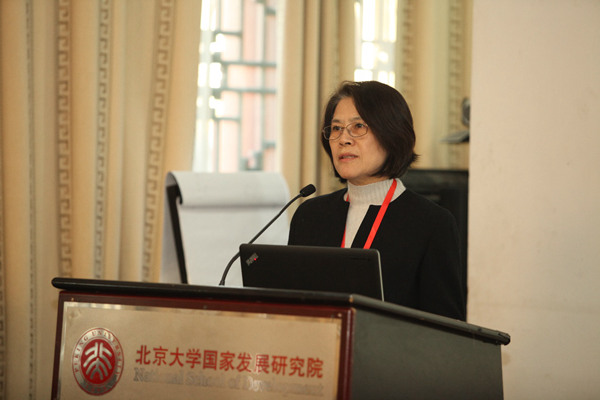
Ke Yang, Executive Vice President of Peking University
First, Ms. Ke Yang, Executive Vice President of Peking University, delivered the opening address. According to President Ke, although China’s medical insurance system has taken shape, it remains in an early stage of development, with many institutional and structural challenges yet to be resolved. Peking University boasts not only an excellent medical education system but also a group of top-tier economists in the field. Reforming the medical insurance system requires joint efforts from both the academic community and government policymakers.
Subsequently, the keynote speakers delivered insightful presentations, which can be broadly summarized into the following four key areas.
I. Integrating Health into All Policies:Yao Jianhong, Deputy Director of the Department of System Reform under the National Health and Family Planning Commission (NHFPC), provided a comprehensive interpretation of the Outline of the Healthy China 2030 Plan. He emphasized that the future focus of national health work will shift from being treatment-centered to health-centered, further reaffirming the government’s determination and confidence in implementing relevant policies. Chang Jile, Inspector General of the Bureau of Disease Prevention and Control under the NHFPC, shared that in the development of Healthy China, universal participation and shared benefits are key; health should be integrated into all policies and into the daily lives of all citizens.
II. Overview of the Development of China’s National Medical Insurance System:Huang Huabo, Deputy Director of the Social Insurance Management Center under the Ministry of Human Resources and Social Security (MOHRSS), systematically outlined the current status of China’s medical insurance system, as well as the framework for nationwide networking and cross-regional settlement. Yao Qinghai, President of the Insurance Society of China, presented perspectives on the reform of the national medical insurance system from the standpoint of commercial insurance. Jin Weigang, Director of the Institute of Social Security under the MOHRSS, emphasized that further deepening the reform of medical insurance payment methods is essential to driving healthcare reform, strengthening the coordinated development of medical care, health insurance, and pharmaceuticals (the “Three-Medical Linkage”), and ultimately leveraging the foundational role of medical insurance in healthcare reform.
III. Sharing of Experiences in Local Medical Insurance System Reform:Director Du Xin of the Beijing Medical Insurance Center outlined the evolution of medical insurance payment system reforms in Beijing, detailing practical experiences with global budget control and global prospective payment methods. Deputy Director Wei Renmin of the Qingdao Municipal Health and Family Planning Commission shared Qingdao’s practical experience with long-term care insurance. Through innovative promotion of long-term care insurance, the efficiency of medical insurance fund utilization has been significantly improved, making it a model worthy of broader replication in other regions.
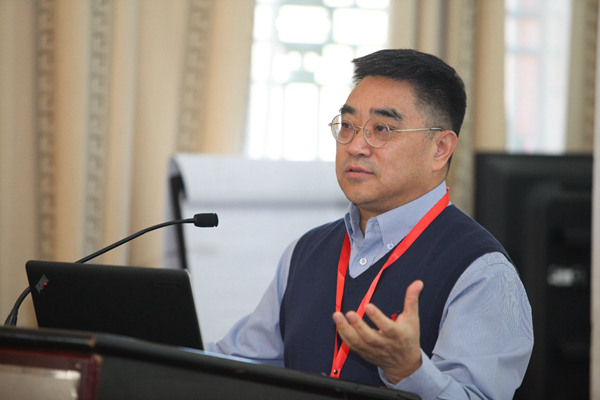
Professor Liu Guoen, Changjiang Scholar of Economics at the National School of Development, Peking University
IV. Reflections on Healthcare Reform and the Medical Security System from a Market Perspective:Professor Liu Guoen, a Changjiang Scholar of Economics at the National School of Development, Peking University, outlined the challenges facing China’s national healthcare reforms and the universal health insurance system. He pointed out that the improvement and development of the medical insurance system will play an irreplaceable and pivotal role in the transformation of China’s economic growth. Reforming the medical insurance payment system is key to initiating healthcare reforms based on tiered diagnosis and treatment as well as specialized division of labor and cooperation.President Chen Zhongqiang of Peking University International Hospital discussed the challenges posed by the medical insurance payment system to privately funded healthcare institutions. He proposed establishing a fair and reasonable medical insurance reimbursement mechanism and implementing a price-based service procurement system that truly reflects costs, thereby ensuring that public and private hospitals compete and develop on a level playing field.Director Zhao Kun from the Health Technology Assessment Office of the Center for Health Development Research under the National Health and Family Planning Commission introduced how to improve the efficiency of resource allocation by advancing health technology assessment.Deputy Director Zhu Hengpeng of the Institute of Economics at the Chinese Academy of Social Sciences discussed the relationship between the public welfare nature of medical services and market mechanisms. He pointed out that the current insufficiency in the public welfare orientation of China’s medical services is caused by excessive administrative intervention and inadequate marketization. Citing the healthcare reforms in Suqian and Sanming as examples, he demonstrated the need to further promote marketization in the healthcare service sector.
Deputy Director Yang Hongwei of the Health Development Research Center under the National Health and Family Planning Commission, former President Zhu Shijun of the PLA General Hospital (301 Hospital), and Vice Chairman Wu Jiuhong of the Chinese Committee of Pharmacoeconomics served as chairs for different sessions and provided insightful commentary.
Following the insightful presentations by distinguished experts, the session transitioned to a roundtable discussion. The Professional Committee on Pharmacoeconomics of China conducted an in-depth deliberation on the theme “Advancing Pharmacoeconomic Research in China to Better Promote the Development of the National Medical Insurance System.” This forum not only provided participants with comprehensive insights into the most current national healthcare reform policies and a profound appreciation of the government’s confidence and determination in reforming the universal medical insurance system, but also facilitated the sharing of successful implementation experiences from various regions. Undoubtedly, it was a forum that bridged macro-level strategy with micro-level execution, closely aligning with public welfare concerns.