

Guanzhong Cloud Health Files IPO Prospectus to Build an Intelligent Healthcare Cloud Ecosystem
As the interview was drawing to a close, Lao Pang (this marked the first time we decided to address an interviewee by name within less than an hour) leaned back comfortably into the sofa, rubbed his hands outward, and said to the reporter, “This is essentially my vision. Do you think it can work?” Before the reporter could offer any comments, Lao Pang added, “Expansion on the consumer side (C-end) is relatively straightforward, whereas penetrating the business side (B-end) is more challenging. However, only by resolving the expansion challenges of the B-end in internet hospitals can we build a true ecosystem and platform.”
During a break at the inaugural meeting of the Shanghai Medical Internet Healthcare Specialty Committee, we took the opportunity to speak with the founder of Guanzhong Yunyi, the company providing technical support and operational services for Xuhui Cloud Hospital, Shanghai’s first internet hospital. His vision is to connect as many offline hospitals as possible, migrate the consultation process online, and leverage software and hardware tools—such as mobile apps and micro-consultation devices—to optimize patient care workflows. This approach aims to help hospitals attract patients and implement tiered diagnosis and treatment. Meanwhile, Guanzhong Yunyi intends to generate revenue from its platform and ecosystem by expanding into elderly care, chronic disease management, and health companion services, thereby achieving a closed-loop business model.
In 2016, widely regarded as the “Year One of Internet Hospitals,” launches of internet hospitals and online hospitals across various regions were announced one after another. However, apart from platform-based companies such as Haodf, WeDoctor, and Ali Health, few people paid attention to the healthcare IT firms that provided technical support for these digital initiatives. Amidst the clamor, their perspectives on internet hospitals may have differed slightly from those of platform enterprises, as they sought to carve out a distinct path.
Before meeting with Mr. Pang, his Chief Architect, Hu Nanfang, delivered a keynote speech titled “The Architecture of the Smart Cloud Sky.” In the words of this data expert with a purely technical background, the vision for Guanzhong Cloud Medicine was described as “grassland, sky, and universe.” The grassland refers to the Guanzhong Cloud Medicine Health Platform; the sky represents tens of thousands of cloud hospitals; and the universe encompasses big data in healthcare and medicine, including artificial intelligence, precision medicine, specialized disease management, and voice and semantic recognition. The event host jokingly remarked that although he came from a technical background, his language was quite poetic. In the “Health Cloud Sky” architecture diagram that Mr. Pang sent us the following day, these components were clearly identified. Beyond the poetic language, the PowerPoint-style presentation also reflected the aesthetic sensibilities typical of technology companies.
In simple terms, Lao Pang’s objective is to connect as many offline medical institutions as possible—including Tier-3 and Tier-2 hospitals, community clinics, and pharmacies—and migrate portions of their operations online, such as online consultations, e-prescriptions, remote imaging, and appointment scheduling. Taking this a step further, the Guanzhong Cloud Medical platform facilitates collaboration among these institutions, enabling upward and downward referrals, tiered diagnosis and treatment, and chronic disease management. By integrating pharmacies, the platform also supports pharmaceutical e-commerce and O2O medication delivery services. For consumer-facing (C-end) users, in addition to mobile healthcare solutions, health management features such as medication reminders can be delivered through hardware devices like “Health Companion.” These functionalities are integrated into a cohesive ecosystem that covers the entire journey of personal and family healthcare, from daily medication management to appointments and consultations for major surgeries. The service providers are the various levels of medical institutions connected to this “universe,” while Guanzhong Cloud Medical serves as the information integrator.
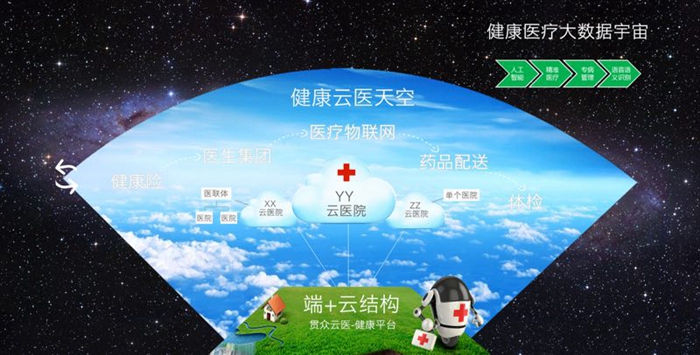
The concept of Guanzhong Cloud Medicine can be viewed as an “enhanced version” integrating doctor-patient communication, internet hospitals, pharmaceutical e-commerce, and the Internet of Medical Things (IoMT) for devices. A direct barrier to entry is determining how many offline institutions must be onboarded to complete this closed loop and enable users across various regions to access a one-stop, end-to-end service for medical consultation and medication. The answer is: as many as possible.
Examining each component individually, the essential equipment required for light consultations includes video transmission tools, basic diagnostic tools, and imaging transmission tools, with physician resources being even more critical. Initially, this involves simple second-opinion consultations and health status communications for patients on long-term medication. In the case of Xuhui Cloud Hospital, which is technically supported by Guanzhong Cloud Medicine, the hospital provides medical resources comprising no fewer than 10 attending physicians per day, with consultation hours lasting at least eight hours daily, thereby ensuring that online consultations are adequately staffed with physicians. Furthermore, when basic diagnostic equipment is needed, it is impractical to require users to bring their own devices. Deploying micro-consultation equipment in community hospitals, clinics, and pharmacies is a viable strategy; this approach not only improves equipment utilization rates but also increases patient volume at primary healthcare facilities.
When patients’ diagnostic and treatment needs exceed the capabilities of primary care and remote assisted diagnosis, upward referral becomes necessary. Thanks to prior communication, patient intake at secondary (Grade II) and tertiary (Grade III) hospitals becomes simpler and faster, thereby saving referral time. Lao Pang has his own clear perspective on what telemedicine and internet hospitals can achieve: “Internet hospitals cannot treat every condition. When upward referral is required, you need resources to facilitate seamless handoffs, ensuring that the diagnostic and treatment process remains controllable and that pathological issues are properly addressed,” said Lao Pang.
Once hospital-based diagnosis and treatment are completed, cloud medicine can provide follow-up visits, ongoing monitoring, and post-diagnosis rehabilitation, which patients can complete remotely without visiting the hospital, thereby simplifying the care process.
Of course, the general internet hospital platforms mentioned above can all achieve this. So, what is Lao Pang’s trump card? First, it lies in the number of connected medical institutions. Users from various regions with diverse needs can resolve their issues through the Guanzhong Cloud Medical platform. Internet healthcare has become a supplement to medical resources; while the original institutions still provide the medical services, both efficiency and processes have been significantly improved. Second, it involves connectivity with pharmacies, rehabilitation and physiotherapy centers, and other entities. “By combining electronic prescriptions with offline pharmacy delivery, medications can arrive at your home before you do after the initial consultation. For follow-up refills, there is no need to travel back and forth between the hospital and the pharmacy—online follow-up consultations paired with offline medication delivery,” said Lao Pang.
In fact, moving medical resources online is also a key focus of policy guidance. The “Guiding Opinions on Promoting the Construction of a Tiered Diagnosis and Treatment System” issued by the General Office of the State Council clearly stated that by 2020, a complete tiered diagnosis and treatment system should be established to achieve initial diagnosis at primary care institutions, two-way referrals, separate management of acute and chronic conditions, and coordination between different levels of healthcare providers. More recently, with various provinces and regions proposing guidelines for the construction of internet hospitals and incorporating online consultations into medical insurance coverage, internet hospitals are receiving increasing policy support.
“Current internet hospital platforms are essentially consumer-centric, as expanding on the consumer side is relatively easier. However, internet hospitals must adopt a business-centric approach. Only by connecting with a sufficient number of healthcare institutions and migrating portions of their operations online can internet-based healthcare evolve into a comprehensive system, rather than remaining merely a technological tool,” said Lao Pang.
From this perspective, more than 20,000 hospitals, hundreds of thousands of clinics, and pharmacies across China should be interconnected through a unified network to ensure the operational feasibility of internet-based diagnosis and treatment, medication services, and health management for enrolled users.
Do standalone internet hospitals generate profits? The answer is likely no. Since the launch of Wuzhen Internet Hospital, nearly 30 internet hospitals have been put into operation, yet few have disclosed their revenue figures. A key reason for this opacity is probably that internet hospitals are not profitable. Currently, the internet hospital sector has entered the latter stage of rapid market expansion and consolidation. Whether operated primarily by physician groups or co-established with governments, the profitability model of internet hospitals remains questionable. Guanzhong Cloud Med’s approach is to address the platform’s profitability challenges by integrating pharmaceutical e-commerce, chain pharmacies, chronic disease management, and medical devices.
Regarding pharmaceutical e-commerce, as previously mentioned, Guanzhong Yunyi’s ecosystem will incorporate online medication purchasing and offline delivery services. Once these two business segments are operational, profits are indeed promising. In fact, many internet hospitals are currently venturing into the pharmaceutical sector; conversely, pharmaceutical e-commerce platforms are also expanding into internet hospital services. The connection between medicine and healthcare is inherent, and the higher-margin pharmaceutical segment will become a key focus of competition in the next phase. Ultimately, all models will evolve toward comprehensive functionality.
Furthermore, Old Pang has placed high hopes on medical devices and equipment. In his vision, introducing these devices can serve as an entry point for home health management, enabling the acquisition of a large base of long-term users and fostering stickiness across the consumption cycle.
“Providing medical devices is certainly better than simply giving away health supplements, especially for the elderly and patients with chronic diseases; this is also an integral part of the ‘Big Health’ concept.” Is there an established benchmarking concept for the type of entry-point devices mentioned by Lao Pang? The Internet of Things (IoT) may be the best descriptor, or more specifically, the “Internet of Medical Things” (IoMT). More important than the devices themselves is the integration of medical resources. Guanzhong Cloud Medicine’s “universe” will serve as the technical backend for these devices, adopting a business model that combines device coverage with long-term service fees.
Chronic disease management and specialized disease management have also become key strategic focuses for pharmacies, pharmaceutical e-commerce platforms, and medical device companies. Data shows that patients with chronic diseases account for 20% to 30% of pharmacy foot traffic, representing a stable, long-term customer base. If health monitoring devices can be introduced to provide long-term coverage for patients with chronic and specialized conditions, both pharmacies and hospitals will eagerly seek collaboration opportunities.
The device has already entered the R&D phase. As the R&D team has primarily been engaged in developing devices for specialized disease management, the product is expected to be launched soon. In fact, most members of Lao Pang’s team have experience in the healthcare sector, and their professionalism ensures that the product will not suffer from the pitfalls of “amateurs attempting expert work.”
So, how effective is this entire system, from hardware to the Wanjia Cloud Hospital? Insights can be gleaned from the data of the Xuhui Cloud Hospital. According to Mr. Pang, since its launch last October, the Cloud Hospital APP has increased patient traffic for the Xuhui District Central Hospital by tens of thousands and boosted revenue by approximately 30%, while alleviating the strain on hospital medical services. “In fact, the primary function of internet technology is to address efficiency issues. Enabling the public to access medical care more conveniently is also one of our key objectives,” said Mr. Pang.
Three months ago, Guanzhong Cloud Medicine successfully closed its Pre-A round of financing, raising RMB 20 million. The investment team comprises professionals with extensive backgrounds in healthcare investments. From capital providers to the R&D team, there is a shared consensus on transforming the healthcare delivery environment. In this context, Guanzhong Cloud Medicine’s visionary blueprint—connecting tens of thousands of medical institutions and building a “Medical Health Universe”—holds considerable promise.