

Smart Elderly Care: Intense Competition in Nursing Sector, Skill-Sharing Emerges as a Promising Approach | 2016 Annual Review
As 2016 draws to a close, VCBeat’s flagship annual event, the “Top 100 Future Healthcare Companies,” is arriving as scheduled. Prior to the unveiling of the Top 100 list, VCBeat has meticulously curated a series of year-end reviews focused on specific healthcare subsectors. These features are designed to help you quickly gain in-depth insights into the hottest healthcare subsectors of 2016, providing a clear overview of the current status of companies, key events, and development trends within each major subsector.2016 Future Healthcare 100 Forum: Registration is Now Open, Register HereHere!
On August 26, 2016, the Outline of the “Healthy China 2030” Plan, serving as the action guideline for advancing the construction of a Healthy China, was officially reviewed and approved. As an important component of the broader health industry, smart elderly care has emerged at a new strategic forefront amid the increasingly severe aging population trend.
According to relevant projections, between 2014 and 2050, the consumption potential of the elderly population will grow from approximately RMB 4 trillion to RMB 106 trillion, with its share of GDP increasing from around 8% to approximately 33%.
Meanwhile, the new round of technological revolution centered on information and communication technology is in full swing, driving fundamental changes in all aspects of human economic, social, and daily life. By integrating elderly care with the Internet and the Internet of Things (IoT), smart care for the aged has emerged as a timely solution.
The integration of the Internet into the elderly care sector leverages its advantages in information exchange, processing, storage, maintenance, and big data mining. By combining computers, servers, information management centers, and mobile terminal devices with the Internet of Things (IoT), personalized services are provided to seniors, encompassing daily life assistance, health management, medical nursing, and emotional support. Smart elderly care significantly enhances management efficiency for elderly care institutions and communities, while also making home-based and community-based elderly care viable.
Smart elderly care is poised to bring about revolutionary changes to the development of eldercare by addressing various issues inherent in existing service models through transforming information exchange and delivery methods, strengthening resource allocation and integration, and enhancing service management efficiency. To this end, VCBeat has compiled a list of 111 startups related to the smart elderly care industry, cataloging them by name, founding date, geographic location, and financing history, with data current as of November 2016.
The Challenge of Talent Shortage
There are currently approximately 35 million individuals with disabilities or partial disabilities. Assuming that one caregiver is needed for every three elderly individuals, more than 10 million eldercare workers would be required. However, there are currently only 220,000 nursing staff in all eldercare institutions across China, of whom merely 20,000 are qualified. According to common international standards, the required caregiver-to-patient ratio for caring for disabled elderly individuals is 2:1 (i.e., two nurses per elderly person). In contrast, the current situation in China achieves only a 1:10 ratio (one nurse for every ten elderly individuals), indicating a 20-fold gap between China’s reality and international standards.
China’s smart elderly care services suffer from a severe shortage of interdisciplinary professionals who possess expertise in geriatric medical nursing, mental health, and nutrition, as well as proficiency in information and data processing. Currently, the majority of individuals working in elderly care are non-professionals, making it difficult to guarantee the quality of services delivered through elderly care platforms. The contradiction between the substantial talent gap in the sector and the reluctance of qualified professionals to enter the field has become a major bottleneck hindering the integration of “Internet+” into elderly care services.
Policy Optimization Brings Opportunities
![U]@]8Y2RIPU9A3AF(UI}8IS.png](https://cdn.vcbeat.top/upload/image/da/23/90/d6/774cef0e143d91a54f9cc44d3ec54d1e.png "1481794953990110.png")
In recent years, there has been a surge in policies promoting smart elderly care. In 2013, the National Working Commission on Aging established the "National Expert Committee on Intelligent Elderly Care" to provide strategic guidance for the development of China’s smart elderly care services and industry. In 2015, the State Council issued the Guiding Opinions on Actively Promoting the “Internet Plus” Action Plan, which explicitly set forth the goal of “promoting the development of the smart health and elderly care industry.” These favorable policies and initiatives signify that smart elderly care has risen to the level of national strategy in China.
New Demands Create New Opportunities
With the convergence of the three networks and the widespread adoption of mobile internet access, older adults have begun to engage with the online world in various forms, making it increasingly possible for a growing number of them to skillfully navigate information platforms to obtain the services they need. According to an industry-specific research report released by Talking Data in January 2016, mobile internet users born before 1970 (aged 45 and above) accounted for approximately 13% of the total, representing a significant increase compared to 2014. The 36th Statistical Report on China’s Internet Development, issued by the China Internet Network Information Center (CNNIC), points out that in recent years, the proportion of older individuals among internet users has continued to rise. Surveys indicate that “older adults have substantial demand and high enthusiasm for accessing elderly care services via the internet, suggesting considerable growth potential for online elderly care service platforms, particularly given that their greatest need lies in accessing medical services through the internet.”
In January 2016, Guanjiabang, a domestic service company, had already completed a C-round financing of RMB 200 million, exclusively invested by Country Garden. Guanjiabang mainly provides users with domestic services, elderly care services, health services, etc. This round of financing was mainly used for training service personnel, development in Shanghai, Guangzhou, and Shenzhen, as well as the promotion of the butler model.
In March 2016, Xiaobai Jiahu, a home-based elderly care service brand, completed its Pre-A financing round, raising RMB 30 million. The investor was Wanhao Investment, a shareholder of Wanda Information, which acquired a 10% equity stake, valuing the company at RMB 300 million in this round. Xiaobai Jiahu primarily provides private in-home and hospital-based elderly nursing services for seniors in Shanghai and Ningbo. Following this financing round, the company will focus on establishing training bases, expanding market promotion in Shanghai, and enlarging its nursing team.
In March 2016, “Ermao Care,” a platform dedicated to providing one-stop services for the elderly—including caregiving, nursing, and rehabilitation—announced that it had secured millions of dollars in angel-round funding from BlueRun Ventures. Following this round of financing, Ermao Care will collaborate with partners to establish a training and certification system, while leveraging its physical stores as hubs to enhance community operations.
In March 2016, Jiuaitech announced the completion of its first round of angel financing, exceeding RMB 100 million. Investors included multiple publicly listed companies, leading enterprises in the big health industry, and prominent venture capital firms. Jiuaitech will deeply integrate resources across the family-care industry chain through community smart cloud platforms, O2O community services, community-based elderly care and healthcare, and smart devices, thereby building an “Smart Community” internet-based family-care ecosystem.
In June 2016, MaiMai Elderly Care announced the completion of its Series A financing round, raising RMB 30 million. The round was led by China Merchants Venture Capital. The proceeds will primarily be allocated to three areas: first, expanding the R&D team; third, strengthening the sales and operations teams.
In September 2016, Huaren Care announced that it had secured tens of millions of yuan in angel-round financing. Huaren Care specializes in outpatient medical escort services, inpatient caregiving, and home-based elderly care, with a focus on building a specialized network service platform for caregiving and home-based elderly care.
In September 2016, Bohou Medical secured tens of millions of yuan in Pre-A round financing from Fenxiang Investment. Bohou Medical’s core business offerings include outpatient services, chronic disease management, and home-based elderly care. Following the completion of this funding round, Bohou Medical will focus its efforts on expanding into new medical service areas, advancing information technology infrastructure, and optimizing team staffing.
In October 2016, Youyoule, a company dedicated to building an integrated ecosystem for the elderly care service industry, announced that it had completed its Series A financing round, amounting to tens of millions of yuan, by the end of 2015. Investor Xue Hefeng became a co-founder of Youyoule.
In November 2016, Tangdou Square Dance, a community platform for square dancing among middle-aged and elderly people, announced the completion of its $20 million Series B financing round. The funds from this round were primarily allocated to product development and content operations.
![8MZNJ(%NH8]}W55~@8T4QX6.png](https://cdn.vcbeat.top/upload/image/17/fe/67/31/1daef043e05630bd8e150d13a99db7b7.png "1482297698785957.png")
Geographic Distribution of Startups
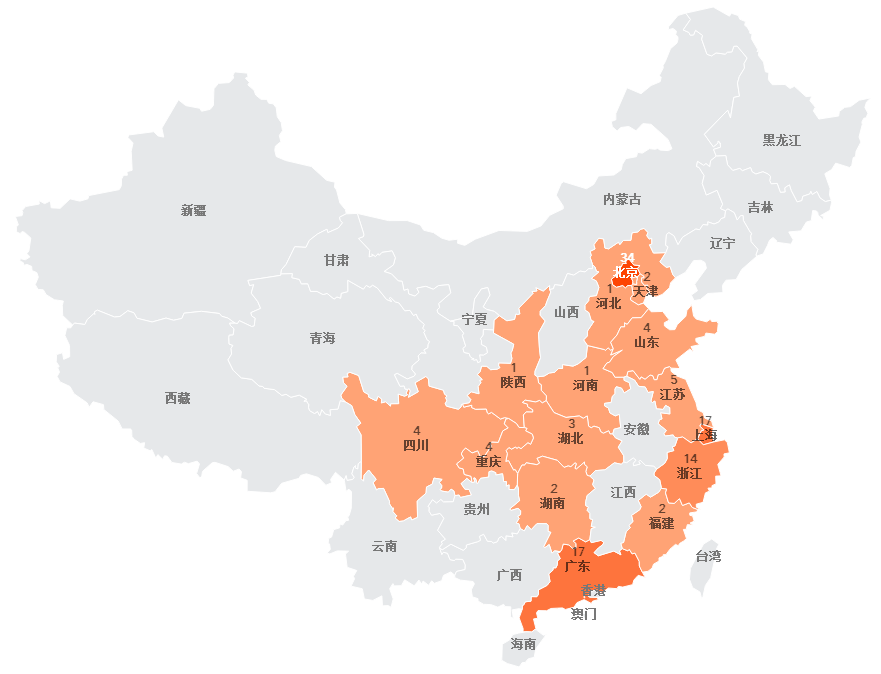
Startups in the smart elderly care industry are primarily distributed across North China, East China, South China, and the Central and Western regions. Beijing serves as the core hub for startups in North China, with 34 smart elderly care startups; Shanghai is the core hub in East China, with 17 related startups; Guangdong is the core hub in South China, also with 17 related startups; while startups in the Central and Western regions are relatively evenly distributed. According to data from the Sixth National Population Census, the six provinces/municipalities with the most severe aging populations in China are Chongqing, Sichuan, Jiangsu, Liaoning, Anhui, and Shanghai. Among these, Liaoning and Anhui have not yet seen any startup activity in the smart elderly care sector.
Distribution of Establishment Dates
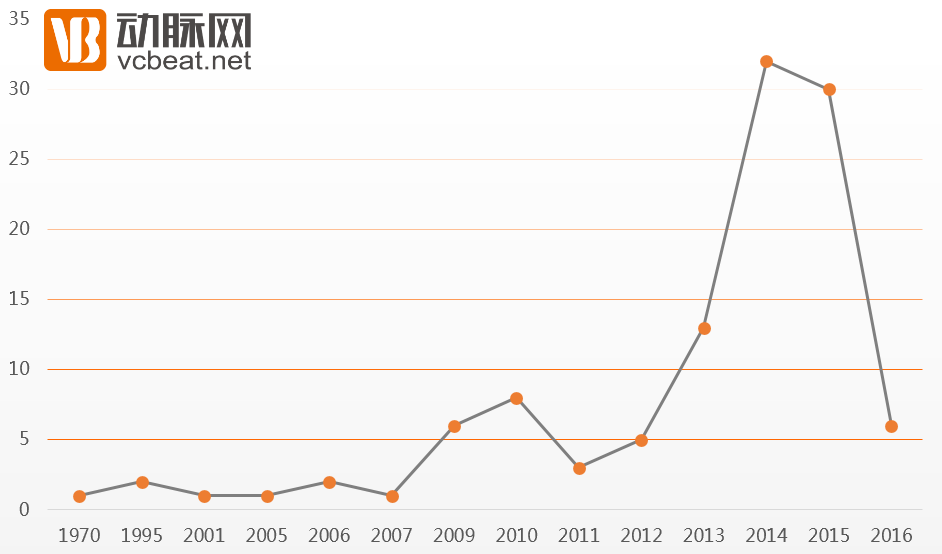
The establishment of startups in the smart elderly care sector was concentrated primarily between 2013 and 2015. VCBeat attributes this trend mainly to policy support and guidance. In 2013, after the State Council issued the “Several Opinions on Accelerating the Development of the Elderly Care Service Industry,” local governments rolled out a series of policies favorable to the elderly care industry, prompting an influx of capital and a rapid surge in the sector’s热度 (heat/activity). Following the release of the “Guiding Opinions on Land Use for Elderly Care Service Facilities” in 2014, multiple policy directives were issued in quick succession within just two months after the 2015 Spring Festival, including the “Implementation Opinions of Ten Ministries on Encouraging Private Capital to Participate in the Development of the Elderly Care Service Industry,” the “Guidelines for the Issuance of Bonds for the Elderly Care Industry,” the “Joint Notice by the Ministry of Civil Affairs and the China Development Bank on Promoting the Construction of the Elderly Care Industry,” and the “Notice on Further Advancing the Development of the Elderly Care Service Industry.”
Startup Financing Status
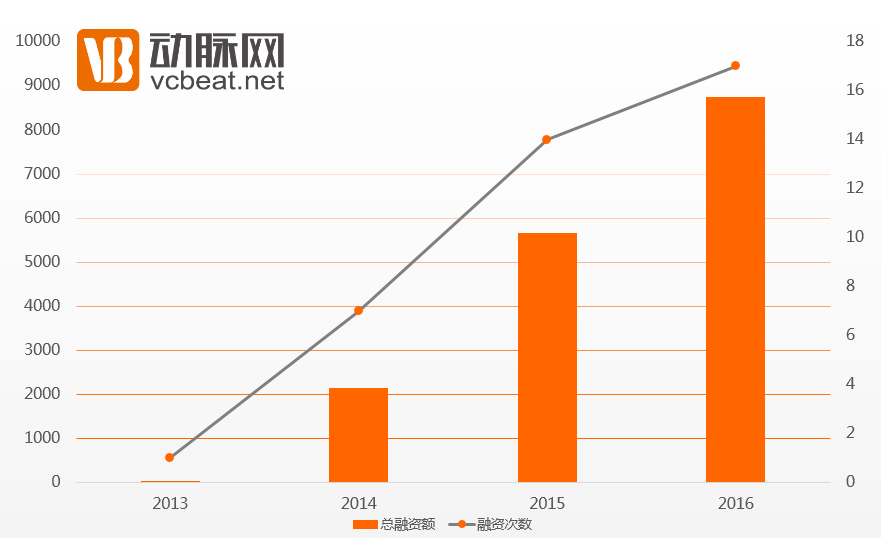
Financing in the smart elderly care industry primarily occurred after 2013; therefore, we compiled statistics on financing activities within this sector from 2013 to 2016. In 2013, there was one financing event, with an amount of $150,000. In 2014, a total of seven financing events took place, amounting to $21.34 million. In 2015, the number of financing events rose to 14, with the total financing amount increasing to $56.6 million. In 2016, both the number of financing events and the total financing amount in the elderly care industry reached historic highs, with 17 financing events totaling $87.58 million.
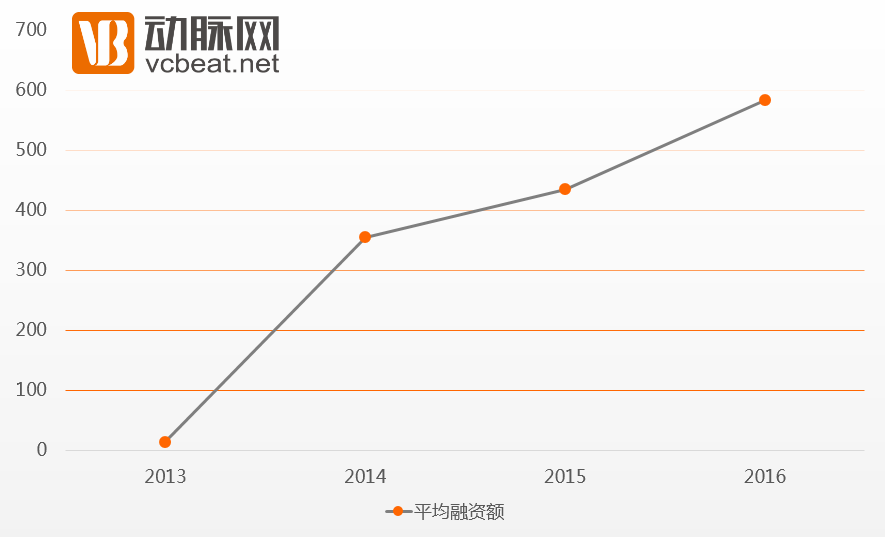
The average financing amount in the smart elderly care industry has also shown an upward trend. In 2013, the average financing amount was only $150,000; it rose to $3.56 million in 2014, and reached $4.35 million and $5.84 million in 2015 and 2016, respectively. It is evident that since 2014, the capital market has begun to focus heavily on the smart elderly care sector. With active participation from both investors and entrepreneurs, the industry has continued to gain momentum.
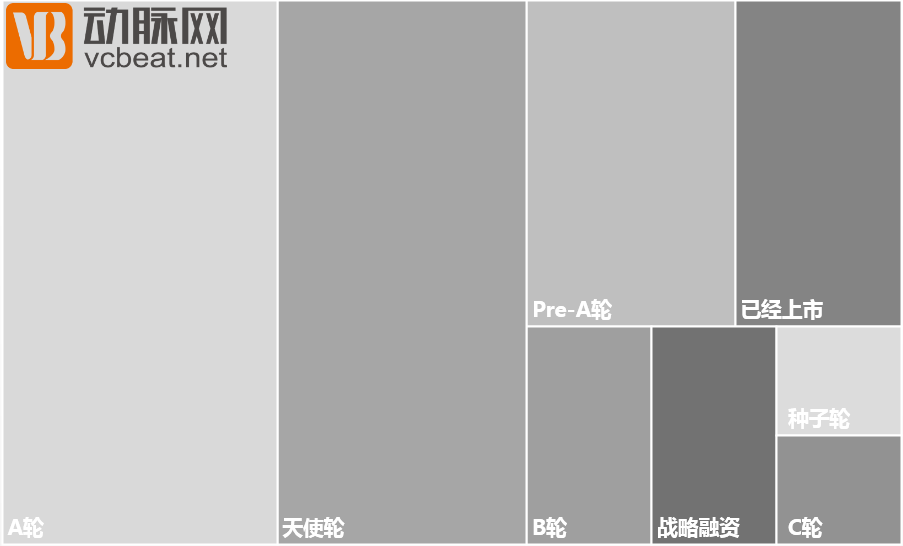
A total of 36 startups in the smart elderly care sector have disclosed public financing information. Among them, Series A and angel rounds are the most numerous, with 11 and 10 companies respectively; there are 5 companies at the Pre-A round, and 4 listed companies. Only two companies have reached Series B, one has reached Series C, and merely one remains at the seed stage. This indicates that the majority of companies are in the angel to Series A phase, suggesting that most have completed product prototyping and are currently exploring their business models, while remaining largely unprofitable. At present, capital markets evaluate smart elderly care startups primarily based on the founders’ backgrounds, with market prospects and corporate vision serving as secondary considerations.
Sub-sector Classification
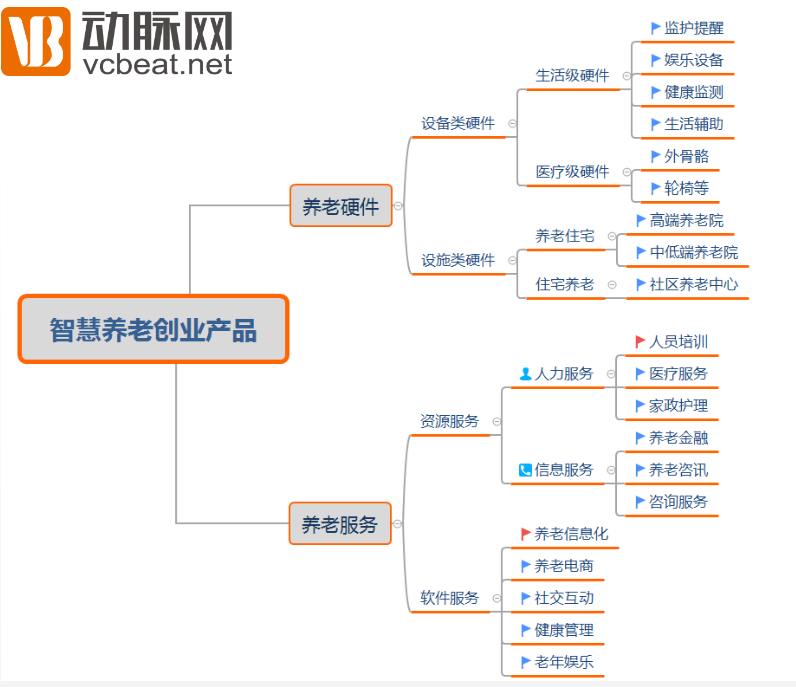
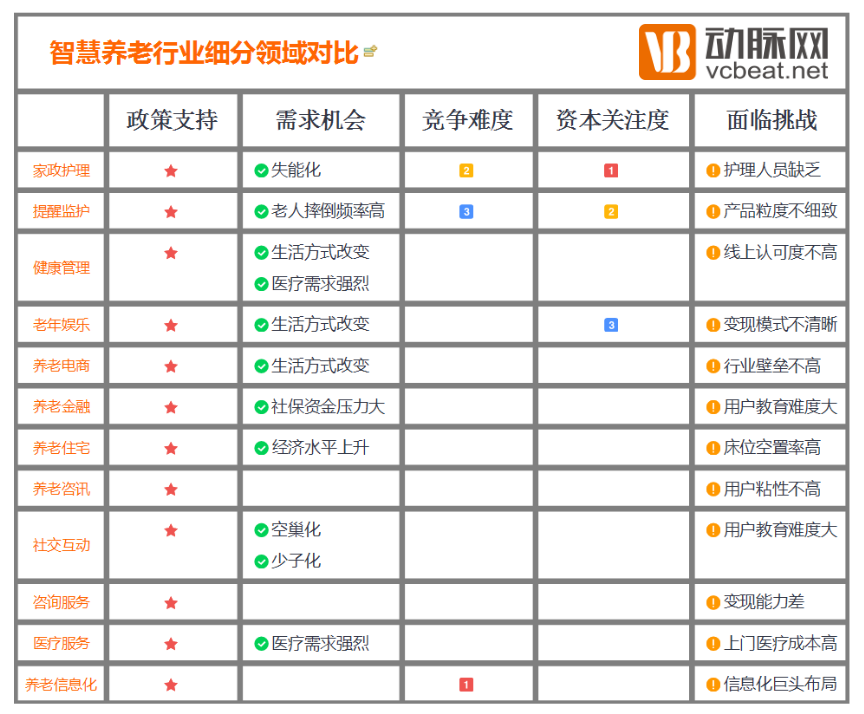
The smart elderly care sector is primarily divided into two major categories: elderly care services and elderly care hardware. It comprises 21 sub-sectors, among which startups have shown significant presence in 12 areas: domestic nursing, monitoring and reminders, health management, elderly entertainment, social interaction, elderly care e-commerce, elderly care finance, elderly care informatization, elderly housing, elderly care information services, medical services, and consulting services. These 12 categories will serve as the primary focus of the following analysis. In the chart, red flags denote B-side products, while blue flags indicate C-side products.
Investment in Subsectors
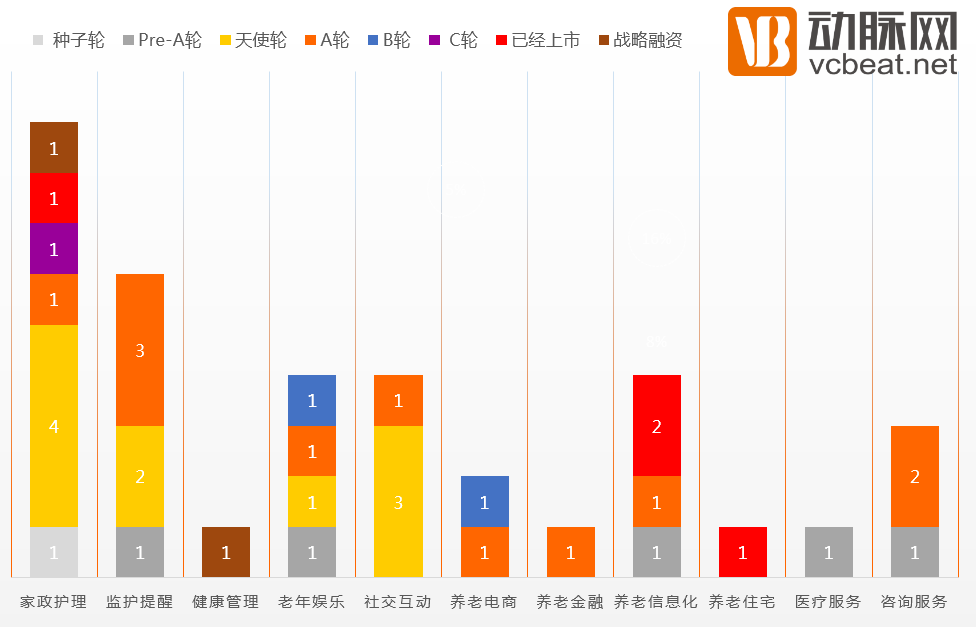
In terms of investment volume, home care startups received the highest number of investments and covered a comprehensive range of financing rounds. VCBeat analyzes that this is primarily because the home care business model is relatively mature and has already achieved profitability, thus attracting significant attention from the capital market; however, competition within the industry is also intense. Startups entering the smart elderly care sector with monitoring and reminder products ranked second in the number of investments received, predominantly at the Series A and angel stages. These companies currently have relatively single revenue models, mainly focusing on personalized mobile health services, but they are generally favored by investors due to the relatively high barriers associated with smart hardware. The three niche sectors of elderly entertainment, social interaction, and elderly care informatization each recorded four invested companies. The revenue models for elderly entertainment and social interaction remain unclear, whereas the maturity level of elderly care informatization is relatively high.
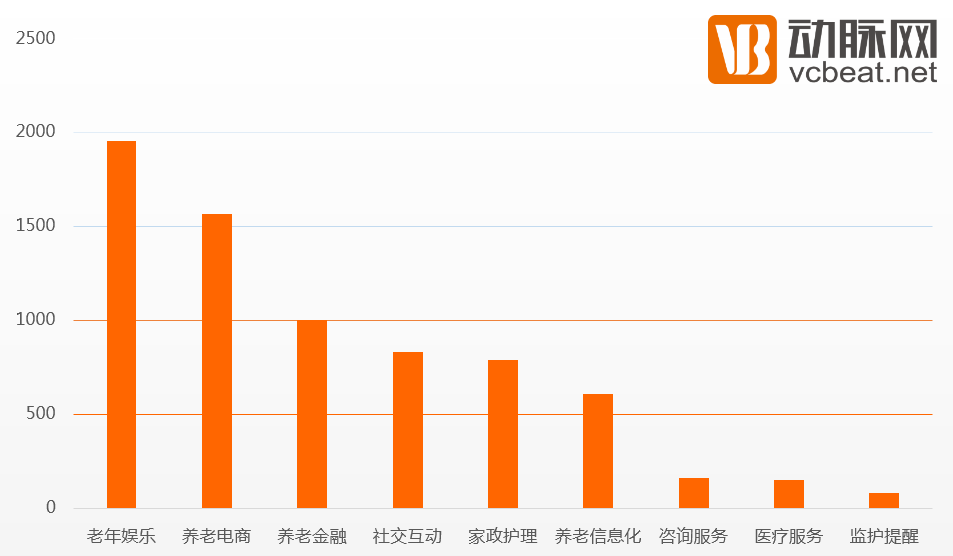
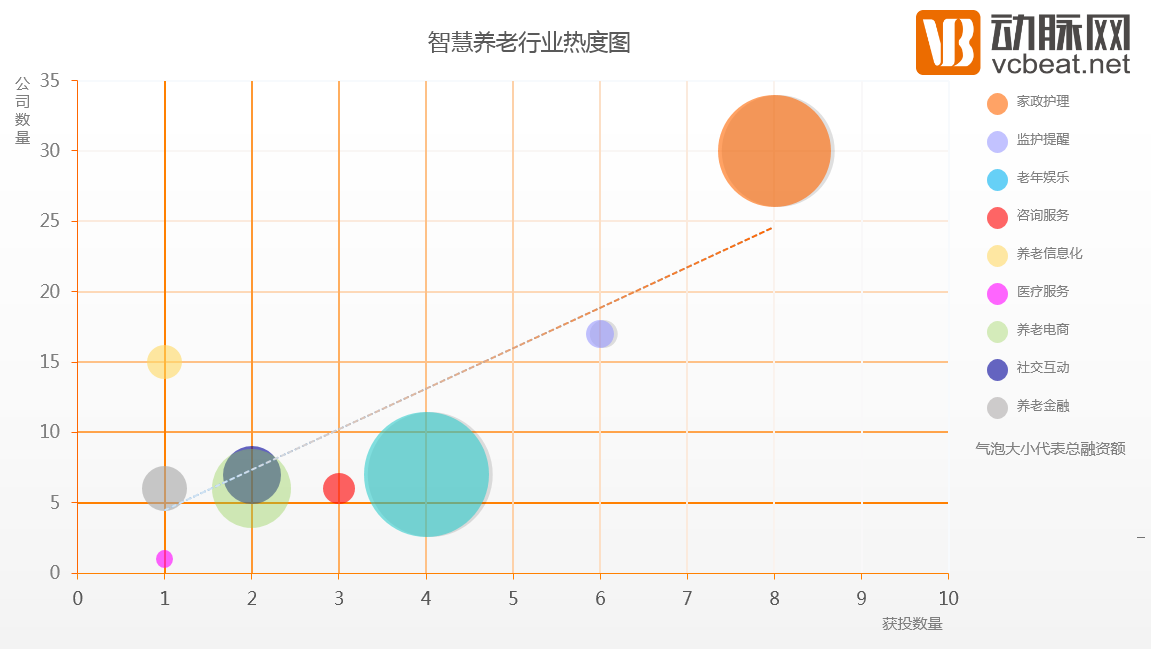
VCBeat has compiled statistics on the average financing amounts across various sub-sectors. The average financing amount in the senior entertainment sector stood at $19.51 million, while that in the elderly care e-commerce sector was $15.65 million. Based on these figures, the senior entertainment sector has attracted the most capital attention. Startups in this sector primarily offer square dancing apps. VCBeat’s analysis suggests that although the profitability model for square dancing apps remains unclear at present, these products benefit from high traffic and strong user stickiness. As the user base continues to expand, their business models are expected to become increasingly well-defined.
To provide a clearer assessment of the heat levels in various sub-sectors of the smart elderly care industry, VCBeat has developed a Heat Map for the Smart Elderly Care Industry. Sectors positioned above the trend line indicate intense competition, while those below the trend line suggest weaker competitive pressure. The size of each bubble represents the total financing amount secured by that specific sub-sector. The heat map reveals that elderly care informatization and domestic nursing services face relatively fierce competition, whereas sectors such as elderly entertainment, elderly healthcare services, and elderly care consulting experience comparatively less competition. Notably, elderly domestic nursing, elderly entertainment, and elderly care e-commerce have attracted the most significant attention from capital investors.
Comparison of Subsectors in Smart Elderly Care
Trend 1: Emotionalization of Service Products
With children owning their own homes and a large number of people working away from home, the rate of elderly "empty-nest" households in China has now exceeded 50%, reaching as high as 70% in large and medium-sized cities. This empty-nest phenomenon has directly led to a "lack of sense of belonging among the elderly." The elderly’s needs for old-age care encompass not only material living conditions but also medical nursing, emotional comfort, self-respect, and self-actualization. However, at the current stage, China’s elderly care services are still unable to meet the diverse needs of the aging population. There is limited understanding of the elderly’s needs, with an excessive focus on meeting their material and medical nursing requirements while neglecting their need for emotional support. Entrepreneurs in the smart elderly care industry should not merely view the elderly as customers; they need to infuse more empathy into their services to provide greater emotional comfort to more seniors.
Trend 2: Becoming an Internet Celebrity by Sharing Skills
As the population ages, the new generation of seniors, influenced by the development of China’s education sector, demonstrates higher levels of educational attainment and cultural literacy. However, due to current limitations in the elderly care service system, older adults are unable to proactively select services tailored to their needs, nor is there a dedicated platform to support their self-actualization. For vibrant seniors who enjoy good physical and mental health—more than half of whom express willingness to participate in social work—standardized skill-sharing initiatives represent an effective approach. Therefore, leveraging the hidden resource of seniors’ rich life experiences, social insights, and professional expertise as a starting point for designing elderly care programs can help realize the goals of “productive aging” and “meaningful engagement.” This strategy unlocks the latent intellectual potential of the elderly population, addressing a significant gap in spiritual and psychological care within the eldercare industry. Consequently, it becomes feasible for seniors to engage in skill-sharing activities and even develop knowledge-based personal brands (IPs).
Trend 3: Integration of Health Management with Offline Services
As individuals age, their physiological functions gradually decline, leading to an increased demand for in-home services. According to a survey on service needs conducted by the China Research Center on Aging, the highest demand among the elderly is for in-home medical visits, at 56.4%, followed by companionship services at 39% and nursing care at 30.5%. Currently, the provision of in-home medical services within the elderly care sector remains limited. Health management platforms primarily rely on online consultations, failing to establish effective interactive models; furthermore, acceptance of internet-based medical products among the elderly population remains low. In contrast, the in-home consultation model enjoys higher acceptance among older adults, largely due to their strong adherence to physicians. Physicians can leverage this trust to influence platform adoption, transforming patient adherence into product recognition. As the elderly increasingly internalize these products, their market influence will expand accordingly. Therefore, health management products that foster interaction among platforms, physicians, patients, and diagnostic hardware offer greater value than those relying solely on online health management approaches.
Trend 4: Integration of Medical Care and Elderly Care
The greatest challenge facing elderly care in China today is ensuring the continuity of maintaining physical health and the accessibility of medical nursing. The elderly population will generate substantial demand for medical service resources, creating an urgent need to establish a comprehensive, continuous, and appropriate healthcare system tailored to their needs. With population aging and increasing life expectancy, the demand for health maintenance, preventive care, and medical nursing is becoming increasingly pressing.
Integrated Medical and Elderly Care is an elderly care model that integrates medical treatment, nursing, rehabilitation, basic elderly care facilities, daily life assistance, and barrier-free activities. Its advantage lies in breaking through the traditional separation between medical care and elderly care, enabling the provision of timely, convenient, and precise medical services to the elderly. Ultimately, it integrates medical services, daily life assistance, health rehabilitation, hospice care, and other services into a unified package of integrated medical and elderly care services, thereby meeting the comprehensive elderly care needs of older adults.
Copyright Notice
This report is produced by VCBeat. All text, images, and tables contained herein are protected by applicable trademark and copyright laws. Portions of the text and data have been collected from publicly available sources, with ownership retained by the original authors. No organization or individual may reproduce or distribute this report in any form without prior written permission from our company. Any unauthorized commercial use of this report shall constitute a violation of the Copyright Law of the People's Republic of China, other relevant laws and regulations, and applicable international conventions.
Disclaimer
This research report is based on information that VCBeat considers reliable and currently publicly available. VCBeat strives for, but does not guarantee, the accuracy and completeness of such information. Due to limitations in research methodologies, sample sizes, and the scope of data collection, the data presented herein only reflects the basic conditions of the surveyed population during the survey period. It serves solely the purpose of the current research and provides basic reference for the market and clients. Furthermore, VCBeat does not guarantee that the opinions or statements contained herein will remain unchanged. At different times, VCBeat may issue reports with information, opinions, and projections inconsistent with those contained in this report.
VCBeat does not consider recipients of this report as clients merely by virtue of their receipt thereof. This report is distributed only where permitted by applicable laws and regulations, solely for informational purposes, and shall not be construed as advertising in any manner. Under no circumstances shall the information contained herein or the opinions expressed constitute investment advice to any person. Where permitted by law, VCBeat and its affiliates may hold equity interests in the companies mentioned in this report and may provide or seek to provide financing, financial advisory, or other related services to such companies.
Note: I am Wang Guanglong, an author at VCBeat. If you are an investor interested in smart elderly care, or an entrepreneur in the smart elderly care sector seeking media coverage, please feel free to contact me. We also welcome any leads on relevant companies. WeChat: touchlife1; Email: wang.gl@vcbeat.top