

Peking University's AI-Powered MR Diagnostic System for Prostate Cancer Enters Commercialization Phase with 34 Tech's IPO Filing
Currently, several companies in the market are dedicated to machine learning for medical imaging. Image-assisted diagnosis for conditions such as breast cancer and lung cancer is relatively mature, but there are few mature products in the niche field of prostate cancer. Recently, a prostate cancer MRI intelligent assisted diagnosis system based on intelligent image recognition and deep learning, jointly developed by the Interdisciplinary Center for Biomedical Research at Peking University and Peking University First Hospital, has commenced clinical studies. Its efficacy is being validated using data from more than 20 hospitals across over ten provinces in China. VCBeat (WeChat ID: vcbeat) has provided follow-up coverage on this development.
The Biomedical Interdisciplinary Research Center of Peking University and Peking University First Hospital have over a decade of collaborative experience in imaging diagnosis, with a long-standing commitment to applying artificial intelligence technologies to clinical diagnostics. The project is led by Dr. Wang Xiaoying, Director of the Department of Medical Imaging at Peking University First Hospital, and Associate Professor Zhang Jue from the Biomedical Interdisciplinary Research Center of Peking University. The technical lead is Dr. Wang Chengyan from the Academy for Advanced Interdisciplinary Studies at Peking University.
According to data released by the World Cancer Association, prostate cancer is the most prevalent malignant tumor among elderly men in Europe and America, and its incidence in China has been rising steadily in recent years. Extensive data indicate that prostate cancer predominantly affects middle-aged and older adults, with the average age at diagnosis being over 65 years.
Early diagnosis and staging of prostate cancer are critically important. Currently, the interpretation of widely used multiparametric magnetic resonance imaging (mpMRI) data presents a technical challenge. MRI comprises images with multiple contrast weightings, each providing distinct diagnostic information. Accurate interpretation requires physicians to possess extensive experience to comprehensively integrate these diverse data sources.
Director Wang Xiaoying introduced that in prostate MR (magnetic resonance) images, inflammation, hyperplasia, and tumors sometimes present with similar features, requiring highly experienced physicians for differentiation. In practice, even experienced physicians achieve an average diagnostic accuracy of no more than 70% in differentiating these conditions. More importantly, the goal of MR is not merely to detect “cancer,” but to identify “clinically significant cancer,” which demands extensive training over a long period and with large sample sizes to accumulate sufficient diagnostic experience. In contrast, machine-assisted diagnosis can “learn” to recognize cancerous lesions within a short time, thereby assisting physicians in making clinical judgments.
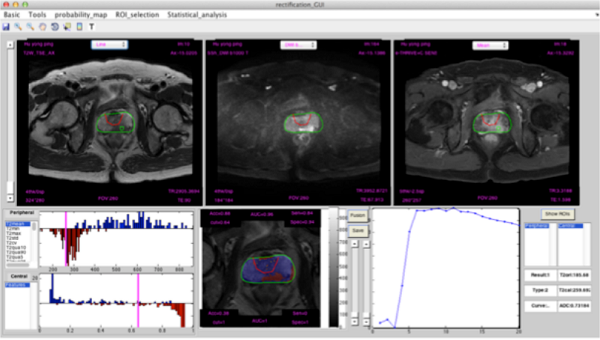
Software Interface of the Intelligent Diagnostic Platform for Prostate Cancer
Intelligent MR-Assisted Diagnostic System for Prostate Cancer is an intelligent learning and diagnostic platform. Leveraging artificial neural network technology, the platform extracts useful information from MR image data, enabling computers to “learn” the imaging characteristics of tumors. Imaging experts from Peking University First Hospital “trained” this intelligent system by using case illustrations and diagnostic results to instruct the computer. After such training, the computer can semi-automatically interpret images.
In multiparametric magnetic resonance imaging (mpMRI), useful features are extracted from the images to identify regions most likely to be tumors, thereby enabling risk prediction for tumor presence. The prediction results are presented as probability maps, providing intuitive assistance for physicians in making diagnoses. Comparison with pathological findings has confirmed the accuracy and effectiveness of this method.
With the assistance of an AI-powered MRI diagnostic system for prostate cancer, radiologists’ image interpretation time can be significantly reduced. In the future, multi-center imaging data will be continuously accumulated and optimized on a cloud-based data platform. Through training on large-scale datasets, the diagnostic capabilities of the AI-driven prostate cancer diagnosis platform will continue to improve.
The current task of MRI examination is to identify targets for biopsy in patients with suspected prostate cancer. After the auxiliary diagnostic system completes its operation, it highlights the locations of suspicious lesions. Urologists then decide whether to perform a biopsy based on the clinical context. If a biopsy is performed, guidance from the auxiliary diagnostic system may improve the positive rate of biopsy and detect more clinically significant cancers.
It took nearly a decade for the Interdisciplinary Research Center for Biomedical Sciences and Peking University First Hospital to explore and develop this computer-aided diagnostic system. As the saying goes, “ten years of grinding yield one sharp sword.” Preliminary validation with small sample sizes has demonstrated that the system achieves an auxiliary diagnostic accuracy of over 90% for clinically significant cancers. Functioning akin to an experienced urologic radiologist, the system provides online assistance to clinicians in image interpretation, enabling clear and quantitative assessment of disease risk.
The application of this system can vary depending on the physician’s level of experience. It may involve the physician interpreting the images first, followed by the system, thereby reducing misdiagnosis; alternatively, the system may interpret the images first, followed by the physician, to minimize missed diagnoses; or both the physician and the system may interpret the images simultaneously, with the system providing a probability of malignancy for suspicious lesions identified by the physician.
Data Advantage: The system was trained on a large number of confirmed prostate cancer cases that adhered to strict MRI indications and protocols, with long-term follow-up.
Technical Advantages: The key to artificial intelligence technology lies in algorithms. Our project team has accumulated many years of experience in intelligent learning algorithms and has gained an in-depth understanding of prostate cancer through collaboration with hospitals. Therefore, our algorithms can be described as clinically oriented.
During the interview, Wang Xiaoying consistently emphasized that the system has reached a level of technical maturity suitable for widespread adoption. While conducting a nationwide multicenter study on MRI-assisted diagnosis of prostate cancer, her team found that many hospitals were already familiar with the system and expressed strong interest in acquiring it, even willing to pay for its installation and use.
It is easy for these medical institutions to adopt the system; however, its application faces certain challenges when prostate MRI examination protocols are not standardized. Optimal outcomes are achieved when patients undergo appropriate MRI examinations at the right time, the system provides actionable information post-examination, and the hospital has the capability to perform biopsies.
To accelerate the industrialization of this system and expedite the commercialization of other research achievements from Peking University’s Interdisciplinary Research Center for Biomedical Sciences, Beijing 34 Technology Co., Ltd. was established under the leadership of the center’s faculty member responsible for industry-academia-research collaboration. The company is specifically tasked with managing the incubation and technology transfer of the center’s outcomes.
According to Fu Xiaoyan, the head of industry-academia-research collaboration at the center, all research projects are initiated based on practical needs arising from clinical and basic medical issues. The research team comprises faculty members and students from Peking University’s disciplines of life sciences, physics, chemistry, environmental science, information science, and engineering, as well as clinical experts from Peking University Hospital. The aim is to leverage complementary strengths across disciplines, integrate advanced scientific technologies with the practical demands of clinical medicine, and address clinical challenges.
In addition to the MR-based intelligent auxiliary diagnosis platform for prostate cancer, the center’s achievements include a series of new magnetic resonance imaging (MRI) technologies, novel auxiliary diagnostic methods based on medical imaging and signals, and a new generation of physical therapy treatments centered on low-temperature plasma and pulse technologies. 34 Technology has currently acquired the intellectual property rights for some of these technologies, including the intelligent auxiliary diagnosis system, from Peking University.
34Tech is also a startup. It incubates ventures with an investor’s mindset and invests with an entrepreneur’s spirit. The company is seeking creative, like-minded partners to join its entrepreneurial journey, aiming to transform more laboratory research achievements into a key driving force for technological innovation in the healthcare industry.
Meanwhile, 34 Tech is also seeking stakeholders in the medical industry, including investment firms specializing in early-stage healthcare projects, experienced entrepreneurial teams with operational expertise, and other large or mid-sized medical companies. Leveraging the achievements of the Peking University Interdisciplinary Research Center for Life Sciences as a foundation for entrepreneurship, 34 Tech aims to co-establish new ventures with entrepreneurial teams and investors to facilitate the commercialization of research outcomes.