

Ipsos Health Tech Survey: China Leads in Connected Health Device Adoption, Diabetes Patients Most Confident in Data Accuracy
On December 13, Ipsos, one of the world’s largest market research firms, shared extensive survey data at the Connected Health Conference held at National Harbor, Maryland. These data show thatThe adoption rate of connected health devices in the United States and globally remains low, with no change observed since last year.。
Reena Sangar, Head of Digital and Connected Health at Ipsos, stated at the conference: “What we lack is objective data. Existing data are predominantly US-centric, and many statistics are difficult to interpret, posing significant challenges. The key to increasing the adoption of connected health devices lies in understanding the profiles of users of these connected devices.”
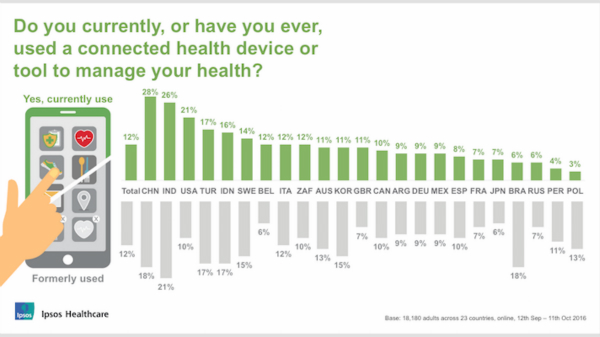
A total of 18,180 respondents from 23 countries were interviewed by Ipsos. The results show that 12% of people worldwide reported currently using connected health devices (including fitness trackers), while another 12% stated they had previously used such devices. However, there are significant variations across countries.
Chinese people are most likely to use connected medical devices.28% of Chinese respondents reported having used connected medical devices, with India (26%) and the United States (21%) ranking second and third, respectively. Turkey and Indonesia ranked fourth and fifth. The attrition rate in the United States is relatively low, with only 10% of U.S. respondents indicating prior use of connected medical devices.
On the other hand, Polish respondents were the least likely to use connected medical devices, at only 3%, followed by Peru at 4%, Russia and Brazil at 6%, and Japan and France at 7%.
Last year, Ipsos conducted a similar survey in a few countries.Usage rates remained unchanged in most countries, with only Japan seeing a slight increase.。
Reasons for Using Connected Health Devices Vary Among Residents of Different Countries.Respondents in China, India, and the United States all indicated that their primary concern is monitoring and improving exercise habits.; Turkish respondents expressed interest in their health data, while Indonesian respondents indicated a need for storage devices for health data.
However,All low-income countries face two barriers: high costs and a lack of awareness of wearable devices.。
“Cost is a relatively common issue. I believe the biggest barrier lies in people’s lack of sufficient understanding,” said Sangar. “People are not unaware of connected health devices; rather, they do not know what functionalities these devices offer. This is the most critical point.”
Beyond differences across countries, Ipsos also obtained some predictable findings regarding wearable device users:Individuals aged 25 to 34 are the most likely to use wearable devices, with this likelihood declining as age increases.. Educated individuals and the working class are more likely to use wearable devices than uneducated individuals and low-income populations.
Most interestingly, Ipsos also asked respondents whether they would be willing to use tracking devices if persuaded by certain stakeholders, namely their physicians and insurance companies. Globally,85% of respondents indicated they would use such devices upon their physician’s recommendation.; 68% of respondents stated they would use such devices upon recommendation from their insurance companies. In the United States, however, few provided affirmative responses, with figures at 68% and 49%, respectively.
In last year’s survey, Ipsos surveyed physicians, the general public, and patients with diabetes in the United Kingdom and the United States. The results showed that a greater proportion of patients believed their physicians were knowledgeable about connected medical devices than the proportion of physicians who considered themselves knowledgeable about such devices. Ipsos’s respondents included 200 U.S. medical device manufacturers, 200 UK manufacturers, 4,185 U.S. consumers, 2,503 UK consumers, 416 U.S. patients with type 2 diabetes, and 257 UK patients with type 2 diabetes.
Reena Sangar, Head of Digital Health at Ipsos, presented these data at the HIMSS Connected Health Conference. The data show that 35% of U.S. patients believe physicians are knowledgeable about connected medical devices, 24% of physicians report being familiar with such devices, and 42% of patients with diabetes believe physicians are knowledgeable about connected medical devices.
Sangar stated, “The proportion of patients who believe that physicians understand connected medical devices is 10% to 12% higher than the proportion of physicians who believe they themselves understand such devices—a significant disparity.” There is clearly a perceptual gap here. Patients with diabetes visit physicians more frequently due to comorbidities. They exhibit greater confidence than the general patient population and, owing to their increased access to physicians, are more likely to adhere to medical advice.
The survey results in the United Kingdom were similar. Twenty-four percent of general respondents believed that physicians had some understanding of connected medical devices, 12% of physicians considered themselves knowledgeable about such devices, and 30% of patients with diabetes believed that their physicians understood connected medical devices.
When three groups in the United Kingdom and the United States were asked about the accuracy of digital health data, Ipsos found that patients with diabetes had the most confidence in the accuracy of these devices。
In the United States, 18% of healthcare providers consider digital health data to be accurate, while 25% of general respondents and 32% of patients with diabetes agree with this view. In the United Kingdom, 10% of healthcare providers, 15% of general respondents, and 21% of patients with diabetes express confidence in the accuracy of digital health data.
Approximately 40% of U.S. physicians consider telemedicine consultations an inevitable trend for the future, whereas only 22% of their counterparts in the United Kingdom agree with this view.. Furthermore, 42% of U.S. vendors believe that insurers should lower premiums for members who use wearable devices, whereas only 22% of UK physicians agree with this view.
Sangar stated, “In developing people-centered new healthcare plans, we need to more clearly define the roles of professional healthcare providers and health insurance companies. Without them, nothing would be possible. We must empower professional healthcare providers, as they are the core of health services.”