McKinsey: How Healthcare Rises in the Big Data Era
Preface
SelfSince 2012, “big data” has gradually evolved from a specialized term into a common topic of discussion among industry professionals, thereby becoming a viable pathway for the commercialization exploration of major (mobile) internet products and achieving leapfrog development. However, most companies have yet to reap the benefits brought by big data.
In its 2011 report, “The Next Frontier: Innovation, Competition, and Productivity,” McKinsey highlighted five promising application areas: the European public sector, U.S. healthcare, manufacturing, U.S. retail, and location-based services. In retrospect, big data has indeed made a significant impact.
Among these, the retail sector and location-based services have been most significantly impacted. This is because users in these two fields are predominantly digital natives (the younger generations born from the late 1980s to early 1990s and thereafter), leading to the fastest adoption rates and the largest scale of impact. In contrast, the influence on manufacturing, the public sector, and healthcare has been less profound. According to statistics, the value demonstrated by data analytics accounts for less than 30% of the potential value estimated five years ago. In other words, the gap between expectation and reality continues to widen.
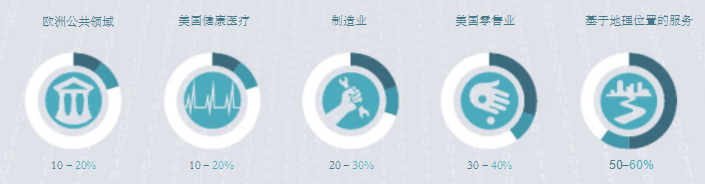
Proportion of Potential Value Realized by Data Analytics Across Five Major Domains (2011)
Furthermore, data analytics has given rise to several disruptive innovation models. Below is a brief overview of novel datasets capable of reshaping established industrial landscapes, breaking down information silos, and creating new paradigms. For instance, ultra-large-scale digital platforms enable real-time transactions, which are highly beneficial for inefficient commodity markets; granular data can be leveraged to design personalized products and services, particularly in the healthcare sector; and emerging analytical techniques can facilitate the discovery of innovations. Collectively, data analytics makes evidence-based decision-making more precise and efficient.
Therefore, in the process of commercial exploration of big data, stakeholders may become lost and overwhelmed by the unpredictable nature of data analysis. However, the healthcare sector presents a different landscape, as regulatory constraints impose significant barriers. The 2011 report estimated that data analytics could generate $300 billion in potential annual value in the healthcare sector, with an annual productivity growth rate of 0.7%. Yet, in 2011, only 10–20% of this potential could be realized, translating to $30–60 billion in value. This limited realization was attributed to two main factors: first, the need for clinical trials to validate findings; and second, the substantial challenges remaining in achieving data sharing and interoperability.
To date, the U.S. healthcare sector has captured only 10–20% of the opportunities offered by data analytics in medicine. A series of challenges remain to be addressed, including insufficient incentives, difficulties in institutional reform, a shortage of technical talent, obstacles to data sharing, and regulatory oversight.
Nevertheless, tangible progress has been made. In clinical practice, the most significant achievement has been the adoption of electronic health records (EHRs), although the vast amounts of data they contain have yet to be fully leveraged. Payers are increasingly utilizing big data to inform reimbursement decisions, suggesting that data analytics will yield innovative benefits in public health surveillance. Furthermore, many pharmaceutical companies are applying data analytics to research and development, particularly to streamline clinical trials. However, continued lagging behind will result in missed opportunities to transform clinical care and advance personalized medicine.
Data analytics can differentiate entities at a profound level. One of its most powerful capabilities is tagging population segments based on human characteristics, thereby enabling the provision of personalized services and products to users in industries such as education, tourism and leisure, media, retail, and advertising.
Integrating these data with patient behavior, genetic profiles, and molecular information will have a profound impact on healthcare services. The declining cost of genomic sequencing, the emergence of proteomics, and advances in real-time monitoring technologies are poised to generate a new form of ultra-high-resolution data.
These data can redefine healthcare in two ways. First, they can help address information asymmetry and incentive issues within the healthcare system. By gaining a comprehensive view of a patient’s health data, hospitals and other healthcare providers can shift their focus from disease treatment to disease prevention and health management, thereby saving substantial medical expenditures and improving quality of life. Second, patients’ access to granular data enables precision diagnosis and treatment. Pharmaceutical companies and medical device manufacturers can also leverage this data to enhance the efficiency of drug development. However, this approach presents a challenge: delivering therapeutic regimens to smaller, more targeted patient populations.
In terms of product innovation, data analytics has exerted a significant impact in the fields of materials science, synthetic biology, and life sciences. For instance, pharmaceutical giants are leveraging data analytics in drug development to identify drug compounds that serve as effective treatments for various diseases. In April 2016, AstraZeneca partnered with U.S.-based sequencing company Human Longevity, the UK’s Wellcome Sanger Institute, and the Finnish Institute for Molecular Medicine to conduct whole-genome sequencing on two million cases, thereby providing guidance for future drug research and development. Furthermore, AstraZeneca will select 500,000 samples from its clinical trials for whole-genome sequencing.
Under the agreement, AstraZeneca will establish a dedicated genomics research center to effectively integrate genomic sequencing data from clinical samples with relevant information on clinical treatments and drug responses. AstraZeneca also plans to publicly publish all research findings from this collaborative project. This model holds significant value in advancing scientific innovation and drug development.
We highlight five major categories of opportunities: clinical care, reimbursement, research and development (R&D), business model innovation, and public health. In the clinical domain, a key success has been the rapid expansion of electronic medical records (EMRs), with adoption rates rising from 15.6% in 2010 to 75% in 2014, largely driven by the implementation of the Affordable Care Act. For instance, Sutter Health’s new EMR system operates 40 times faster than its legacy system and demonstrates significantly improved accuracy in predicting hospital readmission rates.
Payers are also gradually beginning to leverage big data to inform reimbursement decisions, and certain trends are already emerging. Coupled with initiatives by the Centers for Medicare & Medicaid Services (CMS), transparency in healthcare pricing has improved, while more than 30 states have established all-payer claims databases to serve as comprehensive repositories of reimbursement information. Several insurance companies have consequently turned a profit; for instance, Optum, a business unit of UnitedHealth Group, helps employers reduce healthcare expenditures by analyzing prescription drug claims data.
For pharmaceutical companies, this represents significant progress, with many firms leveraging data analytics to support research and development (R&D). Most pharmaceutical enterprises use predictive models to optimize dosing during the transition from animal studies to Phase I clinical trials; however, data analytics has not yet been widely applied in later-stage trials, such as in defining inclusion and exclusion criteria for various clinical drug trials. Furthermore, applying analytics in R&D can rapidly identify target populations, thereby saving time and reducing costs. For instance, Contract Research Organizations (CROs) are utilizing these tools more extensively than they did five years ago. While statistical tools were previously used primarily to improve clinical trial management, it is now possible to derive deeper insights from the data. Some industry leaders have been using clinical trial data for drug repurposing (i.e., identifying additional indications for existing drugs). Meanwhile, the FDA, in collaboration with health insurance companies and electronic health record (EHR) providers, has launched the Sentinel Initiative to collect data on adverse drug reactions from 178 million patients.
Business model innovation has also taken root and flourished; for example, Explorys, an analytics company with access to 40 million U.S. patient records, was acquired by IBM in April 2015 to bolster its health data analytics capabilities.
Patient communities (such as PatientsLikeMe) also serve as a valuable data source, with their applications in public health surveillance assuming new and significant roles during outbreaks such as Ebola and Zika virus in 2014.
In short, there is still a long way to go for the healthcare sector to fully integrate data analytics. At the same time, this possibility is far greater than envisioned five years ago. We should remain patient; as cutting-edge technologies gradually permeate the industry, the entire healthcare system will undergo transformation. In the future, advances in deep learning—particularly in natural language processing and computer vision—may help automate medical activities, thereby reducing labor costs. Currently, labor costs account for 60–70% of a hospital’s expenses, representing a significant business opportunity.
So, what are the problems with data analysis applications in the medical field? The answer is the lack of operations that can enable interactive data. Patients' physiological data often exists in different systems, and each system cannot conveniently achieve seamless information sharing.
Data sharing in the healthcare sector faces numerous inhibiting factors. For instance, service providers and pharmaceutical companies may be reluctant to share more data with payers, as such data could expose their profit models. Furthermore, wearable devices used for personal health management have not yet demonstrated clinical application value in data collection. Meanwhile, given the broader landscape of the healthcare industry and government policies, the utilization of data is likely to proceed at a slow pace.
However, although there are certain inhibiting factors in the application of data analytics in healthcare, we can see the significance of big data in today’s diagnostic and treatment processes compared to past practices. Traditionally, diagnosis and treatment have relied on medical history, medical tests, and laboratory results. Nowadays, a series of new datasets are being generated by users’ wearable and home health devices (such as blood pressure monitors or insulin pumps), and this portion of data holds substantial reference value. Some innovators are conducting experiments with the hope that these data can also play a direct and effective role in clinical practice.
Due to variations in individual disease histories and genetic makeup, standardized treatment protocols are not suitable for everyone. However, each person’s unique characteristics are highly valuable for delivering customized services. As the cost of gene sequencing declines, proteomics (protein analysis) emerges, and breakthroughs continue in sensors, monitors, and diagnostic technologies capable of providing real-time data streams, patient datasets will become increasingly granular. Future innovative technologies, such as immunotherapy and CRISPR/Cas9 genome-specific editing, can maximize each individual’s physical potential.
Advanced analytical methods can transform standardized disease treatment into personalized risk assessment, diagnosis, treatment, and monitoring. Some healthcare providers have already implemented these approaches in their practice, demonstrating immense potential for clinical development. For instance, Essentia Health, a healthcare system in the U.S. Midwest, is conducting home monitoring for patients with congestive heart failure, reducing the 30-day readmission rate to 2%, far below the national average of 25% in the United States.
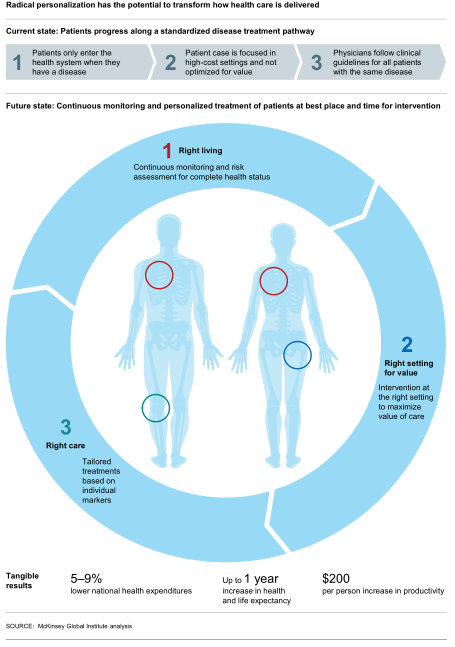
In the medical field, personalization is achieved through data on patients’ biomarkers, genetic profiles, and specific symptoms. Leveraging this granular data enables the determination of tailored individual treatment plans. Moreover, personalized medicine has the potential to transform the entire healthcare system.
In many countries around the world, particularly in the United States, a lack of information transparency has led to dysfunction within the healthcare system. Most patients currently only seek medical care after they have already fallen ill. Furthermore, the focus of diagnostic and treatment services is not on optimizing patient experience or demonstrating clinical value. This situation arises because personal health data is generally not made accessible to patients themselves, preventing them from detecting issues early and adjusting their conditions proactively; consequently, they only seek medical attention when sickness occurs. Clearly, better utilization of data can help individuals understand their health risks before falling ill, which is key to taking responsibility for one’s own health. Health insurance companies can also leverage data to gain insights into their customers. By encouraging clients to take preventive measures against potential health issues, insurers can reduce healthcare expenditure.
Within the entire healthcare system, the current status is that patients undergo diagnosis and treatment along a unified, standardized care pathway. What constitutes a standardized pathway?
Patients only proactively enter the healthcare system when they are ill;
The primary focus of diagnostic and treatment services is not to optimize patient experience or to demonstrate the value of care;
The future of data analytics in healthcare should entail physicians continuously monitoring patients, delivering personalized treatment plans, and implementing health interventions at the optimal time. So, what will the specific pathway for future diagnosis and treatment look like?
Continuous Monitoring and Risk Assessment;
Some institutions predict that, with the application of data analytics in the healthcare sector, per capita GDP will increase by $200, national healthcare expenditures will decrease by 5%–9%, and average human life expectancy will rise by one year.
Despite significant differences in healthcare environments across countries, the advent of personalized medicine is poised to reshape the fortunes of all stakeholders within the system. This article primarily examines the U.S. healthcare system, yet its insights remain relevant to global healthcare.
To deliver truly personalized medical services, healthcare providers need to integrate data from electronic health record (EHR) systems to obtain a comprehensive view of each patient’s clinical condition. This is achieved by leveraging large-scale EHR datasets to build intelligent clinical decision support tools.
Among these, the challenge facing healthcare services is how to manage these continuous streams of data and apply them to medical practice. A vivid scenario illustrates this: today, a doctor sees a patient with asthma; in the future, however, the doctor will have access to the patient’s daily activity data, genetic markers, and information on elevated protein expression levels. Therefore, clinicians and regulatory authorities must carefully consider how to leverage this valuable information for disease prevention and treatment. At the national level, it may be necessary to adjust financial incentives within the healthcare system and transition toward a value-based healthcare model that places greater emphasis on “prevention” throughout the diagnostic and therapeutic process, thereby driving the development of personalized medicine.
Payers can leverage data analytics to promote price transparency across the entire healthcare system. By forging new collaborative partnerships among payers, providers, and pharmaceutical companies, and by establishing novel performance-based compensation models that may help enhance price transparency, payers will increasingly engage in patients’ diagnosis and treatment processes. Although the process of building these new partnerships and models may be relatively slow, we believe that the data-rich environment will strengthen payers’ resolve to drive change.
Big data and advanced analytics can enhance the precision of drug prediction modeling for pharmaceutical companies, thereby accelerating the drug development process. Pharmaceutical companies can also leverage genomic and proteomic data, combined with millions of patient medical records, to design superior therapeutic regimens. What pharmaceutical enterprises need to do is innovate their business models to provide precise treatment solutions for narrowly defined target populations. Although this transformation poses significant challenges to pharmaceutical companies, the application of personalized medicine in oncology serves as an impetus for personalization in other disease areas.
Applying data analytics to the healthcare sector will reduce costs, extend human lifespan, and enable people to enjoy healthier, more prosperous, and fulfilling lives. Within healthcare services, the three areas with the greatest potential are remote monitoring, patient triage/navigation, and personalized medicine. Although much of the discussion surrounding “personalization” has focused on the latter dimension, remote monitoring and patient triage/navigation can also play a more significant role if combined with incentive mechanism design, prevention-oriented strategies, and value-based care models.
What aspects are required to achieve personalized medicine?
First, service providers can leverage the Internet of Things (IoT) and data analytics to remotely monitor patients, enabling timely intervention and adjustment before symptoms worsen. For the treatment of chronic diseases such as diabetes, cardiovascular diseases, and respiratory conditions, IoT-based remote monitoring and data analytics represent a revolutionary therapeutic approach. The use of these monitoring technologies significantly reduces patients' treatment costs. In new business models, service providers may utilize these technologies in conjunction with health interventions to establish a novel disease management mechanism focused on prevention, disease management, and health solutions, thereby addressing health issues before users fall ill.
Secondly, patients need to receive matched diagnosis and treatment plans at the earliest opportunity, thereby avoiding high-cost, high-risk healthcare facilities. Furthermore, it is essential to establish health risk monitoring institutions that leverage data analytics to conduct proactive health risk assessments and predict complications. This approach can prevent unnecessary prolongation of hospital stays and reduce health insurance expenditures.
Finally, and most critically, is matching each patient with a personalized treatment plan. This can be driven by artificial intelligence Clinical decision support systems accomplish this by leveraging artificial intelligence to analyze millions of patient medical records, genomic sequences, and other health behavior data to determine the most effective treatment plan for each individual. This approach maximizes the efficacy of medications, surgeries, and other therapeutic interventions while minimizing unnecessary waste and harmful side effects.
Compiled by: Deng Xueyuan
Source:http://www.mckinsey.com/business-functions/mckinsey-analytics/our-insights/The-age-of-analytics-Competing-in-a-data-driven-world
(Note: The content mentioned in the report is based solely on currently applied technologies and does not take into account other cutting-edge innovative technologies that may reduce healthcare costs and improve therapeutic outcomes.)
For more report content, please follow the VCBeat WeChat subscription account:VBResearch2016
↓↓↓