

WeDoctor Launches China's First Full-Service Primary Care Center in Hangzhou, Pioneering a '4S Store' Model for Family Health
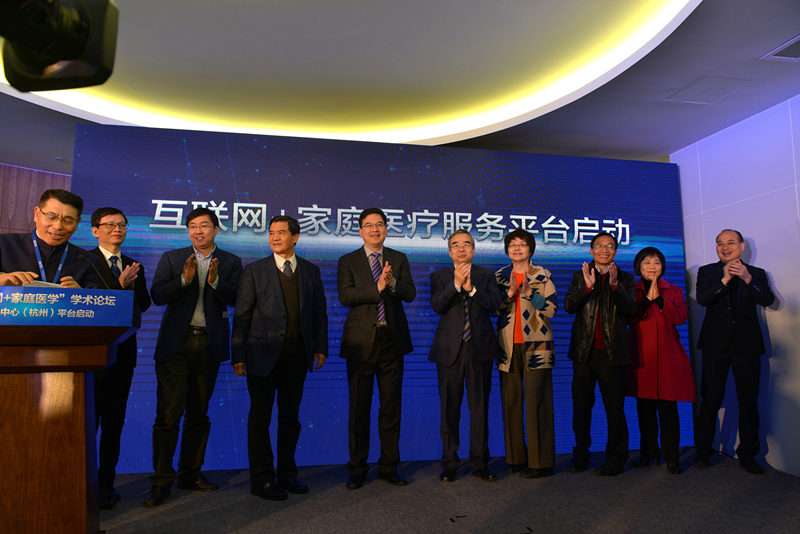
Hangzhou General Practice Center Event Site
On December 17, the 2016 China-US Academic Forum on “Internet+ Family Medicine” and the launch ceremony of the WeDoctor General Practice Center (Hangzhou) Platform were held in Hangzhou, featuring extensive exchange and integration of perspectives from experts and scholars from both countries. At the event, WeDoctor officially launched its General Practice Center (Hangzhou) Platform, which received strong endorsement from Mao Qunan, Director of the Department of Publicity under the National Health and Family Planning Commission.
Attendees included Mao Qun’an, Director of the Department of Publicity under the National Health and Family Planning Commission (NHFPC); Wang Guojing, Deputy Director of the Zhejiang Provincial Health and Family Planning Commission; Huang Lei, Director of the Division of Comprehensive Primary Care under the NHFPC; Liao Jieyuan, Chairman and CEO of WeDoctor; He Chao, Senior Vice President of WeDoctor and CEO of WeDoctor Medical Investment Management (Hangzhou) Co., Ltd.; Feng Wen, Director of the Population Culture Development Center under the NHFPC; Sheng Yuechun, Secretary of the Xiaoshan District Committee of Hangzhou; Cheng Jun, Secretary-General of the Greater Health Committee of the Zhejiang Entrepreneurs Association; and Zhu Shanzhu, Chair of the Department of General Practice at Fudan University Shanghai Medical College and Dean of the WeDoctor Academy of General Practice. Together, they witnessed the launch of the WeDoctor General Practice Center (Hangzhou) platform.
WeDoctor initially launched its online services through an internet hospital before making a significant leap into offline operations. What is the strategic significance of establishing the Hangzhou platform of the General Practice Center within its overall layout? How does it differ from other general practice centers? And how will it support tiered diagnosis and treatment as well as primary healthcare?
The General Practice Center is a vital component of WeDoctor’s integrated operations, encompassing online diagnosis and treatment, remote consultations, and offline medical services. Leveraging information technology platforms and mobile health technologies, it provides local residents with proactive, continuous, one-stop family health maintenance and medical care that seamlessly combines online and offline services, actively promoting a shift in residents’ health approaches from “passive health” to “proactive health.”
Currently, WeDoctor (Hangzhou) General Practice Center primarily provides online consultations, remote second opinions, and offline medical services. It comprises departments including General Practice, Obstetrics and Gynecology, Pediatrics, Dentistry, Traditional Chinese Medicine, Dermatology, Psychology, Clinical Laboratory, and Medical Imaging, delivering comprehensive, continuous, and family-oriented healthcare and health maintenance services.
“In other words, our General Practice Center functions more like the outpatient department of a comprehensive hospital, staffed by numerous renowned experts and professors in general practice from both China and abroad, safeguarding the health of you and your family,” said Liao Jieyuan.
The platform has assembled a team of more than 60 full-time general practitioners, established collaborations with multiple domestic comprehensive medical institutions—including the Children’s Hospital of Zhejiang University School of Medicine—and partnered with overseas second-opinion platforms such as Infinite MD and Yuesheng to build an international-standard health gatekeeper system. Reportedly, Infinite MD is headquartered in Boston and was co-founded by professors and physicians from Harvard University and the Massachusetts Institute of Technology (MIT), boasting over 520 authoritative medical experts from hospitals ranked among the top ten in the United States.
Since its establishment in 2010, WeDoctor has expanded its coverage to 29 provinces across China, integrating the information systems of more than 2,400 key hospitals. Over 260,000 specialists provide online services, including appointment registration, precise triage, and remote diagnosis and treatment, cumulatively saving Chinese citizens 64 million workdays previously spent waiting in queues. The online expert teams and hospital resources will also be integrated into General Practice Centers.
Wuzhen Internet Hospital does not conduct initial consultations, as this is the most challenging aspect of all medical services and imposes high demands on physicians. The establishment of the General Practice Center effectively addresses this gap, ensuring the continuous provision of comprehensive medical services to users.
“General practice centers that integrate online Internet platforms with offline physical facilities represent an ideal model for family medicine. We look forward to WeDoctor’s General Practice Centers becoming the ‘4S stores’ of Chinese family health,” said Mao Qun’an, Director of the Publicity Department of the National Health and Family Planning Commission.
General practitioners deliver primary healthcare services and are also known as family physicians or family doctors, serving as the principal providers of health management services. Equipped with unique attitudes, skills, and knowledge, general practitioners are qualified to provide continuous and comprehensive medical care, health maintenance, and preventive services to every member of a family.
Generally, general practitioners are versatile professionals who manage common diseases, frequently occurring illnesses, and general emergencies in an outpatient setting. For instance, general practitioners working in the community are characterized by providing home-based services; they often visit patients at home, establishing individualized home hospital beds and medical records based on each patient’s specific circumstances.
General practitioners are, in fact, at the most grassroots level of health services, maintaining the health of the majority of the population at a low cost and intervening in various chronic diseases that cannot be cured by specialized medical care, as well as the functional problems they cause.
When general practitioners encounter cases beyond their scope of practice, they need to initiate referrals to higher-level hospitals. Therefore, it is essential to connect with tertiary hospitals across various regions, precisely matching patients with appropriate hospitals and specialists based on their medical conditions. This creates a large-scale hub for tiered diagnosis and treatment, facilitating the implementation of the tiered healthcare system, rectifying the current “inverted triangle” structure of medical resource distribution, and becoming the “4S store” for the health of hundreds of millions of Chinese families.
Ideals are full-bodied, but reality is stark, as there are too few general practitioners across China, resulting in a significant talent shortfall.
Abroad, general practitioners account for 30% to over 60% of the total physician workforce and handle more than half of all healthcare services. Family physicians typically hold at least a master’s degree, practice independently, and are permitted to serve multiple medical institutions, enjoying high social status. General practitioners serve as lifelong health guardians for families, act as gatekeepers for national healthcare expenditures, and function as brokers who guide patients toward specialized care.
As public health awareness continues to rise, the development of general practitioners (GPs) in China is gaining significant momentum. According to statistics from relevant authorities, there is a shortfall of nearly 100,000 GPs in urban community health service institutions alone, not to mention the even more severe scarcity of medical resources in rural areas.
To this end, in addition to providing medical services to users, WeDoctor General Practice Center has established the WeDoctor Academy of General Practice, a professional platform for the education and training of general practitioners. Relying on the team led by Professor Zhu Shanzhu, Director of the Department of General Practice at Fudan University Medical College and Dean of the WeDoctor Academy of General Practice, the academy focuses on the training and continuing education of general practitioners. It offers online, offline, and distance learning programs, providing training and guidance in clinical skills of general practice and health service management to primary healthcare personnel, including those in community health service centers and township health centers. This initiative aims to meet societal demands for health services and to supply qualified general practice faculty as required by health and family planning authorities at all levels.
According to He Chao, the WeDoctor General Practice Center (Hangzhou) platform has signed agreements with numerous chambers of commerce and entrepreneurs, under which the center will provide comprehensive health gatekeeper services covering the whole person, the entire care continuum, and the whole family. Cheng Jun, Secretary-General of the Health Branch of the Zhejiang Chamber of Commerce, stated that the WeDoctor General Practice Center can deliver the most advanced and modern general practice services to 8 million Zhejiang merchants, truly serving their needs.
“WeDoctor has truly become the health gatekeeper for the public through its ‘(1+N)×X’ service system,” said Liao Jieyuan. He noted that WeDoctor, in collaboration with Professor Zhu Shanzhu, established China’s first School of General Practice, launched a General Practice Fund, and brought together domestic and international experts to develop standardized processes and systems.
Hangzhou General Practice Center is merely the first step in establishing a physical, offline medical facility. While beginnings are always challenging, successfully launching the inaugural site will make subsequent expansion and scaling relatively easier. The initial investment totals RMB 20 million, comprising RMB 10 million for basic infrastructure and another RMB 10 million for renovation and software systems, excluding personnel costs. The physical hospital spans an area of 2,400 square meters.
This year, WeDoctor plans to open one general practice center and prepare for the launch of two to three others, with the goal of establishing 100 general practice centers within three years. Going forward, various models will be considered, such as partnerships and entrusted management (with franchising not ruled out). It is certain that future general practice centers will not be fully funded by WeDoctor alone; meanwhile, corresponding flagship stores will be established to guide development in other regions.
In the future, leveraging the gradual establishment of general practice centers, one School of General Practice and N general practice centers will jointly support primary healthcare institutions, empowering the development of family medicine and truly providing the public with proactive, continuous, holistic, lifecycle-wide, and family-oriented managed healthcare services.