

Alipay Launches Organ Donation Registration, Joining Facebook and Apple as Global Tech Leaders in Promoting Public Health Initiatives

Following Facebook and Apple, Ant Financial has become the third “100-million-user club” member globally to launch an organ donation registration feature. On December 22, Alipay, under Ant Financial and boasting 450 million real-name verified users, announced the rollout of its “Organ Donation Registration” function. Eligible users can complete the registration with a single click, in a process that takes no more than 10 seconds.
After searching for “Medical Services” on the Alipay app’s homepage and accessing the medical service platform, users can enter the registration page via the “Organ Donation Registration” application. This registration page is developed and managed by the China Organ Transplant Development Foundation, which operates under the National Health and Family Planning Commission. This adds another channel for Chinese citizens to register for organ donation.
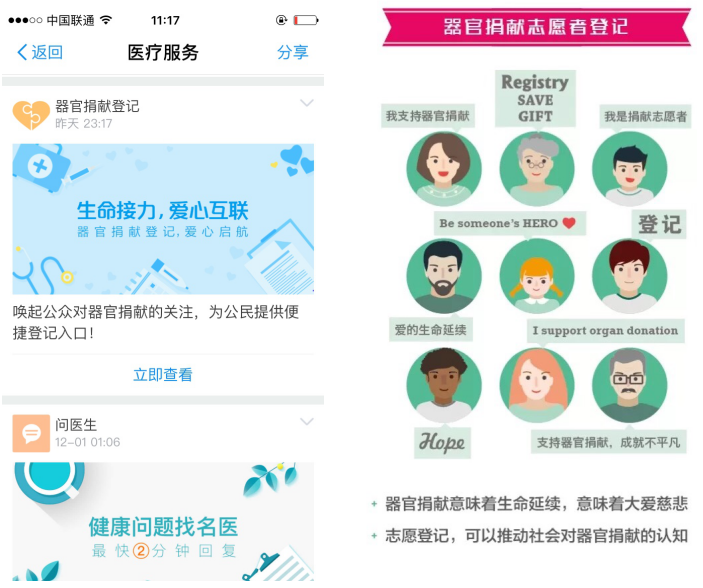
Alipay Organ Transplant Portal
1
Internet + Philanthropy: An Amplifier of Human Goodness
During the 2015 Nepal earthquake, Google launched a People Finder tool; when Paris suffered terrorist attacks, Facebook activated its Safety Check feature—both are excellent examples. In the realm of organ donation registration, the involvement of internet companies holds even greater significance.
Huang Jiefu, former Vice Minister of the Ministry of Health and Chairman of the China Organ Transplant Development Foundation, stated that integrating organ donation registration into Alipay, a national lifestyle services app, represents an unconventional yet effective approach to social mobilization.
Excellent internet products serve as amplifiers of human nature. Leveraging the advantage of real-name user verification, Alipay has integrated traditional organ donation registration channels into its platform, thereby lowering the barrier to entry. It is foreseeable that the breadth and convenience of this approach will bring expression of willingness to donate organs in China to a new peak.
It is understood that Ant Financial will create a “Love Account” for users within Alipay. This will be the fourth major account type, following funds, credit, and the Ant Forest “Carbon Account.” In the future, all charitable acts performed by users within the Alipay app will be recorded in this heartwarming account, with voluntary organ donation registration being one such example.
When Apple launched the organ donation registration feature on iOS, some media outlets sparked online discussions with the headline, “How about China? (When will it be China’s turn?)” Today, China’s internet community can finally respond: China is already on its way.
2
China Organ Transplant Development Foundation
China Organ Transplant Development Foundation (hereinafter referred to as the “Foundation”) is a public fundraising foundation with a public welfare orientation, serving both domestic and international communities. It is under the supervision of the National Health and Family Planning Commission of the People’s Republic of China and was officially registered with the approval of the Ministry of Civil Affairs. Established in 1995, the Foundation was founded by Professor Qiu Fazu, a renowned medical scientist in China. Currently, Professor Huang Jiefu, Standing Committee Member of the National Committee of the Chinese People’s Political Consultative Conference and Director of the China Organ Donation and Transplantation Committee, serves as the Chairman of the Foundation (legal representative). Ms. Liu Xiuqin serves as Vice Chairwoman and Secretary-General.
The Foundation’s mission is to extensively engage and unite domestic and international organizations and individuals concerned with the development of organ transplantation, within the ethical framework established by the Regulations on Human Organ Transplantation and relevant laws and regulations. It aims to promote voluntary, unpaid donation and equitable allocation of human organs, strengthen academic research on organ transplantation in China, enhance the quality and standards of organ transplantation services, and advance the development of organ transplantation in China.
The Foundation’s business activities include: participating in the development of the organ donation system (including organ procurement and allocation systems); supporting basic, clinical, and ethical research and applications related to organ transplantation and donation; providing humanitarian assistance to families of organ donors; organizing domestic and international academic exchanges and training programs on organ transplantation; carrying out activities related to organ transplantation and donation; and recognizing and awarding collectives and individuals who have made outstanding contributions to the development of China’s organ transplantation and donation cause.
In 2010, Huang Jiefu, then Vice Minister of the Ministry of Health, spearheaded the pilot program for citizen organ donation, which was formally established as the national citizen donation system in 2013. Within just a few years, the total number of organ donation cases in mainland China reached 4,518, involving more than 12,000 organs, ranking first in Asia and second worldwide, after the United States.
In July 2015, the China Organ Transplant Development Foundation received a donation of RMB 8 million from the Li Ka Shing Foundation as its seed fund.
3
Current Issues in Organ Donation in China
The benefits of organ donation are self-evident, and the prevalence of organ donor registration is also a key indicator of societal progress. In the United States, 130 million people are registered as organ donors. In China, however, fewer than 80,000 people are currently registered. Given that the U.S. population is only one-fourth that of China, this disparity is even more pronounced.
Is it that Chinese people lack compassion? Not at all. A Public Willingness Survey on Organ Donation conducted among the Chinese population in December 2016, supported by the World Health Organization, showed that 83% of respondents were willing to become organ donation volunteers. However, more than half of those unwilling to register cited “not knowing where to register or finding the procedures too cumbersome” as their reasons.
Under the traditional organ donation registration process, members of the public must first search for the registration website on their own. Upon accessing the registration page, they are required to provide multiple pieces of personal information (with some channels mandating as many as 14 fields). Many individuals lose patience during this process and ultimately abandon their registration attempts.
In the United States, the solution to this problem has been to harness the power of the internet, with Facebook and Apple engaging in this effort early on. Within less than a month of Facebook launching its organ donor registration feature, the number of registrants reached a record high. The collaboration between Ant Financial and state-run foundations represents a proactive attempt to tap into the social mobilization potential of open internet platforms. The viral effect of online philanthropy also helps enhance China’s humanitarian image on the international stage.
In addition to the cumbersome procedures,In China, the actual number of people awaiting organ transplantation each year exceeds 20,000, while there are only a few hundred transplant surgeons nationwide, capable of performing approximately 10,000 procedures annually. Only 169 hospitals are qualified to conduct organ transplant surgeries, including over 70 for liver transplantation, more than 90 for kidney transplantation, 20 for heart transplantation, and fewer than 20 for lung transplantation.
Currently, in regions such as Beijing, kidney transplantation costs at least 300,000 yuan, while liver and heart transplants cost at least 600,000 yuan. As organ transplantation is not covered by medical insurance, most families struggle to afford it, resorting to borrowing money, selling their homes, or fundraising.
Moreover, lifelong medication poses a significant financial burden. In regions where post-liver transplant anti-rejection therapy is not covered by medical insurance, annual drug costs can reach tens of thousands of yuan. Even in areas where such treatments are included in the medical insurance reimbursement scheme, patients still need to pay out-of-pocket for certain essential medications.
4
The Evolution of Organ Transplantation Policy in China
Since the State Council promulgated the “Regulations on Human Organ Transplantation” in 2007, China’s human organ transplantation work has gradually proceeded along a legalized and standardized track, with human organ donation work advancing in an orderly manner and achieving positive progress.
In September 2013, the “Provisions on the Procurement and Allocation of Human Donated Organs (Trial),” issued by the National Health and Family Planning Commission, officially came into effect. Donated organs must be allocated through the “China Organ Transplant Response System.” The allocation system relies entirely on factors such as the patient’s medical condition and waiting time, thereby minimizing human interference in organ allocation and ensuring greater transparency and fairness in organ transplantation.
The Provisions also specify that provincial-level health and family planning administrative departments must, under the unified leadership of the National Health and Family Planning Commission, establish one or more Organ Procurement Organizations (hereinafter referred to as OPOs) composed of transplant surgeons, neurologists and neurosurgeons, critical care physicians, and nurses. The procurement of donated organs must be carried out by OPOs in accordance with China’s Classification Standards for Donation after Cardiac Death. Relevant management regulations for OPOs shall be formulated separately by the National Health and Family Planning Commission.
5
The Two Firsts in Organ Transplantation
In 1972, China’s first human organ transplant surgery was performed at Zhongshan Hospital in Guangzhou; today, it has become one of the largest organ transplant centers in China.
On February 24, 2015, Zhejiang Province’s first cross-border human organ donation was completed in Hangzhou, with transplantation surgeries performed overnight. During the Spring Festival, a French international student met with an accident while traveling in Hangzhou, Zhejiang. The young man had expressed his wish to donate his organs after death, and his family fully supported this decision. On the evening of February 24, when the young man’s heart stopped beating, his parents and brother, who had rushed from France, decided to donate his organs to Chinese patients suffering from severe illnesses. Organs donated by the young man, including his liver and lung lobes, have already saved the lives of four patients in China. Reportedly, this marks the second successful case of cross-border organ transplantation in China.
6
Principles of Organ Allocation
Information regarding the donor and their donated organs will be entered by the Organ Procurement Organization (OPO) into the China Organ Transplant Response System (COTRS). The OPO is responsible for retrieving, preserving, and transporting the donated organs, and shall coordinate with the hospital where the recipient on the transplant waiting list is located to confirm the handover of the donated organs in accordance with the allocation results generated by the organ distribution system.
When medical institutions at all levels and their medical personnel identify potential donors, they shall proactively report to the Organ Procurement Organization (OPO) designated by the provincial health administrative department. Referring potential donors to other institutions, organizations, or individuals is prohibited.
The principles of organ allocation are based on the patient’s medical needs and the urgency of their condition, such as disease severity and waiting time, as well as donor-recipient compatibility to ensure long-term survival of both the donor and recipient, which collectively determine the priority ranking for organ distribution.
The National Health and Family Planning Commission stipulates that any unauthorized allocation of donated organs outside the organ distribution system shall be penalized in accordance with the law; cases suspected of involving the buying and selling of donated organs shall be referred to public security organs and judicial authorities for investigation and handling.
7
Scope of Organ Donation
The scope of organ donation includes cell donation, tissue donation, and organ donation.
Cell donation refers to the extraction of viable cell populations from a healthy individual and their infusion into another person in need of medical assistance. The most typical clinical example is bone marrow donation to support patients requiring bone marrow transplantation.
Tissue donation refers to the donation of parts of the body’s tissues to individuals in need of medical assistance. These tissues include skin and corneas.
Organ donation promotional materials, bones, tendons, blood vessels, nerves, etc. A donor can, in accordance with their own wishes, simultaneously donate multiple types of tissues to those awaiting transplantation.
Organ donation refers to the donation of a viable organ from one individual to another person requiring transplant therapy or to a medical school. Recipients typically suffer from critical conditions that are no longer curable by other therapeutic methods. By the 1960s, successful transplants had already been performed worldwide, including heart, kidney, liver, pancreas, lung, small intestine, and multi-abdominal organ transplantation.
8
Spain—The World’s Leading Country in Organ Donation
Spain has the highest organ donation rate worldwide. In 2011, the number of organ donors reached 1,667, setting a new historical record. According to data from the Spanish National Transplant Organization (ONT), at least 7 out of every 100 organ donors globally are Spanish. Thanks to the selfless dedication of these donors, 4,218 organ transplant procedures were successfully performed in 2011, saving the lives of 445 patients.
Age discrimination in Spain’s organ donation sector has long been eliminated. In the 1980s, it was difficult to imagine using organs from donors over the age of 60; today, however, organ donation has transcended age barriers. Eduardo Martínez, a physician serving the National Transplant Organization (ONT), pointed out: “A healthy organ can still function effectively, regardless of its age.”
Moreover, Spain enacted its Organ Donation Act as early as 1979, establishing comprehensive regulations for organ donation. The law stipulates that all citizens in Spain are presumed to be organ donors unless they have “expressed opposition during their lifetime.” This policy was subsequently adopted by Switzerland, France, Italy, and Portugal.