

Rock Health Releases '2016 Digital Health Consumer Adoption Report': Telehealth Emerges as the Year's Biggest Highlight
A defining characteristic of consumers in the healthcare sector is their status as passive stakeholders. They navigate a complex medical system marked by rising prices and increasing health insurance deductibles, where information asymmetry is pronounced. Against the backdrop of patient-centered care gradually replacing medical paternalism, patients have become the core of healthcare. Just as the internet has transformed how we learn, communicate, shop, and work, it has also reshaped the way we manage our health.
NPR’s Planet Money program recently pointed out, “Healthcare is an indispensable part of our economy.” Rock Health has been observing and studying the interactions between consumers and the healthcare system, gaining deep insights into how the industry is being disrupted by technology.
Since the release of the “Consumer Orientation in Digital Health Report” last year, Rock Health’s national survey of more than 4,000 respondents this year is likewise rich in insights and valuable data. Conducted annually, this survey aims to better understand consumers’ perceptions and adoption of digital health, reveal their attitudes toward health privacy and trust, and measure overall consumer behavior. VCBeat (WeChat: vcbeat) has summarized the key findings and perspectives for you.
1
The Tipping Point of Consumer Health
1. Digital health reached a tipping point in 2016, as consumers adopted digital health tools at a record pace over the previous 12 months. Forty-six percent of consumers are now considered active digital health users, employing three or more categories of digital health tools (such as telemedicine and wearable devices), up from just 19% in 2015. Only 12% of Americans are non-adopters, a significant decline from 20% in 2015.
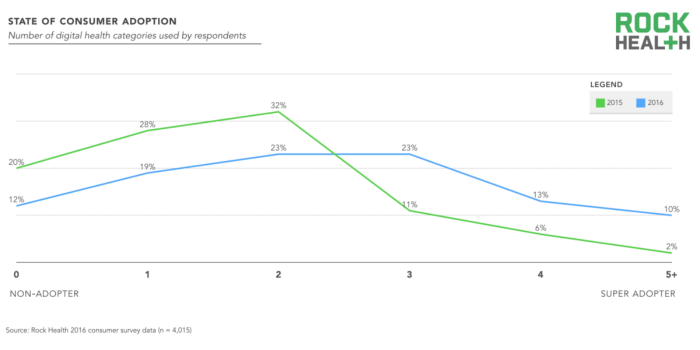
Consumer Acceptance Curve for Digital Health
2. Consumers’ willingness to pay has tripled compared with 2015, with 39% of consumers strongly agreeing that they are willing to cover medical expenses. This trend mirrors the rise in enrollment in high-deductible health insurance plans, which increased from 20% in 2014 to 29% in 2016 (Kaiser Family Foundation data).
3. Even emerging consumer technologies such as virtual reality and augmented reality are applicable to health-related use cases, including relaxation (7%), mental health (4%), rehabilitation (3%), and pain management (3%).
4. Most Americans are interested in obtaining electronic copies of their health records, and 20% of Americans have requested or downloaded a copy in the past six months. This widespread, consumer-driven trend toward the digitization of health data and ownership regulations is moving healthcare out of the traditional analog era.
5. Although consumers are concerned about the privacy and security of their health data, the vast majority (77%) are interested in sharing their health information, particularly to receive better care from their physicians.
6. Ownership and control of health data are important to consumers; sharing medical and health information is considered acceptable only under specific use cases. Nearly 87% of respondents stated that they have the right to decide who can access their health data, and nearly 86% indicated that they should be informed exactly which health data are being collected.
7. Americans are not as greedy as commonly perceived, as more people freely share their health data to contribute to medical research (62%) than do so for financial gain (42%).
8. Doctors and family members are the two groups most firmly committed to safeguarding and trusting the privacy of health data, whereas governments and technology companies are the least trusted.
9. Similarly, when asked which health entities best align with consumers’ health interests, physicians ranked at the top, while government agencies and technology companies ranked at the bottom.
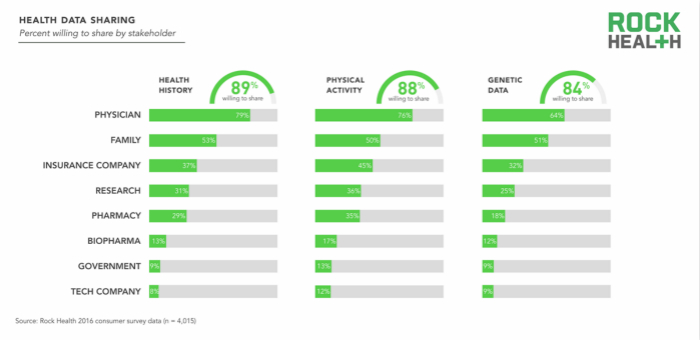
Sharing of Health Records (Left), Physical Activity (Center), and Genetic Data (Right) Among Different Occupational Groups
10. Despite the varying scope of its involvement in digital health, Google has consistently remained the most trusted technology company in this field. On the other hand, social media giant Facebook and IBM, the creator of Watson, are the least trusted technology companies.
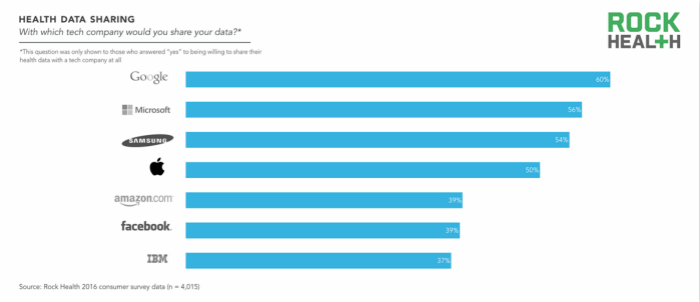
Consumer Ranking of Tech Companies Prone to Leaking Patient Health Data
2
Quantified Health
11. Most health-tracking behaviors primarily serve a psychological support function, with 54% of individuals tracking their weight and 58% tracking their medication.
12. Among those tracking their health, the most commonly recorded metrics using apps were physical activity (44%) and heart rate (31%).
13. The least likely data to be recorded in the application are blood pressure (14%) and medication adherence (10%).
14. Among users who have downloaded health apps, the majority (41%) develop a habit of discovering apps online or in app stores and continue to do so thereafter.
15. Nearly one-third of people downloaded health apps because they were recommended by their doctors.
3
Significant Surge in Wearable Device Usage
16. Nearly one-quarter of Americans own a wearable device, up from 12% in 2015.
17. The most popular wearable device manufacturers, suitable for all age groups, are Samsung (30%), Fitbit (26%), and Apple (22%).
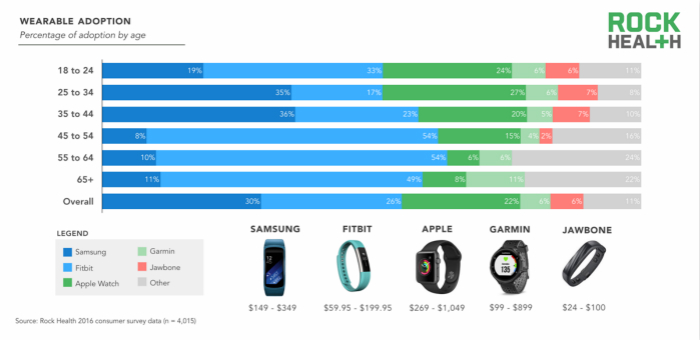
Usage of Wearable Devices Across Different Age Groups
18.75% of wearable device users purchased their devices out-of-pocket, 22% received them as gifts, and fewer than 2% obtained them from their employers.
19. Among those who purchased wearable devices, one-third made their purchases within the past three months, and two-thirds within the past six months.
20. Most wearable device owners aim to increase their physical activity, with other reasons including weight loss, improved sleep, and better stress management.
4
Surge in Telemedicine
21. The adoption rate of video-based telemedicine increased from 7% in 2015 to 22% in 2016, with the majority of usage occurring in the past three months.
22.30% of telemedicine visits were paid out-of-pocket by patients, compared with coverage through insurance (11%) and employers (10%) for other channels.
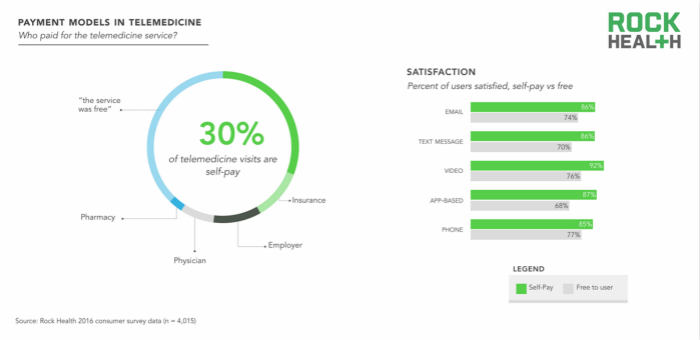
Payment Methods and Satisfaction with Different Media in Telemedicine
23. The most popular telehealth modalities are telephone (59%), followed by email (41%) and text messaging (29%).
24. The telemedicine medium with the highest satisfaction rate is live video, with 83% of consumers reporting moderate or extreme satisfaction.
25. Satisfaction rates exceeded 75% across all telemedicine platforms. Consumers were more satisfied with self-service payment options. If health insurance covers digital health technologies, it will drive an increase in adoption rates.
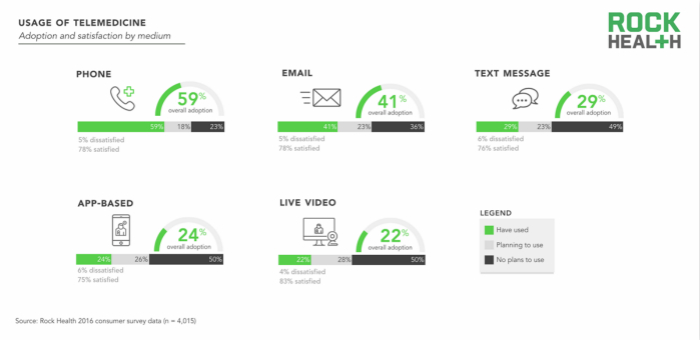
Usage of Different Media
26. More than one-quarter of consumers plan to use live video for medical care or to electronically send images or videos to their healthcare providers in the future.
27. Consumers aged 25–34 exhibit the highest adoption rate of telemedicine platforms, followed by those aged 35–44. Baby boomers (aged 55 and above) are the age group least likely to use telemedicine, although more than half access virtual healthcare services by contacting providers via telephone.
5
The patient continues to search on Google
28.56% of Americans search online for information about disease symptoms and then present their self-diagnoses to doctors (we’ve heard that doctors just love this!).
29. Sixty-two percent of Americans use the internet to search for information about prescription drugs.
30. Nearly half of Americans who search for health information online have asked their doctors to prescribe medications or discontinue specific drugs based on the information they found.
31. One-third of Americans have used the internet to gather information on dietary supplements in the past six months. Our own Labdoor provided data analysis on more than 750 supplements for 5 million users in 2016.
32.56% of Americans who seek information about nutritional supplements online purchase or discontinue use of supplements based on the information found.
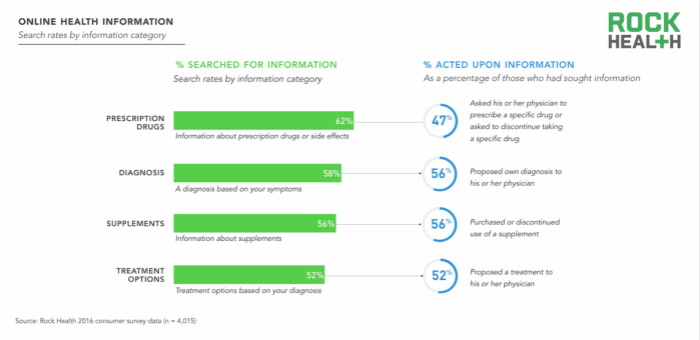
Types of Information Searched Online by Consumers
33. More than one-third of Americans have written online reviews about specific providers. Health-focused review platforms (such as ZocDoc or Healthgrades) are more popular than general review websites (e.g., Yelp).
34. When searching for doctors online, Americans prioritize quality of care the most, followed by insurance coverage and location. Cost is rated as the least important factor.
35. When searching for pharmacies online, location is the most important factor, followed by price and insurance.
6
Target Population for Digital Health
36.40% of Millennials (aged 18–34) own wearable devices, compared to only 26% of Gen Xers (aged 35–54) and just one in ten Baby Boomers (aged 55 and older).
37. Technology companies still have a long way to go in earning the trust of older adults, the largest consumer group in healthcare. While 84% of individuals aged 55 and older believe their physicians will safeguard their health data security, only 19% trust technology companies to do so. In contrast, 82% of those under 55 trust their physicians, and 38% trust health information technology companies.
38. Forty-two percent of Millennials use synchronous video telemedicine, compared to only 25% of Gen Xers and less than 5% of Baby Boomers.
39. Approximately half of Millennials communicate with their doctors via email, while one-quarter of Baby Boomers do the same.
40. Synchronous telephone calls are the most popular modality for seeking medical care or advice across all age groups, while synchronous video visits are the least popular.
41. In the past year, only 5% of individuals aged 55 and older used real-time video, and only 3% indicated that they plan to use this technology in the future.
42. Millennials are the most likely to request their health records (45%) in downloadable or electronic format, compared with nearly one-third of Gen Xers and one-quarter of Baby Boomers who would choose to do so.
43. Among Baby Boomers, the most popular method for tracking health across all categories is monitoring head health; however, among those who use apps, 25% track physical activity, 17% track sleep, and 10% track heart rate.
44. One-third of Millennials downloaded a health app in the past 30 days, compared with 20% of Gen Xers and only 7% of Baby Boomers.
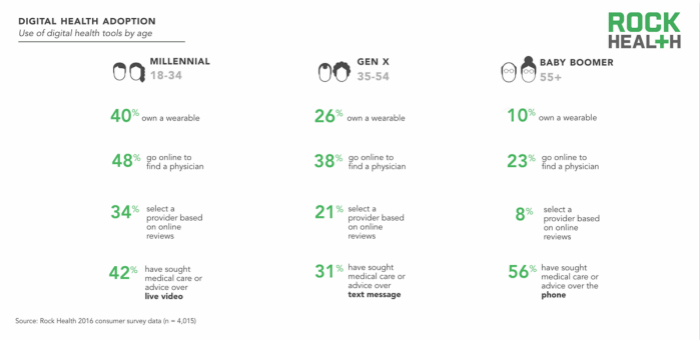
Adoption of Digital Health Across Different Age Groups
7
Digital Health Adoption Varies by Health Status
45. Individuals with poor health are more willing to share their medical history with all stakeholders compared to those in good health. Notably, they are 12% more likely to share this information with pharmacies and 11% more likely to share it with physicians.
46. Only 8% of consumers who rated their health as good purchased wearable devices last year. Among them, 53% made the purchase merely as a trial, 42% became more active exercisers, and 35% used the devices for weight loss.
47. Access to health information is particularly important for those in poor health; 28% of them strongly desire an electronic copy of their health records, compared to only 19% of those in good health who are interested in doing so.
48. Individuals who rate their physical health as very good are more likely to present their own diagnoses to physicians and 7% more likely to propose treatment plans based on online information.
49. Although 18% of healthy individuals decided to use health apps based on their insurance company’s recommendations, only 3% of those in poor health made the same choice.
50. Healthy individuals engage more actively in commenting, whether regarding people they frequently interact with or places they often visit. They most frequently comment on home care aides and nurses (64%), nursing homes and long-term care facilities (61%), and physical therapists (55%).
The views presented in this article are derived from the Rock Health report “A Tipping Point in Consumer Healthcare 2016.” VCBeat has compiled and summarized these viewpoints. For the full report, please contactRockHealth Purchase and Download.