

Healthkeepers Files IPO Prospectus: How a Health Data Startup Won Over Multiple Fortune 500 Companies

Rational on one hand, restless on the other: Qi Yi (Healthkeepers)Founder and CEO, Jia Lü
Lü Jia, Founder and CEO of Healthkeepers.
After moving from Chengdu to Shanghai, Lu Jia set a small goal for himself: to start his own business within three to five years. If he had not taken that step by then, he would leave the city.
In October 2015, Lü Jia began preparing for the launch of Qiyi (Healthkeepers). In November 2016,HealthkeepersOfficially established. During this period, it collaborated with multiple Fortune 500 companies on health management through data analysis., covering more than 35,000 employees. SheXiao Yan「I Am a Fortunate Person」,Her sensitivity to data enabled her to enter the market at the right time.
When I first met Lv Jia, she had a refined and elegant short haircut and wore a well-tailored business suit, exuding the qualities of an intellectual and astute female entrepreneur. At the moment the interview began, Lv Jia appeared slightly nervous,「To prepare thoroughly, I started taking notes three days ago.」Asked if this was her first interview, she said no. “I just hope to maintain my thirst for the unknown; that state of mind is quite intriguing.”
Born in Northeast ChinaLv Jia, who is also of Manchu ethnicity, prides herself on possessing the inherent vigor and spirit of distant nomadic peoples in her very bones."Excitement Point!"Whether it is a catchphrase or not, I heard her mention this term repeatedly during the interview. Amidst her meticulously logical remarks, one could clearly senseLv JiaRigorous Thinking. If one must assign her a label—"Rationality and Restlessness", two seemingly contradictory words that, when applied to her, seem to fit together quite naturally.
At West China School of Public Health, Sichuan University, Lü Jia majored in Health Insurance under Public Health Administration—a field closely intertwined with medicine. After completing her undergraduate studies, she chose not to pursue a master’s degree. In her own words, as someone who is restless by nature, she always hoped to venture out into the world at an early stage.
After spending two years in claims settlement at Taiping Life Insurance, Lü Jia transitioned to Generali China Life Insurance, where he worked in sales for five full years. Subsequently, he spent three years at IH Health and IH Insurance Brokers, assuming dual responsibilities overseeing health checkup services and insurance brokerage operations.
In 2013, Lü Jia traveled from Chengdu to Shanghai, where she set a small goal for herself.“In 3 to 5 years,Must Start a Business, if you haven’t taken this step by then, leave the city.”
Over the following two years, the capital market witnessed dramatic upheavals, and internet healthcare began to take shape. Lu Jia’s entrepreneurial vision, initially vague and uncertain, gradually evolved into a clear and coherent strategy.Years of experience in the insurance industry have given Lv Jia access to a vast amount of insurance data. These dataLaid out before her, it was as tempting as a can of delicious tuna, stimulating Lü Jia’s nerves with excitement. If she could transform the singular, cold data into something more diverse and multidimensional, it would certainly be intriguing. Yet at that time, she had no clue how to proceed; the key to the problem still lay in that「on the can opener.」
After arriving in Shanghai, the diverse array of health data became a new source of excitement, providing Lu Jia with a sudden insight.With a formal background in public health and management experience in the insurance industry, she has an innate sensitivity to numbers. She keenly recognized that health data contains a wealth of valuable medical information—including physical examination results, disease diagnoses, and insurance coverage amounts—that serves as a rich source for in-depth analysis. Integrating and analyzing data from physical examinations, insurance records, and employee health programs can yield insights that play a significant role in corporate health management.
A data model flashed in her mind, like a Rubik’s Cube of the universe whose solution had just been revealed, laying bare the nascent form of Healthkeepers.
Looking back through the timeline, it becomes evident that the founding of Healthkeepers was no impulsive or accidental endeavor. Breaking with tradition to achieve unexpected success is an innate trait ingrained in Lü Jia’s character. Whether in her first job as an ordinary claims adjuster, or later as a sales representative, broker, and consultant, she has consistently been breaking away from her former self.In her resume,Innovation has always been the central thread, and Healthkeepers has been built up incrementally along this very line.
With innovation as the catalyst, entrepreneurship followed naturally. In October 2015, seeing that the timing was ripe, Lü Jia began preparing to launch Qi Yi (Healthkeepers).
HealthkeepersThe core team consists of nine members, including medical statistics experts with years of experience at U.S. clinical institutions, who have repeatedly participated in national-level population health indicator monitoring and the design and management of multiple health and hygiene projects; experts with over ten years of practice in public hospitals, possessing extensive clinical experience and operational expertise in primary care medical institutions; North American and Hong Kong actuaries formerly employed by major insurance companies such as AXA New York, Manulife Canada, and HSBC Hong Kong, with over ten years of experience in the domestic and international insurance industries and data analysis; and an investor deeply engaged in the insurance and healthcare services sectors.
An outright elite team, six months, averageDailyAfter 12 hours of intensive work, the first-generation data model feature of Healthkeepers was officially launched in April 2016.
Fortune 500 companies typically provide their employees with annual health check-ups, group commercial insurance, Employee Assistance Programs (EAP), and other health promotion initiatives. Following these examinations, employee health data is generated, and the examination centers submit comprehensive summary reports to the employers. However, this valuable data often goes unused and unnoticed.“It is a great pity that data remains dormant; enterprises could have leveraged it to greater effect.”
Insurance and health checkups share similar dynamics. When enterprises procure group medical insurance, the insurer transmits accumulated data back to the enterprise on an annual basis. Once in possession of this data, it becomes a logical imperative for enterprises to explore how to unlock deeper value from it.
“These data are certainly valuable; it is just that no one has been able to conduct a comprehensive analysis and interpretation to yield meaningful insights.”Just as a swift horse needs only a discerning eye to recognize its worth, Lü Jia hopes that Healthkeepers can serve as the discerning steward of data. This is why she centered the product’s core on health data modeling from the very beginning.
How much real value do these data generate for enterprises or individuals? Lu Jia already has a complete answer in mind.「There are two dimensions. First, when providing health management services to employees, enterprises can observe trends over time, implement targeted health interventions based on data-driven model recommendations, and subsequently verify changes in health outcomes. Meanwhile, corporate health management can reduce total healthcare expenditures for enterprises.」
In the United States, there is an open secret in health management for both enterprises and individuals: the 90/10 rule. Specifically, 90% of individuals and enterprises that adopt health management see their medical costs reduced to 10% of the original amount, while the 10% that do not engage in health management experience a 90% increase in medical costs compared to before.The reason is simple: companies that implement health management programs see a significant reduction in employee morbidity and hospitalization rates, with the vast majority of disease risks being nipped in the bud through various preventive measures. Even if an employee does fall ill, prompt recovery is often achieved thanks to the “Three Early” principles (early screening, early diagnosis, and early treatment). Consequently, enterprises experience a marked decline in their total healthcare expenditures for employees.
So, what type of data does Healthkeepers actually need to mine? Lu Jia pushed up his glasses.「The logic and dimensions of the data are multifaceted, yet they originate from two primary logical frameworks. The first is the distribution of health risk levels across the entire population, identifying individuals who are relatively healthy, those who are less healthy, those potentially facing clinical disease risks, and those whose conditions may be more severe. The second dimension pertains to the distribution of corporate healthcare expenditures, such as which diseases incur higher costs.」
The data model serves as Healthkeepers’ entry point. While delivering solutions, it also integrates the most effective service providers—such as medical institutions, health examination centers, and chronic disease management companies—to address corresponding pain points for enterprises, thereby creating a complete ecosystem. “I hope that Healthkeepers will leverage data-driven intelligent analytics to establish more diversified and open connections with service providers across the health industry chain.”
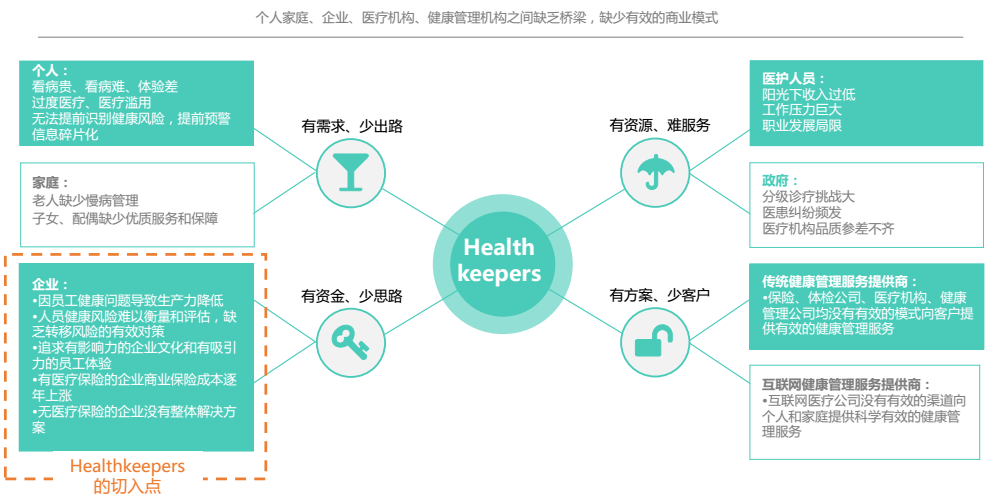
Healthkeepers operates under two models: a B2B model targeting enterprises, and a B2B2C model targeting enterprise employees. The most critical element in this framework is credit authorization, as medical data differs fundamentally from data in any other industry.This involves privacy security and ethics.“You cannot casually use other people’s data for data analysis; privacy must always be the top priority. If you do not respect it, no one will respect your product!”」“Lu Jia said resolutely.”
Whether in the B2B or B2B2C model, unless employees grant simultaneous authorization to both Healthkeepers and the enterprise, only Healthkeepers may access their personal data for further prompts and assessments. If users authorize both Healthkeepers and the enterprise to access their personal data, physicians and health managers within the enterprise can then retrieve such data to conduct subsequent evaluations and implement health promotion initiatives. For all other parties, the data remains completely restricted under a high level of confidentiality, akin to a black box.
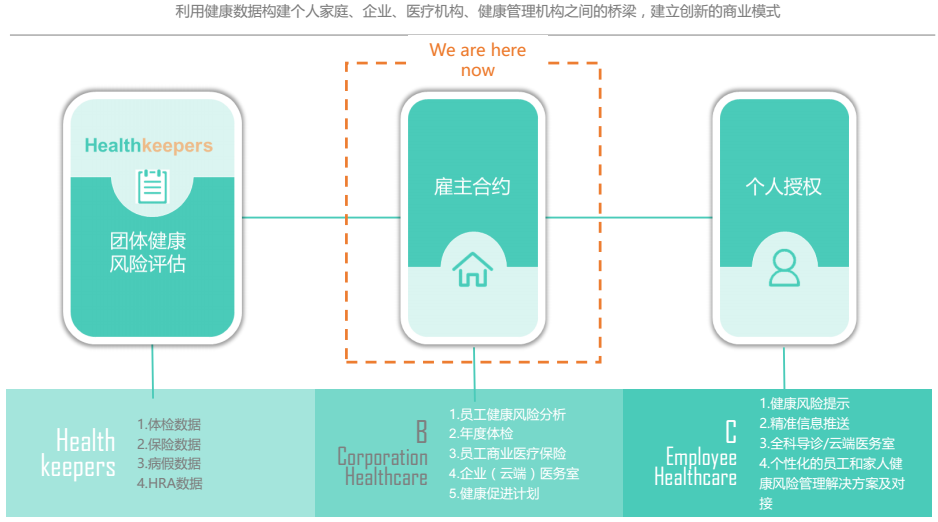
For individual consumers, companies arrange annual health check-ups and purchase commercial insurance for their employees each year. Employees can independently choose the type of check-up package they need, where to undergo the examination, or what kind of insurance plan suits them best, including how to file for reimbursement. In this context, Healthkeepers also delivers valuable health-related information and reminders to employees through its team of general practitioners, via both web and mobile platforms.
For B-side clients, the Healthkeepers data model provides health risk assessment results and generates commercial insurance and medical examination plans for the upcoming year, thereby delivering personalized solutions to enterprises. These solutions encompass optimized management of corporate infirmaries and medical staff, as well as a range of health promotion initiatives for employees, including Employee Assistance Programs (EAP), smoking cessation, and weight management.
In the B2B model, enterprise clients are the paying parties. In the B2B2C model, employees do not pay for services purchased by their employers; however, users can opt for additional paid features on the platform, akin to value-added services.
Since the beginning of this year,Healthkeepers has partnered with multiple Fortune 500 companies, serving over 35,000 users.. Among themA multinational corporation successfully reduced the average per-capita outpatient claim cost for commercial health insurance from RMB 360 to RMB 270 through Healthkeepers, thereby enhancing employees’ overall health levels while further optimizing its integrated benefits management capabilities.
China’s health checkup market began to develop around 2002, and its current total market size has approached RMB 100 billion. Group commercial insurance started developing in the late 1980s, more than 20 years earlier than health checkups, yet its current market size is only RMB 40–50 billion. “The longer development timeline coupled with a market size that lags far behind that of health checkups fully demonstrates how weak primary care is in China.”
“Healthkeepers focuses on the primary care market, which serves as a user entry point even more upstream than basic medical care. It leverages B-side payment capabilities while maintaining long-term C-side user stickiness, extending into health management systems through the dual pillars of physical examinations and commercial insurance. Therefore, Healthkeepers has vast growth potential—a insight I judged accurately.”Lu Jia said with considerable confidence.
Data analysis, in a sense, is a branch of the scientific domain. It requires the application of medical statistics, preventive medicine, and clinical medicine models, employing systematic methods for analysis. From a business perspective, it falls under consulting services. Chinese people tend to be pragmatic; they feel more affinity toward tangible, concrete things than toward abstract data. This mindset has led many in China to misunderstand disciplines centered on rational analysis. “We often lack the patience to recognize the long-term value that consulting services can create.”
HealthkeepersThe decision to expand business in the Shanghai market and radiate nationwide from a first-tier city stems fromIn Lü Jia’s bold assessment, Healthkeepers’ persistent efforts represent a value depression. The national market has already seen improvements, particularly in first-tier cities, where many enterprises have expressed strong demand for consulting and corporate planning services.
Before the interview concluded, the reporter asked Lv Jia, “After starting your business, where will your next source of excitement lie?” Lv Jia paused briefly, then smiled and replied, “Entrepreneurship is innovation; the difference lies in whether you are innovating for others or for yourself. If innovation is the sole objective, doing it for others and for yourself are, to some extent, aligned. The key remains how to create a new product, service, or business model. For me, innovation isOne"A higher logic that transcends excitement and security from a spiritual perspective."
Ultimately, innovation is the source of excitement.「"A journey of a thousand miles begins with a single step."」,Innovation is no different. It will be truly intriguing to see what becomes of Healthkeepers under the restless drive of Lü Jia.