

Luoning Zheng First Reveals Jiuyi160's Breakthrough Strategy and Profit Segments in Newly Filed Prospectus

Luo Ningzheng, CEO of JiuYi160
The year 2016, which is coming to an end, in “Jiuyi 160“...was far from tranquil. On December 23, 2016, at the Beijing Star Base, Luo Ningzheng attended the ‘Top 100 Future Healthcare Forum’ hosted by VCBeat. The forum brought together more than 500 government officials, hospital presidents, industry elites, and media representatives, including participants from government agencies, Grade A tertiary hospitals, listed companies, healthcare unicorns, and well-known media outlets.”
Additionally, Li Datao, founder of VCBeat, joined the guests in unveiling the 2016 China “Top 100 Future Healthcare Companies” list, aiming to identify and uncover the core forces driving the future of China’s healthcare industry through these 100 enterprises. Subsequently, awards were presented for the Most Propulsive Listed Company of 2016, the Most Influential Investment Institution, the Most Promising Enterprise, the Most Watched Enterprise, and the Most Innovative Hospital President.
At this forum, Luo Ningzheng presented “Jiuyi160"How did it break through the fierce competition among numerous online appointment registration platforms?"
"Survive first, then wait for opportunities."
“160 Doctor“VCBeat” is a mobile healthcare platform under Shenzhen Ningyuan Technology Co., Ltd. Established in 2005, it was the first company listed on the New Third Board in the mobile internet healthcare sector. At that time, Luo Ningzheng was serving as the Director of the Computer Center at Shajing People's Hospital in Bao'an District, Shenzhen.
He has worked in hospitals for over a decade and conceived the idea of developing an appointment registration system at an early stage.
“Because I have a personal passion for the internet and possess technical expertise, having worked in hospitals for many years, I aim to thoroughly and meticulously accomplish tasks with an engineer’s mindset. Hence, I adopted the positioning of ‘Tranquility Yields Far-Reaching Impact’—Ningyuan Technology.”
Launched in 2006, “Jiuyi160” early version, but this version did not offer appointment registration services. At that time, Luo Ningzheng approached the hospital to discuss collaboration, only to be turned away. Early “Jiuyi 160"We provided health education to users for over a year, but it proved ineffective and failed to retain users. We truly began entering the appointment registration business in 2009."
Having been immersed in the healthcare industry for many years, Luo Ningzheng believes that healthcare is a highly complex sector characterized by multi-sided dynamics and non-market-oriented features. As shown in the figure below:
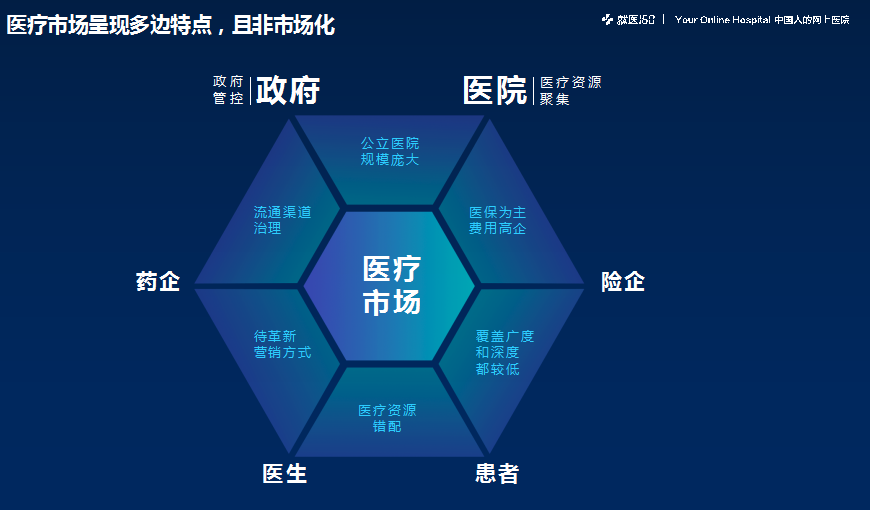
In this diagram, doctors and patients form the foundational base of healthcare services, while hospitals and government entities occupy the top tier. From a broader perspective, the healthcare service market is inherently non-market-oriented. This explains why mobile health enterprises struggle to achieve profitability; even with mature business models, there remains a lack of willing payers. This challenge is primarily reflected in the following aspects:
First, on the hospital side, such as “Jiuyi 160“They expanded into hospitals by providing payment processing services, pushing examination reports, and even donating servers—all free of charge. On the patient side, they offered free registration and subsidies, launching numerous cash-burning initiatives. This incurred substantial costs and consumed significant manpower, yet all these services were provided for free. This is the first harsh reality.”
Second, on the physician side, although there are many doctors currently, very few are truly willing to provide online consultations and services, and even fewer are willing to pay fees to appointment-scheduling apps. In the United States, there is a company whose physicians are willing to pay the app company $200 per month.
Third, on the patient side, due to the presence of mature commercial insurance companies abroad, 40% of patients' medical expenses are covered by commercial insurers. Internet healthcare companies serve as an intermediary in this ecosystem, reducing both medical and membership costs, which makes insurers willing to pay for these services. Consequently, a large number of insurance companies are willing to cover the costs for mobile healthcare enterprises because they help lower their insurance payout costs. However, such a business model is entirely absent in China.
“Your first priority is to find a way to survive, by any means necessary, and then wait for an opportunity,” said Luo Ningzheng.
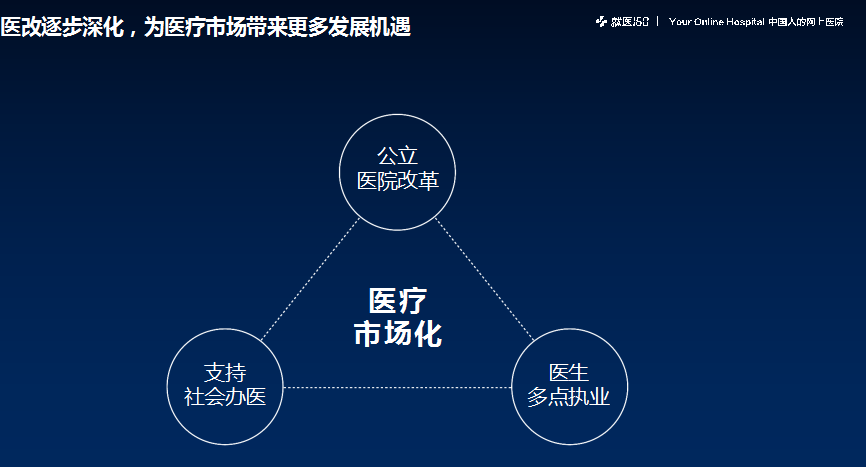
“We look forward to large hospitals embracing more internet healthcare startups that leverage information technology to enhance medical services, we anticipate greater mobility of high-quality hospital resources, and we hope for more open policies. This will enable internet healthcare enterprises to develop more rapidly and create new opportunities for industrial restructuring.”
Fortunately, since 2015, the Chinese government has continuously issued healthcare reform policies. From the “Several Opinions on Promoting and Regulating Physicians’ Multi-Site Practice” and the “Announcement on Matters Concerning the Full Implementation of Electronic Drug Supervision by Pharmaceutical Production and Distribution Enterprises,” to the “Several Policy Measures for Promoting the Accelerated Development of Socially Run Medical Institutions,” these initiatives all demonstrate a firm commitment to implementing healthcare reform.
From Appointment Registration to the “Internet + Healthcare” Ecosystem
As policies continue to be relaxed, “Jiuyi 160"The fields it has ventured into are also expanding, ranging from appointment registration to tiered diagnosis and treatment platforms, the 160 Mall, online hospitals, and more, gradually forming an Internet+ healthcare ecosystem."
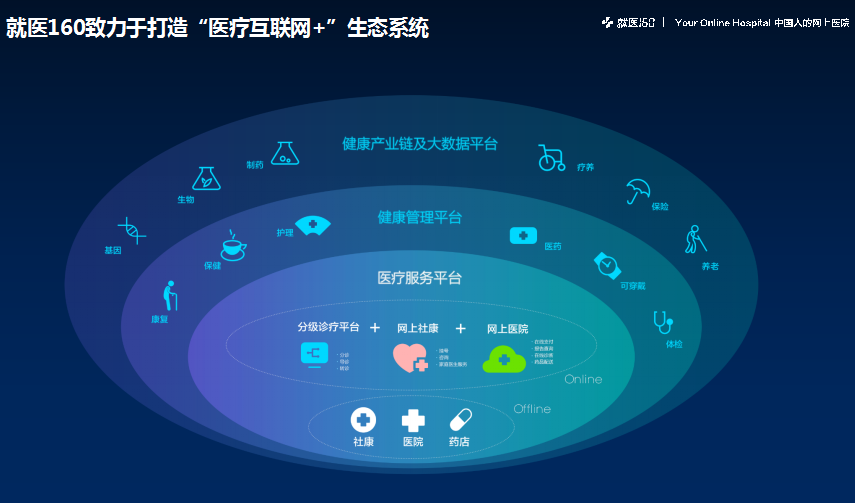
First, “Jiuyi 160” serves some large public hospitals by providing them with appointment registration, payment, or comprehensive end-to-end services. In addition, it also serves communities by offering tiered diagnosis and treatment services and family doctor contract services, thereby serving as ""Jiuyi 160"the foundation of the entire platform’s services. “As our business now covers many hospitals, daily active users on the platform have exceeded 2 million.”
Then, building on the basic service modules of these free services, “Jiuyi 160” connects with a large number of B-side clients, such as private hospitals, county-level hospitals, postpartum care centers, and health examination centers, directing user traffic to them and revitalizing underutilized hospital resources. It generates revenue on a monthly or project basis, which constitutes part of its profitability.
The second profit-generating segment is based on a platform model, featuring the launch of the 160 Mall for product sales, including health supplements, home medical devices, and other health-related products. Additionally, the 160 Pharmacy has been established.
In Luo Ningzheng’s view, the “Jiuyi 160” platform holds extensive user and patient data, accumulating substantial records of appointment-seeking user journeys, as well as numerous prescription and payment data points. The company aims to effectively integrate pharmaceutical supply chains through an internet-based approach. Currently, many hospital pharmacies no longer generate revenue and may even become a financial burden for hospitals. Through the 160 Pharmacy service, these hospitals can arrange direct delivery of required medicines and products to patients. In addition to pharmaceuticals and general merchandise, the platform also offers e-commerce-enabled medical services.
Since engaging in e-commerce inevitably involves JD.com and Taobao due to their extensive e-commerce ecosystems and platforms, it is important to recognize that healthcare service e-commerce differs significantly from traditional e-commerce. First, “Juyi 160” brings its own traffic, thereby saving substantial e-commerce costs. Second, a major pressure point for traditional e-commerce lies in price transparency and razor-thin profit margins. In contrast, users of healthcare services prioritize safety and quality. For instance, patients undergoing surgery will not choose a different hospital simply because Peking Union Medical College Hospital charges RMB 500 more than other facilities.
For these reasons, we are building this healthcare e-commerce platform on the foundation of medical services. Therefore, “Jiuyi 160” has established a presence in both the B2B and B2C sectors. We will remain focused on these two core areas in the future. Despite numerous challenges and pitfalls, we are committed to persevering.
Third, in terms of tiered diagnosis and treatment, “Jiuyi 160“Established a patient-centered approach to reengineer care pathways, enhance healthcare efficiency, and improve the patient experience.”
“The core of tiered diagnosis and treatment lies in resolving the issue of benefit distribution. Physical hospitals can address this through medical consortia and hospital groups, while internet healthcare startups can make breakthroughs by focusing on the patient and physician sides,” said Luo Ningzheng.
From the patient’s perspective, the focus is primarily on cultivating patients’ health-related behavioral habits and providing pre-consultation education. For instance, in cases of pediatric colds and fever, the initial consultation should take place at the community level; if community physicians determine that home-based interventions such as cold compresses and supportive care are sufficient, further referral may not be necessary. Additionally, it is essential to establish a knowledge base for tiered diagnosis and treatment.Which disease symptoms are associated with which hospital departments; finally, through the 160 Doctor API, physicians are integrated into the patient referral process to screen for specialized care candidates.
During the triage process, the patient-centered tiered diagnosis and treatment platform strategy also takes into account physicians’ needs. The “Jiuyi 160” tiered diagnosis and treatment platform uses “condition priority” as its entry point, leveraging the internet’s advantage in connecting information to effectively link patients and doctors, mobilize specialists’ enthusiasm, and reasonably match medical resources through a model of free patient applications plus physician review, thereby improving the efficiency of care for referred patients. Meanwhile, the “Jiuyi 160” tiered diagnosis and treatment platform fully supports contracted services with community general practitioners, providing patients with initial consultation and guiding them toward precise medical care.
In addition to patient guidance and triage, the "Jiuyi 160" platform leverages its extensive resources of physicians, patient base, and traffic to facilitate "two-way referrals" between hospitals and community health centers. By integrating with Hospital Information Systems (HIS), it supports online referrals and can serve as an operational platform for the existing tiered diagnosis and treatment system.
2017 Keywords: Standardization, Value, Responsibility
“Therefore, in building the ‘Internet+ Healthcare’ ecosystem, we will systematically enhance our capabilities.” In 2017, our strategic focus will center on the six characters: standardization, value, and responsibility.
First, as a platform service provider, "Jiuyi 160" is developing many new service standards to improve medical services, similar to the JCI hospital accreditation standards, in order to regulate internet-based medical services. This is something we will focus on doing.
Next is value, which means providing valuable services to doctors, hospitals, and patients. In previous collaborations with many institutions, we provided an entry point and a backend system. However, to better serve them by helping match patients more effectively and identifying users who are truly suitable, refined operational efforts are required.
On the patient side, capabilities for continuously extending services—from appointment registration to payment and chronic disease management—require ongoing enhancement.
Most importantly, there is accountability. In the wake of the Wei Zexi incident, for platform-based enterprises, responsibility remains an undeniable fact, regardless of whether it is formally assumed. Safety is paramount in medical services. Although “Jiuyi 160” operates as a connectivity platform, it must strive for continuous improvement to help patients find better physicians and ensure that information and reviews for all institutions affiliated with the 160 platform are objective and fair.
“We have already achieved break-even, and we will continue to enhance our platform operations in the future. We are confident that the industry will keep improving. Moreover, we are more inclined to collaborate with all stakeholders to build an open ecosystem and framework.”