

How to Invest in Healthcare Projects in 2017: Insights from Five Leading Investment Firms
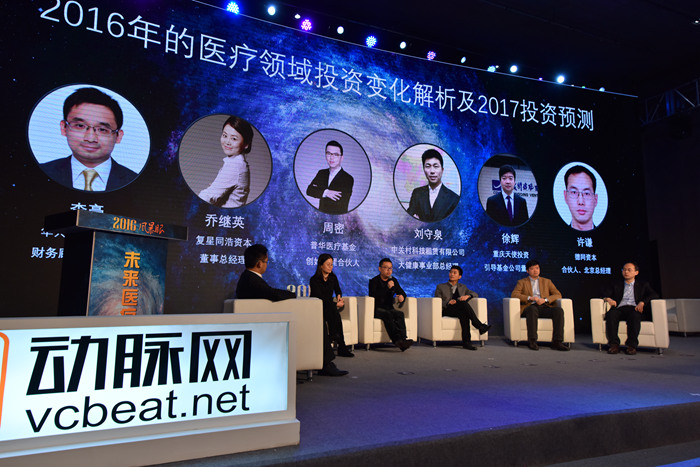
On December 23, the VCBeat Future Healthcare 100 Forum officially opened in Beijing.InMorningbyModerated by Mr. Li Hao, Head of the Financial Advisory Department at China Renaissance’s Zhulu XAt the roundtable discussion, Qiao Jiying, Managing Director of Fosun Tonghao Capital; Zhou Mi, Founding Managing Partner of Puhua Medical Fund; Xu Hui, Chairman of Chongqing Angel Investment Guidance Fund Co., Ltd.; Liu Shouquan, General Manager of the Big Health Division at Zhongguancun Technology Leasing Co., Ltd.; and Mr. Xu Qian, Partner at DT Capital Partners, summarized and shared insights on their 2016 investments, while also analyzing and forecasting investment trends for 2017.
2016 Investment Activities of Fosun Tonghao:
The first direction is new technologies.Including genetic testing, diagnostic technologies, novel medical devices and materials, and new drug development platforms.
The second direction is big data and artificial intelligence. Fosun is now the national distributor of the da Vinci Surgical System in China.
The third direction is medical services。
In 2017, the key investment focus of Fosun Tonghao:
1. Medical Services; The market opportunity for medical services in China is currently immense, with the market size having reached 8 trillion yuan. We are particularly optimistic about companies driving innovation in niche segments of the healthcare services industry, such as traditional Chinese medicine (TCM), mental health, and nursing care.
Second are specialized hospitals,Because of its scale and advantages, its segmentation will be more precise.
3. Basic Medical Care and Tiered Diagnosis and Treatment,Quality issues in primary healthcare will give rise to a series of entrepreneurial opportunities, including the emergence of clinic brands.
Fourth is new technologies,Medical devices, such as Dexcom’s glucose monitors, address clinical needs and represent a significant shift in consumer healthcare scenarios—a direction we are particularly bullish on. Currently, few wearable devices deliver genuine value by solving medical problems, but this remains a key future trend. We also favor platforms that leverage new technologies and methodologies to improve the success rate and efficiency of new drug development. Furthermore, Fosun is interested in intelligent robots that assist primary care physicians in delivering grassroots clinical services.
Investment Activities of Puhua Medical Fund in 2016:
The first direction is big data and artificial intelligence,Since the beginning of this year, there have been some strategic deployments in robotics, Watson for Oncology applications, and smart hardware. Puhua Capital has invested in these areas at a relatively early stage.
Secondin the field of precision medicine, we have invested in several representative areas, including upstream synthesis and capture technologies, as well as downstream bioinformatics cloud platforms. Recently, we have been gradually increasing our investments in precision medicine, proteins, cells, and other related fields.
The third category is advanced medical devices,Medical devices have long been a key investment focus for Puhua Capital, including surgical and cardiovascular devices. With the new Puhua Medical Fund, we are focusing on two dimensions: first, cutting-edge emerging technologies; and second, leading enterprises in the field of high-quality consumables and equipment for endoscopic procedures.
The final section is healthcare services.We have established a portfolio of vertically integrated enterprises capable of combining online and offline services in fields such as nephrology, dialysis, and ophthalmology. We place significant emphasis on the physician resources behind these ventures, recognizing that physicians are the core of healthcare. Our strategy focuses on securing this critical asset through early- to mid-stage investments.
2017 Key Investment Focus of Puhua Medical Fund:
This year, we are betting on artificial intelligence.In 2017, artificial intelligence remained a key focus area.. In terms of big data, we have long sought to establish a strategic presence, but currently, this sector requires the identification of more suitable investment targets.
Precision medicine is undoubtedly also a key focus.
Advanced medical devices, including new pharmaceuticals, also present numerous opportunities. Relatively speaking, the advanced medical device sector will continue to offer a steady stream of high-quality investment targets.
AdditionallyWe will also make strategic moves in two additional areas: one related to oncology and the other to traditional Chinese medicine."Whether it is IVD, new drugs, or physician groups, many niche industries are pointing towards the two words 'oncology.' This is something we see very clearly."
From a trend perspective, pharmaceuticals may account for 20% to 30% of the overall healthcare market in the future. This sector involves extensive segmentation, including issues related to medicinal materials, which constitute a serious strategic concern. Other aspects include granule formulations and the modernization of traditional Chinese medicine (TCM). Additionally, the service model of TCM is evolving, with medical administration across various regions and the proliferation of TCM chain clinics becoming increasingly common.
I believe investment firms should be more adaptable. Investment is inherently cyclical; what performs well this year may not do so next year. Therefore, we aim to consistently capture top-tier opportunities and resources throughout this process.
Investment Activities of Zhongguancun Science and Technology Leasing’s Healthcare Division in 2016:
First, we support pharmaceutical innovation, specifically innovative drugs.Certainly, we are strategically positioning ourselves across the entire ecosystem, spanning from CROs to pharmaceutical R&D and ultimately to drug industrialization.
The second direction centers on medical devices,Financial leasing primarily addresses the need for medium- to long-term debt financing for enterprises during their development, with a core focus on providing long-term services centered around equipment.
In addition to medical devices, there is also IVD. We have made investments across biochemistry, immunology, and molecular diagnostics. From the perspective of sub-sectors, its integration with financial leasing may become even closer.
In addition, we have made corresponding strategic investments in the healthcare services sector. We define healthcare services as private medical institutions driven by significant capital investment, aiming to address the challenges of difficult and costly access to medical care.
The final area is “Internet + Healthcare,” where we have also undertaken extensive innovation. Broadly speaking, as a state-owned medium- to long-term financial leasing company, we aim to provide more comprehensive financial solutions to entrepreneurs and innovators.
Key Investment Focus of Zhongguancun Technology Leasing’s Healthcare Division in 2017:
Currently, we primarily align with policy directives, focusing our efforts where the policy points. Next yearOne of the key areas of support is pharmaceutical research institutions., we should support institutions that truly possess drug R&D capabilities. Second, regarding medical devices, high-end medical equipment, including CT and MRI, we need toSupporting the Domestic Development of Large-Scale Medical Equipment with Internationalization, as the era of GDP monopoly has long passed, our country aims to better serve domestic consumers.
Of course, within niche sectors,such as IVD, chemiluminescence immunoassay, POCT, and gene sequencingWe will continue to prioritize these key areas next year.
For medical services, including personalized care such as maternal and infant health and obstetrics and gynecology, we will prioritize policy support next year to alleviate current queuing issues.
Another is the “Internet+” project. Through our practice, we are more inclined to support Internet projects adopting the B2B2C model.
This yearThere are many M&A funds in the pharmaceutical and medical sectors., this is the first domain.
The second area is medical services,Regardless of whether they are public hospitals undergoing PPP (Public-Private Partnership) reforms, private hospitals, health examination centers, third-party clinical laboratories, or third-party medical imaging centers, all are uniformly classified as healthcare service providers. Over the next three to five years, we will expand our operational scale through chain-based growth, while exporting management expertise to reduce operating and procurement costs among our entities, thereby enhancing overall managerial efficiency.
Such industries also have their own characteristics: they are capital-intensive, with relatively stable cash flows, but the return on investment is not particularly high, typically around 15% and no more than 20%. For such industries, it is more suitable to use industrial capital for investment, as it aligns better with strategic investments and long-term returns.
As can be seen, listed companies such as China Resources and CITIC exhibit the characteristics of industrial capital. Their exit strategy involves injecting assets into listed company shells through mergers and acquisitions, thereby establishing a solid foundation for market capitalization management.
The third direction is future healthcare, weIt is divided into two categories: one is called precision medicine, and the other is called smart healthcare.We define precision medicine as leveraging diagnostic technologies to significantly reduce costs, with improved efficiency driving new business models and services. This definition encompasses areas such as precision medication and the development of targeted therapies. The second domain is smart healthcare, which we define as being grounded in medical big data enabled by the internet, thereby fostering new business models and services.
2016 Investment Activities of DT Capital Partners:
From the perspective of DT Capital Partners’ investment focus, in 2016 we made investments in pharmaceuticals, medical devices, healthcare services, precision medicine, and M&A transactions in collaboration with listed companies. Our portfolio even includes investments in areas such as traditional Chinese medicine (TCM) granules.
In the field of medical devices, we are optimistic about the cardiovascular sector,This sector holds significant potential for future growth. Additionally, we have invested in rehabilitation robotics. Within the healthcare services domain, our investments have focused heavily on Tier-3 private hospitals, and we have also invested in a big data company that integrates internet technologies with insurance. In the field of precision medicine, we have invested in a DNA testing company. Regarding circulating tumor cells (CTCs), we are currently monitoring the landscape and aim to identify promising investment targets, particularly those with strong teams or leading-edge technologies.
Advice for Entrepreneurs:
For entrepreneurs, securing funding in 2016 may prove challenging.At this juncture, the primary priority is cost control., expenditures must be curtailed. As the overall funding cycle will lengthen and securing capital will become more difficult.
Second, efforts must be made to increase revenue. In this regard, the healthcare sector is in a relatively favorable position. Certain healthcare services, such as in vitro diagnostics (IVD), typically generate strong cash flows. However, in niche segments involving the integration of the internet with healthcare or artificial intelligence with healthcare, many projects are still in the early to mid-stage development phase, characterized by substantial upfront investment. Even some later-stage projects may still be in their investment-intensive period, including certain internet hospitals. These entities need to simultaneously boost revenue and cut costs to navigate the current downturn in the capital markets.