

Weitang CEO Feng Yanfei Pioneers Digital Diabetes Management with Integrated Online-Offline Platform
In the highly specialized vertical sectors, beyond maternal and infant care, another area that strongly attracts entrepreneurs is chronic disease management. Among chronic conditions such as diabetes, hypertension, and cancer, diabetes is particularly favored by entrepreneurs.
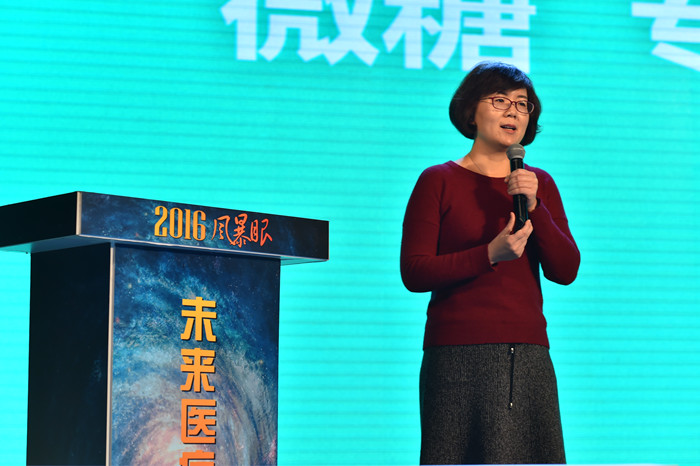
On December 23, 2016, at the Beijing Star Base, Feng Yanfei, CEO of Weitang, attended the “Top 100 Future Healthcare Forum” hosted by VCBeat. The forum brought together more than 500 government officials, hospital presidents, industry elites, and media representatives from government agencies, Grade-A tertiary hospitals, publicly listed companies, healthcare unicorns, and renowned media outlets.
At the event, Li Datao, founder of VCBeat, joined guests in unveiling the 2016 China “Top 100 Future Healthcare Companies” list, which selected 100 innovative Chinese healthcare enterprises representing the future of medical care. The initiative aims to identify and uncover the core driving forces behind China’s future healthcare industry through these 100 companies. Subsequently, awards were presented for the Most Influential Listed Company of 2016, the Most Influential Investment Institution, the Most Promising Enterprise, the Most Watched Enterprise, and the Most Innovative Hospital Director.
How Did Yanfei Feng Stand Out in the Fierce Competition Among Glucose Monitoring Companies to Become an Industry Leader? How Has She Advanced the Digitalization of Blood Glucose Health in the Field of Diabetes Over the Years?
Highlights
01
From the "Hundred Glucose Meters War" to Consolidation: The Formation of the Digital Health Industry
Diabetes, as a highly specialized vertical sector within the mobile health industry, appears to have completed a full cyclical journey—rising in 2013, gaining widespread acclaim in 2014, undergoing segmentation in the second half of 2015, and settling into a phase of quiet integration in 2016.
The healthcare sector has long been characterized by three major industry chains. The first is pharmaceuticals; the second is healthcare services, primarily segmented into public and private providers; and the third is insurance, where state-run basic medical insurance serves as the core component, with commercial health insurance playing only a supplementary role. How can startups identify their appropriate positioning within this complex industrial landscape?
“For diabetes, 2016 was a year of survival of the fittest, with most companies gradually moving from differentiation and competition toward integration, which is a positive development,” said Feng Yanfei.
In the field of diabetes management, WeiTang has indeed undergone what is known as the “Hundred Sugar Wars.” For WeiTang, 2016 was a remarkably quiet yet highly rewarding year. “We have witnessed the emergence of an entirely new landscape across the industry, namely ‘integration.’ It is no longer a matter of ‘Internet plus healthcare’ or ‘healthcare plus Internet,’ but rather a brand-new sector: the digital health industry,” said Feng Feiyan.
The digital healthcare industry is characterized by three key attributes: 3D, ST, and SD. The 3D framework encompasses medical devices, data generated by these device products, and the clinical decisions derived from such data. ST and SD refer to “anytime, anywhere” accessibility. Maintaining healthy blood glucose levels is a priority for every individual and household. Short-term fluctuations in blood glucose, whether high or low, do not typically cause significant harm to the body. The primary goal is to keep blood glucose within the normal range, with the ultimate objective of preventing complications and avoiding disease onset. So, how does WeiTang address this? How does it meet user needs?
In terms of blood glucose data collection, Weitang offers patients various measurement options during the “blood glucose control” phase, including random blood glucose and pre- and post-prandial blood glucose measurements. The platform is divided into three sections—charts, analysis, and logs—enabling patients to monitor their blood glucose fluctuations and review analytical results at any time, thereby assisting them in managing their blood glucose levels. Patients can also send their blood glucose data to their physicians with a single click, providing clinicians with evidence for diagnostic and treatment decisions.
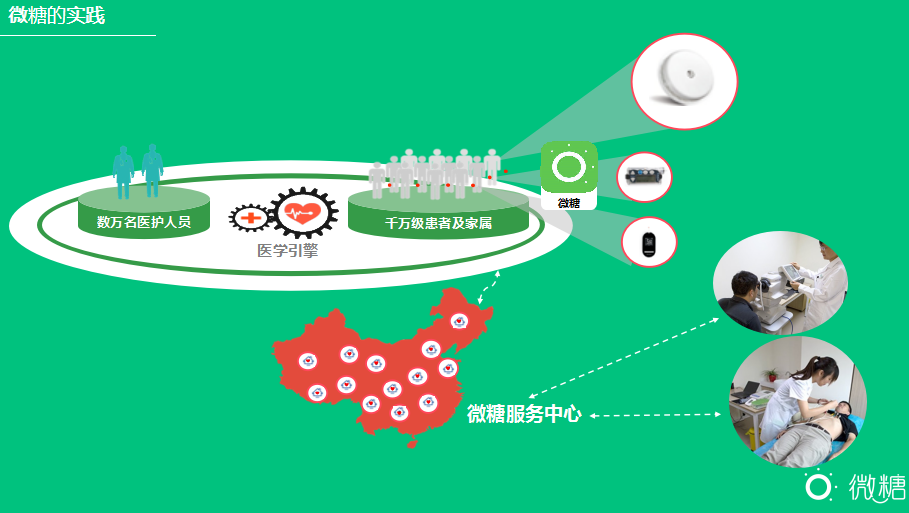
On the product side, WeTang operates two core apps: the “WeTang” app for patients with diabetes and the “WeTang Doctor” app for healthcare professionals. Since its launch in January 2014, WeTang has onboarded 11,000 leading diabetes specialists across China, achieving 100% coverage of hospitals at Level II and above, while accumulating over 2 million registered users with diabetes.
Meanwhile, physician consultation services are provided to patients through the “Medical Services” module. Physicians deliver care via four channels: text-and-image consultations, private monthly health management, telephone consultations, and the “Essential Blood Glucose Course.” The “Essential Blood Glucose Course” is a distinctive feature of WeiTang, offering one-on-one guidance from professional physicians specifically tailored to patients with special needs, such as those newly diagnosed, undergoing medication adjustments, or traveling for business or leisure.
In fact, diabetes management relies primarily on patient self-management, with its core being patient education and the management of adherence to treatment regimens. The ultimate goal is to help patients master disease management knowledge and adapt to and control diabetes from both physiological and psychological perspectives.
Highlights
02
Seamless Integration of Online and Offline, Software and Hardware
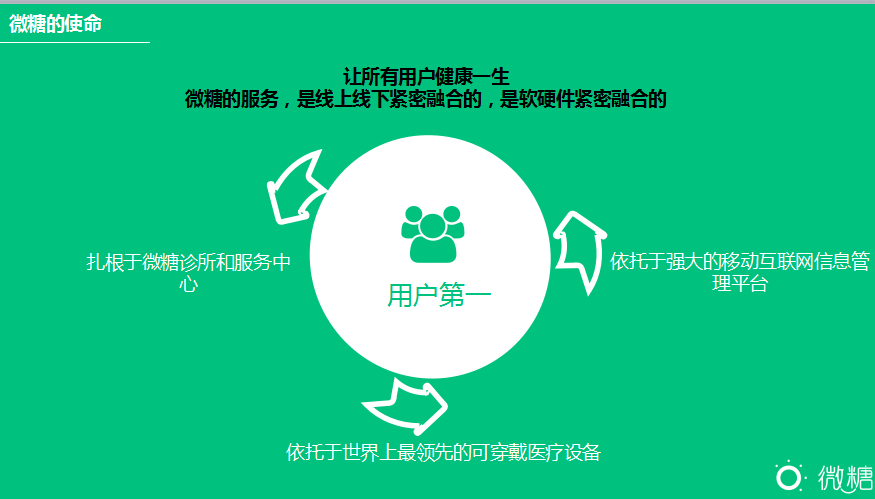
Most internet entrepreneurs in the diabetes management space build their models around the “Five Carriages” of diabetes care, which encompass five key areas: blood glucose monitoring, doctor-patient communication, exercise support, dietary support, and patient education. However, as the market matures and products continue to evolve, significant differences have emerged among today’s diabetes-focused startups. For instance, Weitang has made adjustments in two areas.
Online, Weitang has introduced community group features and launched the “Donut” function, allowing patients to post freely and connect with peers facing similar conditions. On the other hand, it has built an e-commerce marketplace that offers not only hardware and test strip consumables but also insurance, traditional Chinese medicine products, health supplements, and even general merchandise. This strategy aims to enhance user stickiness while serving as a transitional measure to boost early-stage revenue and unlock traffic value.
Offline, in September 2016, WeTang’s first self-operated offline service center opened in Shanghai, achieving an integration of online and offline services to provide patients with more convenient, comprehensive, and innovative whole-course diabetes management. After six months of service validation, it received widespread acclaim from users. To bring superior blood glucose management solutions closer to patients, WeTang reached a consensus with Haiyihui and established a physical medical service facility—the Beijing Blood Glucose Management Center—within the Haiyihui Wangjing Boya Clinic.
In terms of software and hardware, in October 2015, WeTang completed the development of a robust information management system connecting its professional service team with users, laying a solid foundation for serving millions of families; in June 2016, it completed the integration of the flash glucose monitoring system and the insulin pump system.
Whether in terms of hardware or medical services, enhancing user stickiness remains the fundamental objective. Only by fostering user dependence on the platform can the long-term diagnosis and treatment needs of diabetic patients be met, enabling them to track and manage their condition independently, while ensuring the accuracy and continuity of patient information.
Highlights
03
One-Stop Full-Course Service Model for In-Hospital and Out-of-Hospital Care
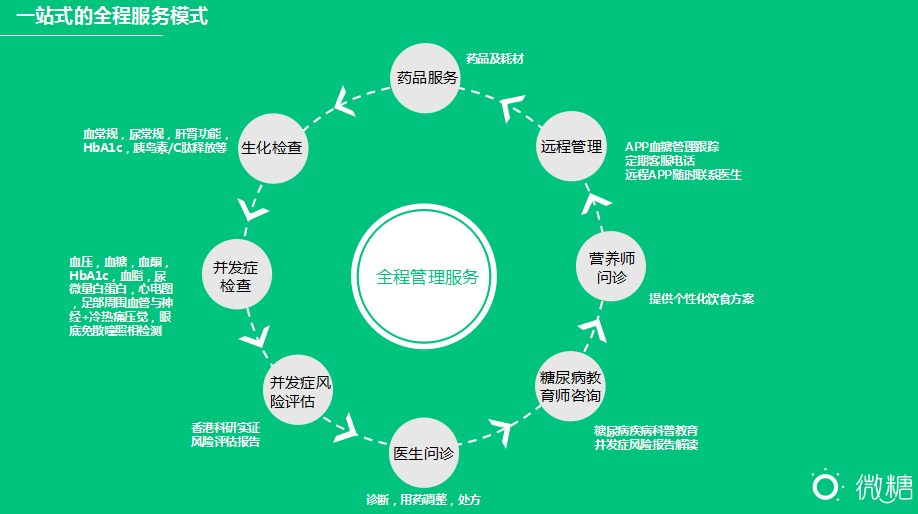
Drawing on the U.S. concept of “shared care,” WeiTang has established a multidisciplinary care team comprising physicians, diabetes educators, dietitians, and specialized nurses to assist individuals with diabetes in managing their condition. The platform currently boasts 11,000 registered healthcare professionals specializing in diabetes, including more than 8,000 endocrinologists from secondary hospitals or higher-tier institutions. Physicians specializing in diabetes have demonstrated considerable enthusiasm for mobile internet solutions, and WeiTang plans to further expand its provider-side resources. The company has already forged collaborations with leading diabetes care institutions such as Shanghai Ruijin Hospital and Shanghai Sixth People’s Hospital.
Currently, the WeiTang platform has activated over 2 million users with diabetes, distributed across China, with a trend of higher concentration in first- and second-tier cities. Relying on word-of-mouth promotion and brand building, new user growth remains robust. The platform demonstrates high user stickiness, with a 7-day retention rate of 35%, and patients spend an average of more than 5 minutes per day on the app, underscoring the strong demand among individuals with diabetes for mobile internet-based management solutions.
In the future, Weitang will continue to adhere to its service-oriented core strategy, extending from online to offline channels, continuously improving the diabetes industry chain, clarifying its business model, and achieving scale in the diabetes market. It aims to establish an ecosystem-based business model that integrates bundled service fees, pharmaceutical services, medical device services, and financial services.
Weitang has also launched various strategic collaborations, aiming to build a service-oriented, full-ecosystem platform. In 2017, the company continued to focus on scaling up while actively exploring more defined commercial monetization models, making its future development promising.