

Liang Liang of Yixin Mama Knows: Tackling the 'Hard Path' with Deep Vertical Focus in Maternal and Child Healthcare
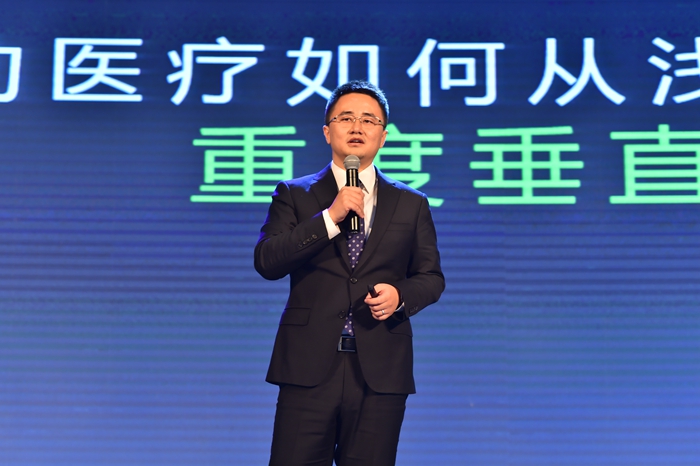
2016Year12Month23On [Date], at the Beijing Star Base,Founder of Mommy Knows andCEOLiangLiang participated in the event hosted by VCBeat.“2016VBInsight Future Healthcare100Qiang Forum", and shared past3Over the years, Mommy has learned which pitfalls to avoid and gained insights into the future of healthcare.
The forum brought together more than 500 government officials, hospital presidents, industry leaders, and media representatives from government agencies, Grade A tertiary hospitals, publicly listed companies, healthcare unicorns, and prominent media outlets. During the event, Li Datao, founder of VCBeat, joined guests in unveiling the 2016 China “Top 100 Future Healthcare” list, which selected 100 innovative Chinese healthcare enterprises representing the future of medical care. The initiative aims to identify and highlight the core driving forces shaping the future of China’s healthcare industry. Subsequently, awards were presented for the Most Influential Listed Company of 2016, the Most Impactful Investment Institution, the Most Promising Enterprise, the Most Watched Enterprise, and the Most Innovative Hospital President.
"Mommy Knows" has won the award for Most Watched Enterprise. As a leader in internet-based maternal and infant healthcare, how has it become a dominant player in this niche sector?
"Mami Zhidao" is a mobile application for maternal and infant health, developed by Shenzhen Yixin Technology Co., Ltd. It provides thoughtful services throughout the entire journey of preconception preparation, pregnancy, and child-rearing, with various free consultations and answers available online. "Our app is primarily designed for consumers in the maternity demographic."
Initially, Liang Liang also pondered whether to adopt a deeply specialized vertical strategy or a comprehensive platform approach. To this end, he charted all services across every industry covered by both comprehensive platforms and deeply specialized vertical internet models, plotting them against frequency and average transaction value to identify underlying patterns.
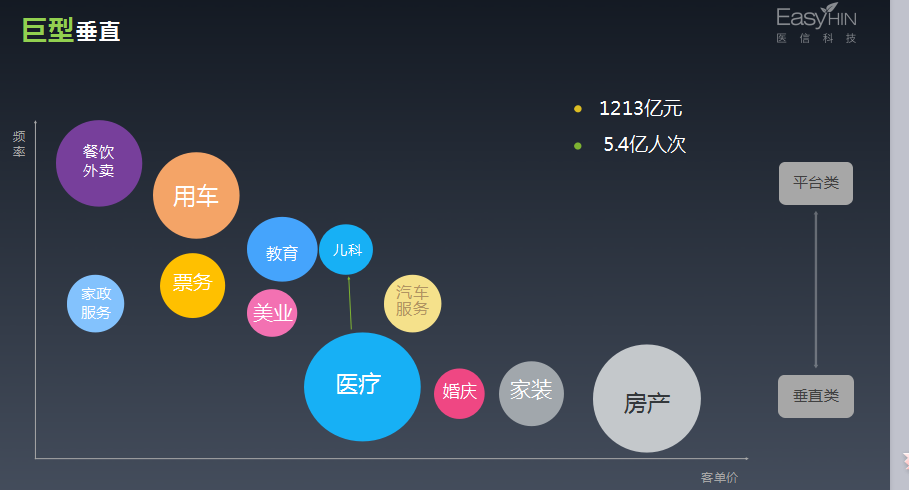
As shown in the chart, food delivery and ride-hailing are characterized by high frequency and low average transaction value, whereas healthcare, wedding services, home furnishings, and real estate fall into the category of low frequency and high average transaction value. In general, industries positioned toward the upper-left corner exhibit higher user engagement frequencies, making them more suitable for comprehensive, platform-based strategies. Conversely, those toward the lower-right corner are less frequent and better suited for vertical, end-to-end coverage models.
Pediatrics is the market that Yixin has consistently focused on and refined. Relevant data indicate that the annual pediatric market size exceeds RMB 120 billion, with over 450 million outpatient visits by children, the vast majority of which occur in public hospitals. Based on this calculation, if represented on a matrix, it would be characterized as a mid-frequency, mid-average-ticket-size segment. For such a segment, there are two strategic options: a vertical platform or a deeply specialized vertical platform. Yixin has chosen the latter.
However, achieving deep vertical integration is not as straightforward as creating a roadmap. In this process, Liang Liang overcame four major challenges. The first was shifting user behavior: how to transition users from their habitual practice of visiting public hospitals for both minor and serious ailments to being willing to connect with doctors online first. To achieve this, he initially targeted users in Beijing, Shanghai, Guangzhou, and Shenzhen—cities where smartphone penetration and acceptance of mobile devices are relatively high. Currently, 80% of Mammy Knows’ users are urban middle-class women in these first-tier cities, a demographic that has higher expectations for mobile apps, mobile payments, and content quality. Among these 6 million users, 20% are paying customers.
Therefore, the issue with internet healthcare is not low willingness to pay among users, but rather whether you clearly understand the alignment between your target users and the services you provide. For deeply vertical platforms, if you clearly define which cities your target users are located in and what specific services you offer them, the challenge of online payment adoption can be gradually resolved.
The second aspect is the management and incentive system for physicians. Liang Liang has never pursued the sheer number of contracted doctors; to date, there are no more than 2,000 specialists from Grade A tertiary hospitals in Beijing, Shanghai, Guangzhou, and Shenzhen. He places greater emphasis on deep collaboration with each expert, founded on the principles of co-creating value and sharing benefits. Additionally, one business development specialist is assigned per 100 experts to specifically assist physicians with operations, promotion, and branding, helping them truly transform into internet-era physicians. This encompasses not only online services but also the offline clinic services provided by Yixin Pediatrics.
At Yixin, there are full-time physicians, multi-site practicing physicians, and exclusively contracted physicians. On the physician side, the Yixin platform has developed remote education, a physician community, physician groups, and physician workstations. These features facilitate interconnectivity among physicians, enabling them to find their professional niche, contribute their value, and share in the benefits.
Third, how to package products and services. For startups in the internet healthcare sector, it is essential to understand from a market perspective what services users need, what benefits they bring, and what constitutes a superior user experience. Only by clarifying these aspects can users truly understand your products and services and engage with them on a high-frequency basis.
Fourth is innovation. Since 2016, YiXin has been independently establishing its own pediatric outpatient clinics and developing a proprietary SaaS system, with the aim of fully integrating all online and offline services. Currently, it has three operational service locations in Beijing, Shanghai, and Shenzhen, with more to be launched next year. “Establishing our own service points is intended to standardize our services, ultimately generating word-of-mouth and referral benefits, while creating synergies between online and offline channels to attract more users.”
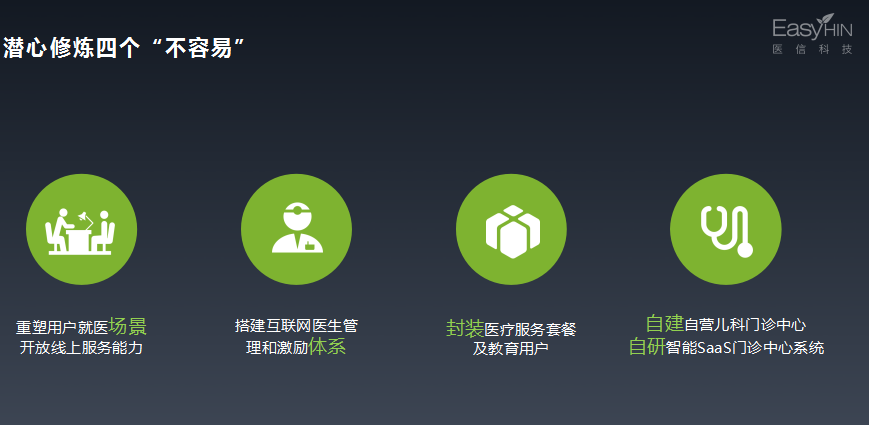
Therefore, pursuing a highly specialized vertical strategy is extremely challenging, as it requires possessing the attributes of a comprehensive platform while delivering greater depth than such platforms. This also demonstrates that your core competitiveness is continuously accumulating, creating irreplaceable revenue and user experience. “Only by enduring these pitfalls and persevering through relentless effort can you behold the beautiful scenery.”
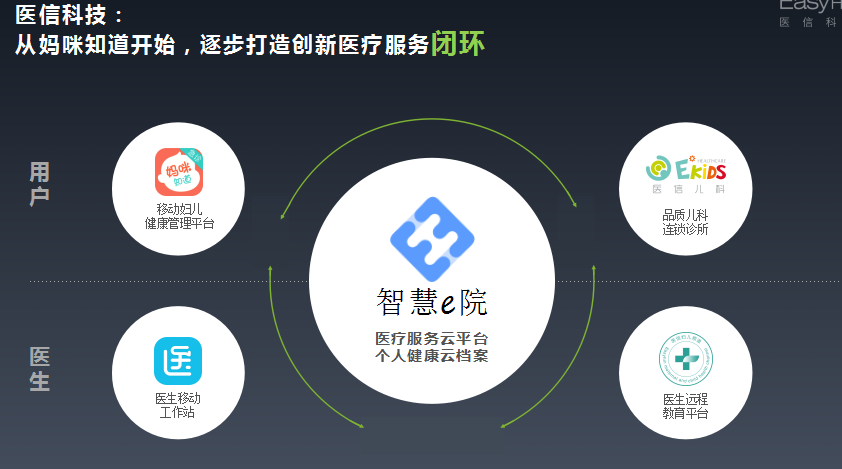
To date, Yixin has establishedThe closed-loop ecosystem of the five-product matrix anchored by "Mami Knows." For example,"Mami Knows" is an app designed for the consumer segment of pregnant women and parents, enabling online health management and liberating the medical supply side, including doctors and medical resources; offline, it hasQuality Pediatric Care and Chain Clinics;On the physician side, we offer mobile workstations and a remote teaching and training platform for doctors. Additionally, we dedicated nine months this year to independently developing the “Smart e-Hospital” system, which creates an online-to-offline closed loop and establishes a cloud-based platform for medical services.
Yixin’s business loop starts with the user. Users demand payment mechanisms because they seek better services; they also call for the establishment of offline clinics, hoping to meet online doctors in person. This applies to insurance and various third-party services as well. “I believe this is a shared aspiration among internet healthcare startups.”
So, what will the future of healthcare look like?
“It is not simply O2O, ‘Internet + Healthcare’ or ‘Healthcare + Internet,’ but rather a multiplicative effect: Future Healthcare = Internet × Healthcare. This creates exponential and power-law benefits, enhancing user experience, attracting users and patients, while fulfilling mutual value propositions within your ecosystem.”
For example, the medical information platform offers a product called “Medical Package,” which is a typical example of multiplicative benefits. Priced at over RMB 2,000, it includes consultation fees for ten offline outpatient visits in Beijing, Shanghai, and Shenzhen, as well as ten telephone consultations with online doctors. In other words, after the initial outpatient visit, patients can choose telephone or text-and-image consultations for follow-up visits during subsequent treatment, thereby saving time.
In Liang Liang’s view, these new service models may not merely result in a simple additive effect between the parties involved, but rather an exponential amplification. This is where internet technology and innovation can empower healthcare, and where healthcare, in turn, can facilitate the practical implementation of technological advancements.
“At present, the company also hopes to have the opportunity to collaborate with platform-based companies or those in various vertical niche sectors, jointly discussing how to better enhance the warmth and quality of our medical services, and bring superior products and services to everyone.”