

Jianke's Xie Fangmin: Building Consumer Awareness Is the Key to Unlocking the Breakthrough of Pharmaceutical E-commerce

“The primary challenge for pharmaceutical e-commerce is to address consumer trust. Many consumers are unaware that online channels exist for purchasing pharmaceuticals; even among those who are aware, few are as willing to buy these products online as they are fast-moving consumer goods (FMCG), due to concerns about counterfeit drugs and uncertain product quality. The Authentic Product Alliance aims to alleviate such consumer concerns.”
“As the industry expands, Jianke will certainly grow alongside it. Given our current scale, it is foreseeable that we will become one of the top two players in the pharmaceutical e-commerce sector.”
“We once turned down a well-known PE firm; we are very selective in choosing our investors. Jianke has been rejected by many investors, and we have also declined many others. We do not accept just any capital; our ultimate goal is to build a great enterprise.”
In a two-hour conversation with Xie Fangmin, what left the deepest impression was his logical approach to market analysis. He breaks down an issue into several key terms, assigns different weights to each, and ultimately provides a comprehensive assessment of a particular event or company. This method makes the market landscape clear at a glance and facilitates the identification of problems.

When asked if this could be interpreted as an expression of rational thinking, Xie took the opportunity to explain that rational thinking enables a clearer understanding of the essence of things, helps prioritize tasks, and thereby improves efficiency. Guided by this mindset, Xie led his team to position Jianke at the forefront of China’s pharmaceutical e-commerce sector, gradually expanding from online drug sales into areas such as online consultations, internet hospitals, an authentic product alliance, insurance, elderly care services, and offline pharmacy projects. Efficiency, rationality, and clear logic can be considered the key words for understanding Xie Fangmin. For Xie, who operates in the rapidly evolving pharmaceutical e-commerce industry, anchoring both the company’s and his own position has been the unwritten secret behind Jianke’s transformation from mere survival to industry leadership.
Reviewing Xie Fangmin’s Insights on Pharmaceutical E-commerce, Internet Healthcare, and Mobile Healthcare May Clarify the Future Direction of the Medical and Health Industry
“By attending a banquet, I was able to secure several orders for Jianke. One lady, upon learning that we operate in the pharmaceutical e-commerce sector, placed an order for chronic disease medications for her father. She mentioned that she had previously been unaware that medicines could be purchased online, highlighting the significant convenience that pharmaceutical e-commerce brings to patients with chronic conditions.” Xie Fangmin joked that she had become a sales promoter for pharmaceutical e-commerce.
Thanks for the introduction. Many people are still unaware of how to purchase medications online, and consumer habits have yet to be fully cultivated. Therefore, he acts like an “evangelist,” promoting the convenience of pharmaceutical e-commerce. He believes that the primary challenge for the development of pharmaceutical e-commerce is to address consumer habits and brand awareness.
Guided by this logic, Jianke launched the industry’s first “Genuine Product Alliance.” Since its inception in November, the alliance has grown to include 300 members within just over a month and continues to expand. According to Xie’s projections,In the future, the Genuine Product Alliance will expand to include over a thousand member entities, encompassing pharmaceutical companies, e-commerce platforms for medicines, and insurance providers, thereby establishing an industry-wide mechanism for genuine product assurance.

“The primary challenge for pharmaceutical e-commerce is to address consumer trust. Many consumers are unaware that online channels exist for purchasing medicines, and even those who are aware remain hesitant to buy them online, unlike fast-moving consumer goods, due to concerns about counterfeit drugs and uncertain quality assurance. The Genuine Product Alliance aims to alleviate these consumer concerns,” Xie Fangmin further explained.
In fact, another consideration behind establishing the Authentic Product Alliance is to leverage pharmaceutical manufacturers to provide credibility endorsements for online drug sales. “Consumers may not trust e-pharmacies, but they do trust pharmaceutical companies such as Baiyunshan, Tongrentang, Bayer, and Pfizer. By forming an alliance and incorporating authenticity insurance, we can gradually establish an industry-wide mechanism for guaranteeing product authenticity, thereby creating a ‘show of strength.’”
Xie’s judgment is not without merit. According to data from the “2016 Annual Review of Pharmaceutical E-commerce” previously published by VCBeat (WeChat ID: vcbeat), the scale of pharmaceutical e-commerce in China’s retail drug market is relatively small. In comparison, online pharmacy (B2C) sales in the United States account for approximately 35% of the entire pharmaceutical retail market, whereas our figure stands at 8%.
In 2014, China issued the "Measures for the Supervision and Administration of Online Food and Drug Operations (Draft for Comments)," which has since spurred significant expansion in the pharmaceutical e-commerce sector. Classified by platform nature, these operations fall into two categories: B2B pharmaceutical procurement and B2C services targeting individual consumers. Notably, the B2C pharmaceutical segment has experienced the most rapid growth, with projections indicating an average annual growth rate as high as 30%.
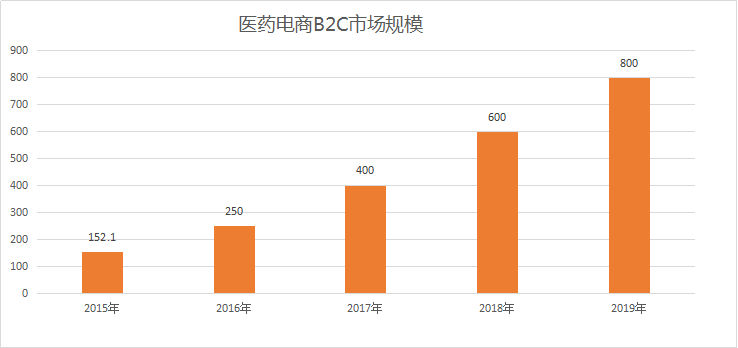
This is also corroborated by the publicly disclosed operational data of several pharmaceutical e-commerce platforms; semi-annual report data from pharmaceutical e-commerce companies controlled by listed entities show that,In the first half of 2016, the revenues of Kangaiduo, Haoyaoshi, KeDeWang, Renhe Pharmacy, and Quanyuantang all exceeded RMB 100 million, marking the official entry of pharmaceutical e-commerce into the “RMB 100 Million Era.” According to Xie Fangmin, Jianke’s revenue has already reached RMB 1.5 billion this year, with a “modest target” of RMB 2 billion for next year.
“Although our data is strong, the development of pharmaceutical e-commerce still lags behind that of other industries. Therefore, it is essential to expand aggressively in the consumer (C-end) market and increase the share of pharmaceutical e-commerce within the overall pharmaceutical distribution sector,” said Xie Fangmin.
“How many consumer sectors currently have an e-commerce or internet penetration rate below 15%?” Xie Fangmin countered with a question to the reporter. As the reporter struggled to find an answer, Xie further elaborated, “There is still significant room for growth in pharmaceutical e-commerce. What we pharmaceutical e-commerce companies need to do is raise consumer awareness of this channel, provide the best possible service, educate consumers, and increase the scale of e-commerce in pharmaceutical distribution to over 15%.”
Thank you. Another underlying logic is “Industry > Enterprise > Individual.” First, consumers must recognize pharmaceutical e-commerce as a viable channel where they can purchase authentic medications. Only then do they focus on specific enterprises, such as Jianke, 111.com, Kangaiduo, and Dekai. Finally, attention shifts to the founders of these companies.
Nevertheless, Xie Fangmin has a slight “self-interest.” “As the industry grows, Jianke will certainly develop alongside it. Given our current scale, it is foreseeable that we will grow to become one of the top two players in pharmaceutical e-commerce,” said Xie Fangmin.
“What is the essence of internet healthcare, pharmaceutical e-commerce, and mobile health? Most importantly, it is about improving efficiency—enhancing the efficiency of information flow, service delivery, and drug supply.” Xie Fangmin offered this analysis of the currently booming internet healthcare sector.
In Xie Fangmin’s view, internet healthcare is a rather “conceptual” entity. Online appointment registration, remote consultations, mobile health, and pharmaceutical e-commerce all fall under the umbrella of internet healthcare; however, what truly matters is which player demonstrates the greatest professionalism. Therefore, his outlook on the future of internet healthcare is that “no single company will be able to integrate every link in the online healthcare chain; instead, industry giants will emerge within specific vertical sectors.”
So, among the various sectors of “online healthcare,” who will emerge as the ultimate leader? Xie Fangmin provided an explanation based on VCBeat’s “Top 100 Future Healthcare Companies” list. Within the Top 100 Future Healthcare Companies, two pharmaceutical e-commerce companies were listed. Among the 13 most watched companies, Jianke.com was the only pharmaceutical e-commerce enterprise included. “Going forward, the concept of a ‘Top 100 Future Healthcare Companies’ list will no longer apply; instead, each industry will give rise to a few dominant players, most likely three. If you subdivide internet healthcare into 10 or 20 niche areas, there would be 30 or 60 leading companies in total.”
Xie Fangmin believes that the most reasonable competitive trend for the future of the pharmaceutical e-commerce industry will be the emergence of three major players, with a market share distribution of 7:2:1. Under this competitive landscape, the industry will maintain robust competition, enabling optimal resource allocation.
According to Xie Fangmin’s “rational” evaluation logic, efficiency is the most critical competitive advantage for pharmaceutical e-commerce. “Our sales data ranked second in the industry last year. This year’s revenue reached RMB 1.5 billion, with a target of RMB 2 billion for next year. Meanwhile, our headcount has been decreasing as we have optimized our team and business structure. While overall efficiency has improved, costs have declined. Refined management is our strength.”
“This is, in fact, a social inevitability. In e-commerce, Alibaba and JD.com have emerged as the dominant players; in lifestyle services, 58.com and Ganji.com have consolidated their positions; and in ride-hailing, Didi and Uber have become the leading platforms. Every industry will ultimately see one or two market leaders emerge,” said Xie Fangmin.
Jianke Unveils New Brand Identity
“E-commerce, at its core, leverages information technology to enhance efficiency. Email, QQ, WeChat, and websites are all IT-enabled tools. The essence of pharmaceutical e-commerce lies in improving the efficiency of drug transactions. Traditionally, pharmaceuticals have constituted a major component of healthcare, a pattern that is unlikely to change. As the array of digital tools continues to expand, efficiency will improve, making pharmaceutical e-commerce increasingly popular. In China, out of a RMB 1.6 trillion market for pharmaceuticals and medical devices, e-commerce accounts for 30%, equivalent to RMB 400–500 billion.” In Xie Fangmin’s view, the importance of pharmaceutical e-commerce within internet healthcare is self-evident.
So, what is the specific competitive landscape of this multi-hundred-billion-yuan pharmaceutical e-commerce market? Xie Fangmin believes that the strong will remain strong.
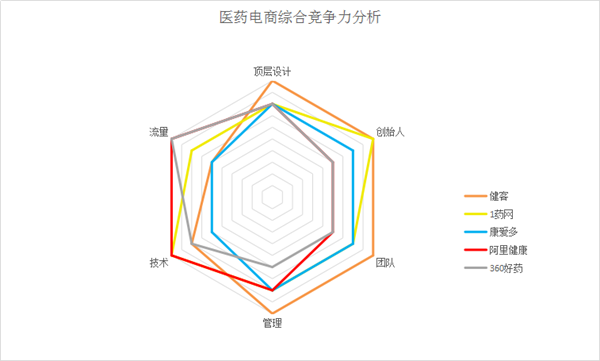
Specifically, the following indicators can serve as references: traffic, technology, top-level design, founder’s competitiveness, supply chain, and management capabilities. According to his unique “weighting” analysis method, top-level design ranks first. Only by properly designing the business system can an organization maintain the correct direction and ensure the efficiency of resource output.
Based on the framework provided by Xie Fangmin, we have created radar charts for several leading pharmaceutical e-commerce companies, offering a glimpse into the competitive landscape of the pharmaceutical e-commerce sector as viewed by Xie Fangmin.
This raises the question of whether pharmaceutical e-commerce should rely on existing e-commerce platforms or establish independent websites. A reporter asked Xie Fangmin, “Pharmaceutical e-commerce is essentially a low-frequency consumption sector. It appears that embedding within e-commerce platforms may be more convenient and better aligned with consumer behavior. Does this suggest that platform-based pharmaceutical e-commerce will become the mainstream direction in the future?” Xie Fangmin explained that while pharmaceutical e-commerce may generally involve low-frequency purchases, this does not apply to patients with chronic diseases. First, pharmaceutical e-commerce offers the convenience of online medication purchasing and delivery. Second, the frequency of consumption has little bearing on whether the business operates via a platform or through self-run channels; general shopping is also considered a low-frequency activity. Therefore, there is no inherent issue of one model being embedded within the other.
On August 1 this year, the suspension of the pilot program for third-party retail of pharmaceuticals provided guidance on whether platforms should transition to self-operated models or build their own official websites. Platforms are shifting toward self-operation (by acquiring offline pharmacies to obtain Class C licenses or engaging in mail-order services), while pharmaceutical companies and retail pharmacy-controlled e-commerce entities are intensifying their efforts to develop official websites. These two channels are advancing in tandem, creating greater possibilities for the future.
Meanwhile, it is our understanding that pharmaceutical e-commerce platforms are gradually exploring the “Medical + Pharmaceutical” model by incorporating services such as lightweight consultations, online medical consultations, appointment registration, health management, and family doctor programs. The objective is to enhance user stickiness and secure long-term medication demands. Jianke has also made strategic moves in this area; Xie Fangmin previously disclosed that Jianke has invested in online consultations, medication counseling, health Q&A, and its mobile app, with the aim of establishing a closed-loop “Medical + Pharmaceutical” ecosystem.
Notably, 1YaoWang, AliHealth, and KangAiduo are also expanding into internet hospitals and mobile healthcare, leading to a convergence effect in the pharmaceutical e-commerce sector.
So, what are Jianke’s competitive advantages? “From a top-level design perspective, we focus on pharmaceutical e-commerce; other business layouts are not our core operations. The company’s positioning is quite clear—the essential purpose of other businesses is still to drive drug sales,” explained Xie Fangmin. “I believe a company should know what it should and should not do. Jianke’s goal is to serve the consumer end (C-end); as long as consumers recognize us, we can continue to lead the market,” said Xie Fangmin.
Regarding competition with other companies, Xie Fangmin stated that Jianke has never regarded other enterprises as competitors, nor has it fixated on competing against specific firms. “Jianke possesses its own advantages. With my background in technology and extensive experience in the internet industry, I have a clear understanding of market trends. Our team is stable, and after a period of development, we can ensure our own traffic flow. We implement refined management practices, resulting in highly efficient team operations.”
Overall, competition in the pharmaceutical e-commerce sector is expected to stabilize, with the leading role of companies that have already been validated by the market and capital becoming increasingly prominent.Data from VCBeat shows that by the end of November this year, pharmaceutical e-commerce companies had raised a cumulative total of RMB 5.84 billion in financing, with RMB 1.76 billion raised this year alone. Most of the funded enterprises were at Series A or B stages and beyond, with seven companies securing individual funding rounds exceeding RMB 100 million each.
“Therefore, the future will see the strong grow stronger. The market leader may capture 70% of the share, the second-place player 20%, while the third-place contender will still command billions in revenue. The emergence of companies with valuations exceeding RMB 10 billion is merely a matter of time and a historical inevitability. This may not happen within three years, but enterprises valued at RMB 10 billion could emerge within five years, and those reaching RMB 100 billion will appear within ten years.” Such is Xie Fangmin’s forecast regarding the scale of the pharmaceutical e-commerce sector.
Meanwhile, Xie Fangmin also mentioned that China’s pharmaceutical e-commerce sector will follow “Moore’s Law,” with its development accelerating over time and ultimately achieving exponential growth.
The key to doubling the size of the pharmaceutical e-commerce market lies in policy breakthroughs. As is well known, pharmaceutical e-commerce is heavily dependent on regulatory conditions. Notably, recent advancements in electronic prescriptions, internet hospitals, the separation of prescribing from dispensing, and the outflow of prescriptions have created favorable conditions for the development of pharmaceutical e-commerce.
In February this year, Jointown Pharmaceutical Group’s Haoyaoshi Pharmacy piloted a remote sales and delivery service for selected medications at the outpatient pharmacy of Wuhan Central Hospital. Meanwhile, Jointown partnered with AliHealth to launch a pilot online hospital initiative. On March 25, Xinhua Pharmaceutical, the Zibo Municipal Health and Family Planning Commission, and JD.com collaborated to enable the transfer of prescriptions from within pilot public hospitals to designated retail pharmacies outside the hospitals. In April, the State Council prohibited hospitals from restricting the outflow of prescriptions, allowing patients to purchase medications at pharmacies using their prescriptions.
Benefiting from favorable policies, Jianke is also actively expanding its footprint. It is reported that Jianke opened its 20th offline pharmacy in August this year and launched its first Direct-to-Patient (DTP) pharmacy in September. At these DTP pharmacies, customers can purchase imported innovative and specialized oncology drugs unavailable at hospitals or regular pharmacies, while also accessing more professional pharmaceutical care services than those offered by conventional pharmacies.
Meanwhile, Xie Fangmin also revealed to reporters that Jianke had acquired Jingtai Hospital in Baiyun District, Guangzhou, and would launch its online hospital initiative. By leveraging the hospital’s prescription-issuing capabilities, Jianke aims to provide prescription support for its online pharmaceutical sales, targeting the market for online prescription drug sales.
Offline pharmacies, DTP (Direct-to-Patient) pharmacies, and internet hospitals can be viewed as Jianke’s “three-step” strategy to accommodate the outflow of prescriptions.
Capital has always been a crucial factor driving the development of pharmaceutical e-commerce. Currently, few pharmaceutical e-commerce enterprises are profitable; whether they are pure-play pharmaceutical e-commerce firms, platform-based pharmaceutical e-commerce companies, or those controlled by listed corporations, achieving a balance between costs and revenue remains challenging. Against this backdrop, sustained capital injection can help pharmaceutical e-commerce businesses survive the early stages and establish a solid foothold in the market.
Jianke secured $100 million in Series A financing from Kaixin Capital at the end of last year, setting a record for the largest single round of financing in China’s pharmaceutical e-commerce industry. It is understood that Kaixin Capital has previously invested in multiple publicly listed companies, including Baoxin Auto, Tudou.com, and Baozun E-commerce. The rationale behind its investment in Jianke is the expectation that Jianke will maintain rapid growth in the pharmaceutical e-commerce sector. Jianke’s financing case illustrates that pharmaceutical e-commerce enterprises require capital support to sustain operations once they reach a certain stage of development. Similar to fast-moving consumer goods (FMCG) e-commerce and 3C product e-commerce, pharmaceutical e-commerce involves substantial cash burn; collaboration with capital partners enables faster customer acquisition and cultivates user habits more efficiently.
“Using U.S. dollars for investment and using RMB for investment have different impacts on enterprises. Dollar financing indicates that the enterprise has strong competitiveness and a sound governance structure.” In Xie’s view, gaining favor from U.S. dollar capital represents investors’ recognition of the enterprise. “The advantage of RMB investment is its low cost, while its disadvantage is high uncertainty. By contrast, dollar investment is relatively more controllable and better suited to support the long-term growth of enterprises.”
“We once turned down a well-known private equity firm simply because their term sheet came with too many conditions. We are very selective in choosing our investors. Jianke has been rejected by numerous investors, and we have also declined many offers ourselves. We do not accept just any investment; our ultimate goal is to build a great company.” Xie Fangmin regards securing investment more as an “art.”
When asked by a reporter whether investing in U.S. dollars meant that Jianke would list in the United States in the future, he said, “Jianke is one of the few pharmaceutical e-commerce companies that have already implemented a VIE structure, having made preparations for an IPO in the United States, with plans to list on NASDAQ expected to be carried out within the next two to three years.”
He specifically explained that although Chinese concept stocks are undervalued in the U.S., their advantages are clear. First, the listing process does not involve lengthy queues; by contrast, going public domestically requires a wait of several years and entails more stringent listing requirements. Second, after listing, companies can standardize their corporate governance structures, gain greater resource support (including from users, suppliers, and employees), and secure financing more easily.