

How Doctor-Centric Platforms Create Value: Insights from Medlinker CEO Wang Shirui

On December 23, at the VCBeat Future Healthcare 100 Forum, Medlinker CEO Wang Shirui delivered an insightful speech titled “How Physician Platforms Create Value.” The editor has compiled the following highlights without altering the original meaning:
The earliest platform was one that entered the market from the hospital side.Many veterans of traditional software systems have made a graceful pivot amid the internet wave, building internet platforms with hospitals as their entry point; indeed, many outstanding companies on the Future Healthcare Top 100 list have adopted this approach.
Subsequently, a number of internet companies began to enter the industry. Leveraging their core competency in acquiring consumer-facing traffic, they possess a more profound understanding than many other companies when it comes to patient acquisition. With their expertise in optimizing user experience, this has led to the emergence of a large number of highly excellent patient platforms andPatient-Centric Companies。
By 2014, the “Licensed Physician Law” had been promulgated, and multi-site practice and independent practice gradually became widely recognized. The authorities released numerous policy signals favorable to tiered diagnosis and treatment and beneficial to physicians.Doctor-Centric Physician Platformhave also begun to emerge, seeking their own positioning.
When it comes to defining what a physician platform is, Wang Shirui offers the following definition:The physician platform is built on serving doctors, providing them with capability support for clinical work, scientific research, and academic networking. It productizes and digitizes physicians’ expertise, delivering it to demand-side stakeholders such as patients, healthcare institutions, enterprises, and internet portals, thereby jointly creating social and economic value.
Previously, doctors in China were not permitted to practice freely, making it difficult to productize their services. The lack of service standardization hindered the ability to deliver scalable solutions to B-side companies and medical institutions. Today, with the allowance of free medical practice, physician platforms have emerged as a new business model in the new era. These platforms focus on physicians as the primary entry point, aiming to serve them well by leveraging their spare time and implementing a layered strategic layout for commercial development.
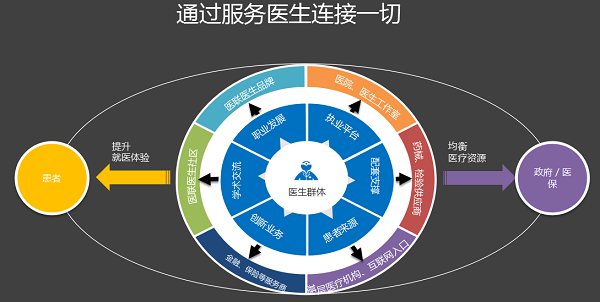
The primary function of the physician platform is to facilitate connectivity, and Yilian offers a diverse array of such connections.Practice Platform, this primarily supports physicians in practicing at multiple locations, featuring physician-centric practice platforms that include some high-quality Putian-affiliated private hospitals and physician studios.
Supporting Facilities, including pharmaceutical vendors, medical device suppliers, supply chains, clinical laboratories, and imaging departments, all fall within the scope of support provided by Yilian.
PatientPatient SourceIn addition to patients from tertiary hospitals, the patient base provided by the Medical Consortium mainly comes from primary care institutions. County-level hospitals are a key focus of its services. Furthermore, internet-based entry points are emerging; tech giants such as Tencent, Alibaba, and Baidu are preparing to launch online consultation services on their respective platforms. As these major internet gateways begin to open up, BAT (Baidu, Alibaba, and Tencent) are entering the industry in a more appropriate manner.
Innovative Business,Financial Insurance BusinessIt also uses physicians as a foundational point for connection,Specifically, it primarily targets patients., prior to surgery, patients may require surgical insurance. When physicians explain the risks of a procedure, they often outline approximately 18 potential complications, which can cause significant anxiety and make patients reluctant to undergo surgery. In such cases, offering insurance coverage can help alleviate their concerns. Additionally, the cost of a single surgery may reach RMB 200,000, a substantial financial burden for most families that cannot be readily covered out-of-pocket.Installment Payment for Surgical ProceduresThis is also being explored by Medlinker.
Academic Exchange, in discussions with numerous physicians, Medlinker has found that out of 100 doctors, 80 aspire to earn a decent income, while the remaining 20 remain committed to perfecting their medical craft. Many of these latter physicians come from multi-generational families of doctors and are not driven by financial gain.
The academic community is also divided into two factions. One is the “publication-oriented” group; recently, Wang Shirui stated that the sale of Science International (SI) is, to some extent, a positive development, as it allows medicine to return to its true surgical value. The other is the “clinical practice” group, which frequently discusses surgeries and case studies. Yilian Medical aims to rectify the distorted academic ecosystem by leveraging internet-based approaches to connect physicians with academic resources.
Career Development, the personal brand exposure of physicians will continue to rise in the future. In the past, patients would directly seek care from a physician at a tertiary Grade A hospital, saying, “I am going to Peking Union Medical College Hospital for a consultation today.” However, in the future, you may directly seek out Dr. Wang, stating, “I am going to see Dr. Wang today.” This shift in phrasing indicates that the future healthcare landscape will be physician-centric.
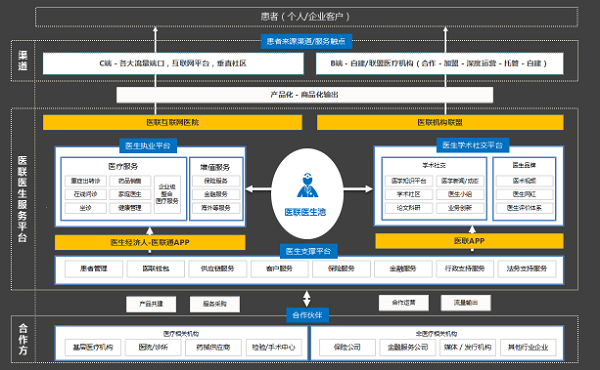
This diagram likely represents the future model for all physician platforms and serves as Medlinker’s strategic direction for the next five years.
The bottommost layer consists of partners., with partners in healthcare-related institutions, including primary care facilities, hospitals, clinics, pharmaceutical and medical device suppliers, surgical centers, and diagnostic laboratories. It also collaborates with non-healthcare entities such as insurance companies, financial firms, media distribution companies, and other industries. Yilian works with these partners on co-developing products and driving traffic.
The layer above is the physician platform currently being centrally developed by Yilian. The physician platform is divided into several sections, with the central section dedicated to physician groups, which then branch out to both sides.Some physicians practice independently, while others engage in academic networking., which represents the reputation and financial interests of physicians; together, they constitute the entirety of a physician's career planning.
MedLinker provides physicians with comprehensive support, including patient management, wallet services, supply chain, customer service, insurance, financial, administrative, and legal assistance. MedLinker excels particularly in legal support. China is a unique country where approximately 110,000 incidents of medical disturbances occur annually, a phenomenon difficult to comprehend in other nations. Therefore, MedLinker has established a robust legal department to provide assistance when physicians collaborating with the platform encounter legal disputes in offline settings.
These services underpinPhysicians' Practice Platform: Medlinker Productizes Physicians and Their Capabilities, after productization, it can serve various purposes, such as being adopted by enterprises, healthcare institutions, or high-traffic consumer-facing platforms to provide services including critical care referrals, pharmaceutical sales, health management, online consultations, and corporate medical services. Medlinker offers the full spectrum of internet hospital medical services; however, rather than operating a direct doctor-patient platform, Medlinker delivers these medical services as an output to existing patient-facing platforms.
On the other side isAcademic Social Networking, encompassing medical knowledge, news, academic content, community groups, research papers, and business innovations. Additionally,Doctor Brand, in the future, medical alliances will produce a large number of physician influencers who possess strong communication skills and professional appearances, frequently sharing popular science education knowledge with the public.
All these medical services are integrated by the Medical Consortium and output upward.The topmost layer interfaces directly with patients; however, WeDoctor refers to this model as B2B2C, as it does not engage in direct-to-consumer (2C) services.
The final focus is on healthcare institutions. The Medical Alliance has prioritized partnerships with over 6,000 county-level hospitals across China, currently engaging more than 1,000 partners. Collaborative models include joint department development and departmental trusteeship, or even full trusteeship of private clinics, with cooperation strategies tailored to local conditions. Meanwhile, the Medical Alliance has independently established clinics in five cities nationwide to deliver comprehensive physician capability outputs.
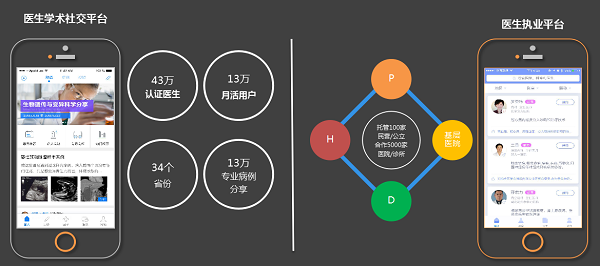
Currently, Medlinker has nearly 430,000 verified physicians, with 130,000 active physicians each month. Among these active physicians, 30,000 earn income on a monthly basis. Meanwhile, Medlinker collaborates with over 5,000 institutions, including public hospitals, private hospitals, and clinics, as well as more than 100 managed clinics and specific departments. It is these impressive figures that have established Medlinker as China’s largest real-name physician platform.