

Beijing Shankan Technology Secures RMB 100 Million Funding and Launches China's First PCI Perioperative and Postoperative Complication Insurance
On December 28, 2016, the launch event and signing ceremony for China’s first insurance product covering intraoperative and postoperative complications of coronary artery stent implantation was held in Beijing. At the event, Beijing Shankan Technology Co., Ltd. (hereinafter referred to as “ASK”) announced the completion of a new round of financing amounting to RMB 100 million. This round was led by GTJA Investment Group, with participation from Hangzhong Holdings, Zhichu Capital, Zhonglian Capital, and Chongshan Capital.
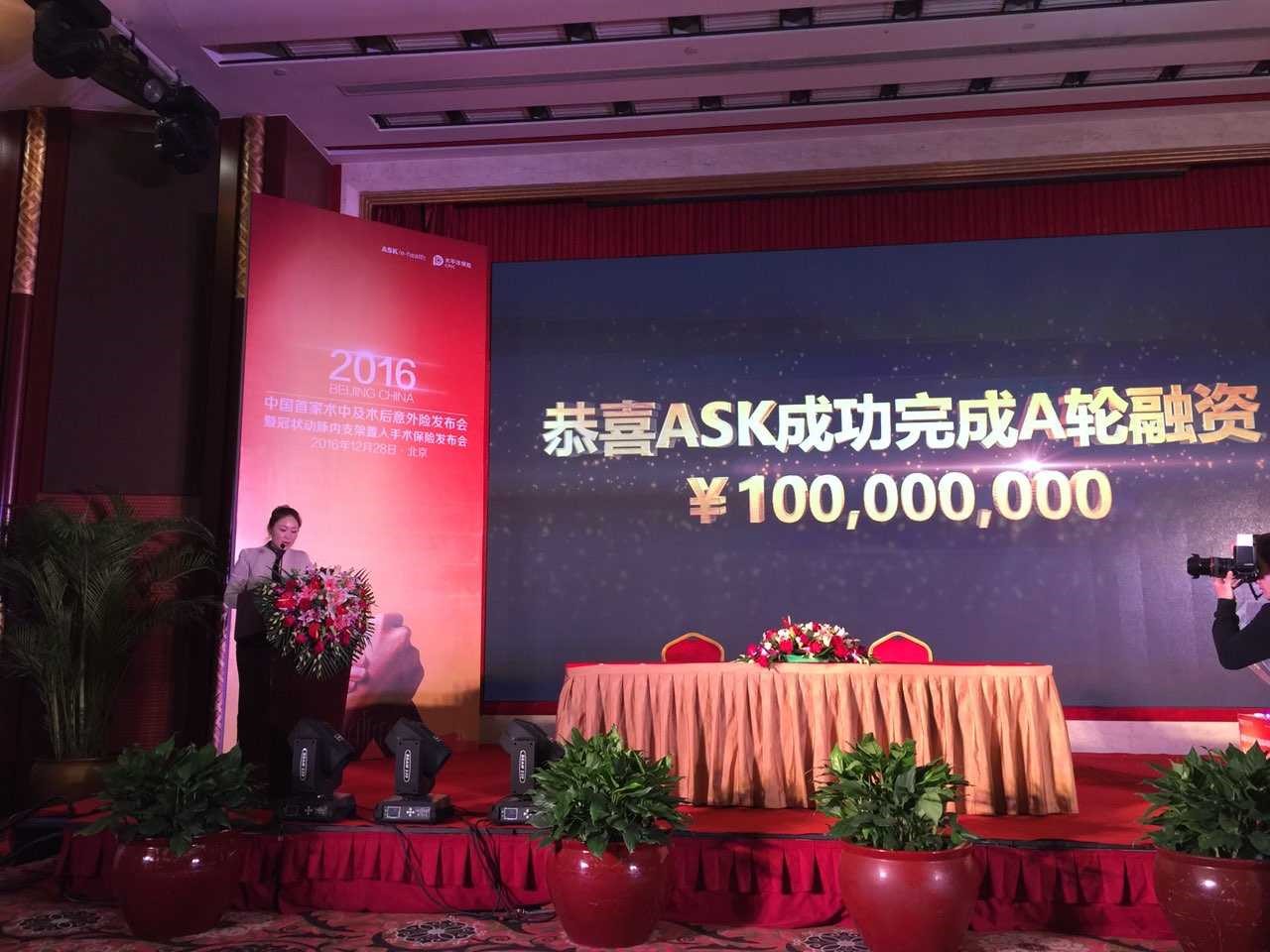
Address by Huang Qing, Partner at Shenzhen GTJA Investment Group Co., Ltd.
Distinguished guests in attendance included Mr. Cao Lianyuan, Deputy Director of the Hospital Management Institute under the National Health and Family Planning Commission; Ms. Huang Qing, Partner at Shenzhen GTJA Investment Group Co., Ltd.; Mr. Sun Jianbo, Partner at Zhichu Capital; Mr. Sun Chao, Partner at Chongshan Capital; Mr. Yin Chenguang, Partner at China United Capital; Mr. Wang Yu, Vice President of Hangzhong Capital; Ms. Cheng Fengfei, General Manager of the Xiamen Branch of China Pacific Property Insurance Co., Ltd.; Mr. Chen Shaobo, Vice Chairman of the Bethune Public Welfare Foundation; and Mr. Wang Jingmin, Secretary-General of the Beijing Ivy League Medical High-End Talent Alliance. Together, they witnessed the signing ceremony for the launch of the ASK product.
A grand signing ceremony was held at the event, where ASK partnered with China Pacific Insurance to launch China’s first accidental injury insurance covering both intraoperative and postoperative phases of coronary stent implantation—named “PCI Intraoperative + Postoperative Accidental Injury Insurance,” also known as “Jixiang Xinbao.” This is the first insurance product in China to provide comprehensive coverage for the intraoperative and postoperative stages of percutaneous coronary intervention (PCI), and currently the only internet-based healthcare protection product focused specifically on the cardiovascular medical sector in the country.
Policies Have Arrived; The Spring Breeze Is Just Right
In 2016, the State Council’s “Outline of the ‘Healthy China 2030’ Plan” stated: “We should actively develop commercial health insurance, implement preferential policies such as tax incentives, and encourage enterprises and individuals to participate in commercial health insurance and various forms of supplementary insurance.”
Beijing Releases Implementation Opinions on Accelerating the Development of Commercial Health Insurance, Encouraging the Development of Surgical Accident Insurance and Anesthesia Accident Insurance to Better Resolve Medical Disputes.
Lin Maohua, Chairman of ASK, stated, “Currently, the integration of the internet and healthcare still faces numerous challenges: the absence of a standardized service system has led to fragmented services, and there is insufficient data for effective intervention and management. The launch of Jixiang Xinbao helps rapidly resolve doctor-patient conflicts, share medical risks, reduce the incidence of medical disputes, improve the quality of medical services, and enhance patients’ awareness of medical risks, thereby fostering harmonious doctor-patient relationships. This contributes to establishing a health protection system that benefits patients, medical institutions, and insurance companies alike.”
Insurance + Internet Healthcare: A Heartwarming Partnership
In China, a market where medical insurance has yet to truly take off and has not experienced a surge in volume, how can it support the subsequent integration of services? Under current market conditions, what models are likely to align with insurance companies?
Cheng Fengfei, General Manager of the Xiamen Branch of China Pacific Property Insurance Co., Ltd., pointed out, “We deeply feel that the integration of insurance and internet healthcare is a heartwarming partnership, embodying warm humanistic care and profound social significance.”
Through ASK, consumers can conveniently purchase suitable insurance coverage, effectively alleviating the heavy burden of medical expenses. Insurance is no longer obscure and difficult-to-understand text, but rather warm and tangible services such as post-operative monitoring and health management, effectively conveying the goodwill of insurance. The interconnectivity of information among patients, medical institutions, and insurance companies can improve customers’ medical experience, optimize the allocation of medical resources, and ease doctor-patient tensions. Together with ASK, China Pacific Insurance will launch more innovative and compassionate insurance products, driving China’s health management industry to new heights of innovative development.
New Opportunities in Mobile Health and Commercial Insurance
Chen Shaobo, Vice Chairman of the Bethune Public Welfare Foundation, stated that amid the financial strain on social security funds, the commercial health insurance sector has witnessed an industry-wide growth rate exceeding 40%. Driven by persistent pain points in traditional healthcare settings, the gradual penetration of internet technologies into the medical field, and advancements in hardware such as sensors, the mobile health industry is flourishing. However, both commercial insurers and mobile health enterprises must leverage core medical big data to ultimately deliver personalized services; the rise of these commercial entities is accelerating the formation of a closed-loop ecosystem for medical big data.
Current policies clearly emphasize the urgent nationwide rollout of the critical illness insurance system. While favorable national policies provide macro-level momentum, complementary policies or specific implementation measures must also be introduced at the national, industry, and corporate levels. In the context of deepening reforms in healthcare institutions, innovative service models like ASK are increasingly essential. By placing patients at the center, such models address diverse medical needs, enhance patient experience, accelerate reform efforts, and resolve key pain points in commercial health insurance.
Creating a Closed-Loop Business Model for "Internet Healthcare + Insurance"
GTJA Capital, the lead investor in this financing round, specializes in strategic equity investments and M&A activities within the healthcare sector, facilitating resource integration across the healthcare and capital industries. As a pioneer in proposing the concept of “thematic industry investment,” it focuses on the healthcare industry and has invested in nearly 40 companies in the healthcare sector to date.
“Currently, the development opportunity of integrating cross-sector internet healthcare, insurance, and health management resources has yielded promising results in some local hospitals and pharmaceutical companies. As more cases and models emerge, this field is likely to become the next major trend in internet healthcare, forming a closed-loop business model of ‘insurance + healthcare.’”
“ASK is a service platform connecting hospitals and insurance companies, designed to address hospitals’ needs for scientific research and patient follow-up, as well as insurers’ cost-containment requirements. It explores emerging profit models aimed at reducing the likelihood of policyholders falling ill or experiencing disease progression, thereby increasing the operational profits of health insurance businesses. We are confident in ASK’s future development,” said Ms. Huang Qing, Partner at GTJA Investment Group Co., Ltd.
In the long term, the internet healthcare industry will continue to face significant challenges primarily in the product domain. Innovation and R&D in product technology remain unavoidable imperatives, requiring sustained investment and focus from enterprises. ASK will continue to deepen its presence in the internet healthcare sector, seeking new strategic footholds through emerging technologies, and launching more differentiated and refined health management service products for users.