

Zhejiang Provincial Hospital of Traditional Chinese Medicine Launches IBM Watson Oncology Collaboration Center
According to a report by Zhejiang Online, on December 26, Zhejiang Provincial Hospital of Traditional Chinese Medicine, together with SinoCare and Cognitive Network, jointly announced the establishment of the Watson Multidisciplinary Consultation Center. The three parties will engage in long-term cooperation to deliver IBM Watson for Oncology services. This marks the first Watson Multidisciplinary Consultation Center to officially announce its external service offerings since the introduction of IBM Watson for Oncology into China, signaling that China’s healthcare industry is ushering in a new era of AI-assisted diagnosis and treatment.
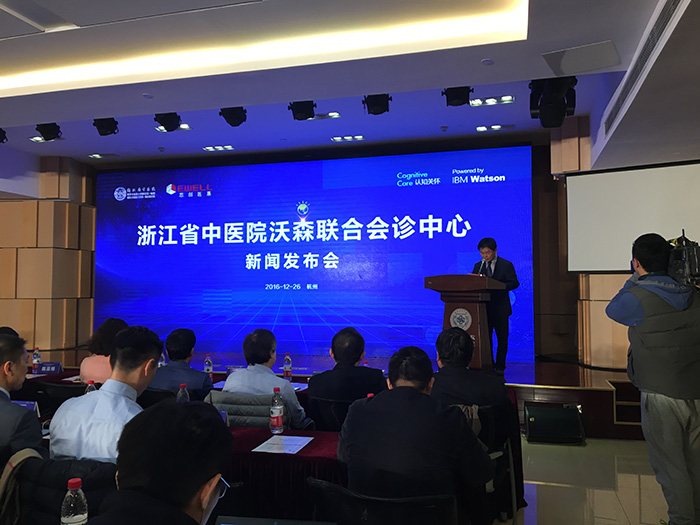
IBM Watson for Oncology officially entered the Chinese market in August 2016. Hangzhou Cognitive Network Technology Co., Ltd. is currently the sole operator of IBM Watson for Oncology in China, while Yihui Health Technology Co., Ltd. serves as the technical service provider for the comprehensive implementation and application of Watson. In February this year, Yihui Health issued an announcement stating that on February 19, 2016, the company obtained the Registration Certificate for Private Non-Enterprise Units (Legal Person) issued by the Zhejiang Provincial Department of Civil Affairs for the establishment of the Zhejiang Watson Smart Healthcare Research Institute (hereinafter referred to as the “Watson Research Institute”). The announcement indicated that the Watson Research Institute was established with funding from the company, in collaboration with Zhejiang University, several leading domestic hospitals, and experts. Relying on IBM, the world’s largest information technology and business solutions company, the Watson Research Institute primarily engages in fundamental research on medical big data, leads the research and formulation of standards for medical big data, and conducts research on intelligent auxiliary diagnosis and treatment in specialized medical fields in China using IBM Watson artificial intelligence technology, thereby promoting the application of Watson AI within China’s healthcare industry.
Watson, deployed at Zhejiang Provincial Hospital of Traditional Chinese Medicine, currently provides consultation services for six types of cancer: lung cancer, breast cancer, rectal cancer, colon cancer, gastric cancer, and cervical cancer. After physicians input information such as cancer type, patient age, sex, weight, disease characteristics, and treatment history, Watson can provide multiple treatment recommendations within seconds, a capability that relies entirely on its robust data repository and learning abilities.
By leveraging Watson’s existing cognitive computing capabilities, hospitals can not only access state-of-the-art oncology treatment protocols but also equip their clinical oncologists with a global perspective, thereby achieving new breakthroughs in scientific research. Notably, the first hospital to implement this system is a Traditional Chinese Medicine (TCM) hospital, suggesting that integrated TCM-Western medicine treatment regimens may become a unique value proposition for Watson in China. However, the inheritance and development of TCM currently face numerous practical challenges. How to utilize innovative approaches such as smart healthcare and cognitive computing to overcome these obstacles in preserving and advancing TCM remains a critical question under active consideration by industry stakeholders.