

Ctrip Releases '2016 Online Medical Tourism Report': Health Checkups Emerge as the Most Popular Medical Tourism Category
On December 29, Ctrip Travel released the “2016 Online Medical Tourism Report.” The report indicated that in 2016, Ctrip’s overseas medical tourism products experienced explosive growth. The number of travelers participating in overseas health check-ups and other medical tourism services through Ctrip was five times that of 2015, with an average order price exceeding RMB 50,000 per person—approximately ten times the average per-capita expenditure for outbound tourism from China, making it the highest-priced segment in tourism consumption. Ctrip projected that the number of Chinese tourists engaging in outbound medical tourism exceeded 500,000 in 2016.

Unlike standard tourism products, medical tourism is a customized offering that integrates healthcare services with travel. These products require coordination with specialized overseas medical institutions, feature personalized itineraries, and may include dedicated escorts to accompany patients during medical examinations and treatments. Consequently, the pricing of medical tourism products is significantly higher than that of conventional tourism packages.
The recently released “13th Five-Year Plan for Tourism Development” explicitly calls for promoting the integrated development of tourism and healthcare. As living standards rise, medical tourism is gaining increasing popularity, and online travel agencies are beginning to focus on the health and medical service needs of Chinese consumers. It has become trendy among mid-to-high-end consumers to undergo cosmetic surgery in South Korea while traveling, take their parents to countries such as Japan for health check-ups, pursue oxygen therapy and wellness in Europe, or undergo genetic testing in the United States. “High-quality overseas medical services are the primary factor attracting Chinese consumers,” the report states.
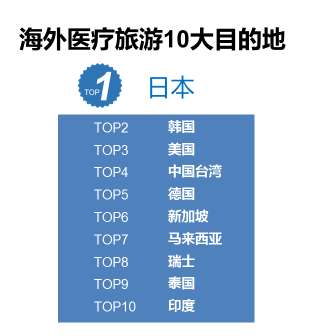
The report reveals the top 10 most popular destinations and countries/regions for overseas medical tourism: Japan, South Korea, the United States, Taiwan (China), Germany, Singapore, Malaysia, Switzerland, Thailand, and India. Japan is the most popular medical tourism destination, primarily focusing on cancer prevention and early screening. South Korea ranks second, with plastic surgery being its most sought-after specialty.
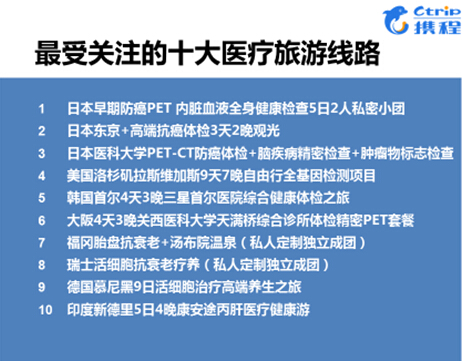
In terms of medical services, overseas health check-ups are the most popular, accounting for more than 50%. These include comprehensive health examinations, early cancer screening, cardiac assessments, and whole-genome testing. The top three medical tourism offerings are all precision health check-ups in Japan, while cosmetic and aesthetic procedures rank as the second most common purpose for cross-border medical travel. Additionally, certain Southeast Asian countries offer price advantages in medical services, making vacation-style medical tourism highly popular.
According to the number of orders on the Ctrip app and website, residents of Beijing are the most enthusiastic group about overseas medical tourism, followed by those in Shanghai, Tianjin, Hangzhou, and Shenzhen. Medical tourism involves high costs, so only consumers from affluent regions have the financial capacity to pursue cross-border medical care.
Ctrip’s release of this report not only summarizes the medical tourism market but also reflects its ambition to expand into high-net-worth overseas travel products. In September 2015, Ctrip launched a dedicated medical tourism channel, offering products centered on health check-ups and therapeutic wellness services, while attracting domestically and internationally based merchants with qualified travel agency credentials. In November 2016, Ctrip announced a strategic investment in ZhiTe Medical (IVF USA), a U.S.-based provider of in vitro fertilization (IVF) medical services, thereby strengthening its push into outbound medical tourism.
Ctrip co-founder James Liang has long been optimistic about the medical tourism market. He believes that, in a broad sense, tourism is not merely about sightseeing; in the era of globalization, the best products or services—such as top-tier medical care and hospitals—may be located in other parts of the world. Chinese consumers’ travel spending is essentially aimed at accessing the finest services available worldwide.