

Gene Therapy and Drug Pricing Emerge as Key Themes at the 35th J.P. Morgan Healthcare Conference
From January 10 to January 13 (Beijing Time), the 35th J.P. Morgan Healthcare Conference will be held in San Francisco. It will be a very busy week for pharmaceutical companies. Thousands of pharmaceutical industry executives, investors, bankers, and analysts will gather there.
Since the 1980s, what began as a small gathering with only 150 participants has evolved into a premier platform where both large pharmaceutical companies and small biotechnology firms announce their annual strategies. The J.P. Morgan Healthcare Conference has become a launching pad for many companies to initiate acquisitions or other transactions with investors, while also providing investors with an excellent opportunity to grasp the latest trends for the coming year.
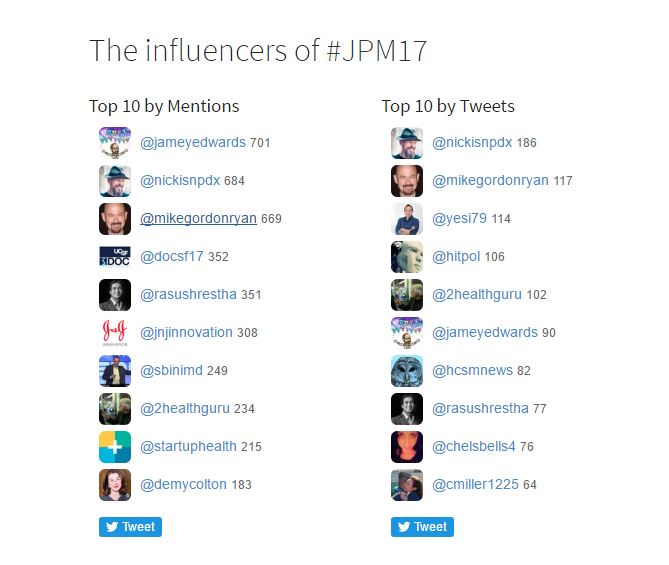
JPM17 Twitter Influence Ranking: No Shortage of Major Pharmaceutical Companies and Star CEOs
Jamie Streator, Managing Director of Healthcare Investment Banking at Cowen and Co., stated, “If there is one place to showcase yourself, this is it.” Beyond mergers and acquisitions, which companies will be in the spotlight this year, ranging from the political landscape to major industry events? What key themes are worth anticipating? VCBeat (WeChat: vcbeat) will provide you with the most cutting-edge analysis and outlook.
One of the biggest questions facing the industry in 2017 was which technology or disease area would emerge as the hottest. Doug MacDougall, Managing Partner at MacDougall Biomedical Communications, revealed, “Generally, the topics generating the most buzz are those poised to make significant waves in the future. This trend is also evident from the movements of pharmaceutical companies; when they spot promising technologies, they immediately seek ways to acquire and develop them.”
However, new technologies often fail to deliver immediate results in disease treatment. At times, therapies leveraging these novel technologies prove ineffective, necessitating extensive detours and iterative trials to elucidate the correct mechanisms. In many cases, it is only at the end that one realizes the new technology or therapy remains in its very early stages.
Last year, companies utilizing the CRISPR gene-editing technology represented a major industry development from the perspective of emerging technologies. However, even if the pace of future advancement does not slow, widespread clinical application in human diseases remains a distant prospect. It is foreseeable that cell therapy and gene therapy will continue to be the focal points of this year’s conference. As disease-causing genes can be directly knocked out or silenced, some positive developments are expected to emerge in 2017.
CAR-T cell therapy, or chimeric antigen receptor T-cell immunotherapy, is fundamentally based on using a patient’s own immune cells to eliminate cancer cells. Recognized internationally as a revolution in oncology, CAR-T technology has demonstrated significant efficacy in treating advanced leukemia, a condition that was previously untreatable. Although three patients with leukemia died during the Phase II clinical trial of Juno Therapeutics’ CAR-T immunotherapy JCAR015, the field continues to show strong momentum. Bluebird Bio is developing gene and cellular therapies for diseases including multiple myeloma, while two companies, Novartis and Kite Pharma, have announced their plans to submit cell therapy applications to the FDA in 2017.
High drug prices have long been one of the most controversial and sensitive issues in American society. Investors breathed a sigh of relief after the U.S. presidential election, with biotech stocks surging 13.3% in the week following the vote. The question now is that it remains unclear what Donald Trump’s new administration intends to do about drug pricing.
As early as December 2016, Trump stated in an interview with Time magazine, “I will lower drug prices; I do not like the changes in drug prices.” News of this comment caused the biotechnology index to drop by approximately 3% on that day, although it later rebounded. Regarding drug pricing, Trump proposed removing barriers in the pharmaceutical distribution chain to reduce costs. However, the current challenge lies in major pharmaceutical companies colluding to raise prices. Biogen Idec, a global giant in the biotechnology industry, increased the prices of three drugs used to treat multiple sclerosis (a central nervous system disorder) by 8%. Acorda Therapeutics also raised the price of its extended-release tablet Ampyra, used for treating multiple sclerosis, by 9.5%. Teva Pharmaceutical followed suit, increasing the price of its multiple sclerosis medication Copaxone by 8%.
Although President Trump has called for action on Twitter, it remains unclear whether there will be legislation addressing rising drug prices. To date, the new policy measures successively announced by the Trump administration have not addressed the issue of excessively high drug prices. It would also be interesting to see if more companies begin to consider alternatives to routine price increases, or if more companies commit to capping price hikes at below 10%, as Novo Nordisk and Allergan have done.
Mergers and acquisitions in 2016 slowed down compared with previous years. Bloomberg reported that the value of M&A deals in 2016 was $91 billion, lower than the $118 billion recorded the year before. However, transactions among pharmaceutical companies are not always driven by overall corporate sales. More commonly, especially as the momentum for bulk purchasing wanes, companies collaborate to develop or commercialize a promising drug.
MacDougall stated, “The evolution of conference themes over the past 15 to 20 years more clearly reflects a trend toward commercialization, rather than being merely an investment conference.” Seth Lederman, CEO of Tonix Pharmaceuticals, said he is developing a drug for PTSD and is traveling to San Francisco in hopes of finding a partner to help bring it to market. The drug is currently undergoing Phase III clinical trials. He is seeking a partnership rather than a direct acquisition of his company, although such deals could potentially delay the product’s launch. Essentially, the ideal scenario is for commercial partners, such as pharmaceutical companies, to ultimately acquire smaller biotechnology firms at a lower cost.
For pharmaceutical manufacturers, 2016 was a rather bleak year, with only 22 new drugs approved by the FDA, compared to 45 in 2015. The track record of major pharmaceutical companies in developing new drugs has been worsening.
According to a report released by Deloitte last month, the return on research and development (R&D) for large pharmaceutical companies is declining, dropping from 10.1% in 2010 to 3.7% in 2016. However, the solution may not lie in achieving greater returns through mergers and acquisitions (M&A), as Deloitte found that larger companies exhibit a negative correlation with the rate of return on R&D investment.
Establishing the right partnerships with companies in the development stage is crucial for transforming pharmaceutical companies’ track records. However, we are particularly interested in understanding how pharmaceutical companies are transitioning from relying on large orders and routine price increases to depending on pioneering novel therapies in potential, uncharted territories.
2016 was a relatively quiet year for biotech IPOs, partly because the biotechnology industry as a whole fell by 21.47%, while the S&P 500 Index rose by 10.78% last year.
Jounce Therapeutics, a cancer drug manufacturer, had a highly promising IPO in 2017, having announced a major strategic collaboration with Celgene in July 2016 to develop next-generation tumor immunotherapies. Silicon Valley Bank (SVB) predicts that there will be 28–32 initial public offerings (IPOs) by biopharmaceutical companies in 2017, indicating a bright outlook. Notably, SVB pointed out that the number of medical device IPOs is expected to double in 2017 (with only three such deals in 2016).
Celgene: Investors will focus on how the company expands its business in the inflammation and immunology field beyond its anti-cancer drug Revlimid, thereby achieving business diversification. The results of the pivotal Phase 3 clinical trial of ozanimod for the treatment of Multiple Sclerosis will be announced this year.
Gilead Sciences: The hiring of former Novartis executive Dr. Alessandro Riva to lead the company’s hematology/oncology division suggests that Gilead Sciences may make a significant acquisition this year.
Biogen:What new initiatives will the company’s new CEO, Mr. Michael Vounatsos, undertake following the FDA approval of Spinraza, a novel therapy for spinal muscular atrophy (SMA)?
Vertex Pharma: The initial market rollout of Vertex’s cystic fibrosis drug, Orkambi, did not go smoothly. This year, TheStreet expects Vertex to demonstrate its execution capabilities.
Biomarin Pharma: The company will present the latest data on BMN 270, a gene therapy for the treatment of Hemophilia A.
Editas: The company’s first drug developed using CRISPR technology, LAC10, is poised to enter clinical trials. Investors are eager to learn about the timeline for this drug’s entry into clinical trials.
Regeneron Pharma: In 2017, the company received FDA approval for three drugs. Their post-market performance will draw investor attention. These three drugs are sarilumab for rheumatoid arthritis, dupilumab for eczema, and alirocumab for high cholesterol.
Seattle Genetics:2017 will be a pivotal year for determining whether the company’s Adcetris can become a blockbuster drug. Results from the Phase 3 clinical trial evaluating Adcetris as a first-line therapy for advanced Hodgkin Lymphoma may be reported this year.
Ariad Pharma: The company’s investigational new drug brigatinib for the treatment of non-small cell lung cancer is expected to receive FDA approval.
Kite Pharma: 2017 was a pivotal year for this biotechnology company developing CAR-T cell technology. The company will release six-month long-term efficacy data for its KTE-C19 therapy targeting aggressive non-Hodgkin lymphoma. This will be followed by the submission of a Biologics License Application and the FDA’s approval decision.
The information in this article is sourced from Business Insider, jpmorgan.com, thestreet.com, and others. VCBeat will continue to monitor subsequent conference viewpoints and trend analyses.