

Yaodou.com: Bridging Traditional Pharmaceuticals and E-commerce as the New Gateway to China's Medical Industry

yao dou wang
Smart Medicine B2B Trading Platform
“The two decades from 1995 to 2014 marked the era of pharmaceutical tendering, while the period after 2014 has ushered in the era of pharmaceutical e-commerce. Pharmaceutical e-commerce serves as an effective channel and solution for addressing information asymmetry. In the future, large-scale pharmaceutical manufacturers and distributors will evolve into delivery and logistics enterprises.”
“The rise of pharmaceutical e-commerce will drive the development of mobile healthcare, which in turn feeds back into and strengthens pharmaceutical e-commerce, creating a virtuous cycle.”
The aforementioned assessment comes from Qiu Zhongxun, CEO of Yao Dou Wang. He believes that under the influence of policies such as the “Two-Invoice System” and the replacement of business tax with value-added tax (VAT), pharmaceutical e-commerce will become a crucial channel in future pharmaceutical distribution. Primarily, B2B pharmaceutical e-commerce can address many existing issues in current medical representative practices and drug bidding processes. In the B2C market, pharmaceutical e-commerce may serve as a positive catalyst for mobile healthcare; only after pharmaceutical e-commerce gains user acceptance can mobile healthcare identify profitable models, thereby feeding back into and reinforcing pharmaceutical e-commerce to form a stable industrial ecosystem. His bold stance stems from confidence in his company’s operational performance and his judgment of industry trends.

Qiu Zhongxun, CEO of yao dou wang
According to Qiu Zhongxun, Yao Dou Wang was established in June 2014 and officially commenced operations at the beginning of the following year. The company currently has a team of approximately 50 employees, comprising e-commerce operations and technical development teams.
“We are a pharmaceutical e-commerce company that follows a traditional business model. We currently hold 11 technology patents related to pharmaceutical e-commerce and have accumulated substantial expertise in pharmaceutical e-commerce systems and software. In particular, the years 2015 and 2016 laid the foundation for the development of Yao Dou Wang,” said Qiu Zhongxun.
Qiu Zhongxun, a veteran of the pharmaceutical industry, previously held marketing management positions at both foreign-invested and state-owned pharmaceutical manufacturing enterprises. In the early stages of his entrepreneurial venture, he explored multiple strategic directions, including pharmaceutical manufacturing, pharmaceutical distribution, and mobile health.
The reason for choosing to start a business in the pharmaceutical e-commerce sector was to leverage internet technology to improve efficiency and provide better services for the pharmaceutical industry. “At that time, our view was that there were indeed many problems in the pharmaceutical industry, and we questioned whether the pharmaceutical industry could effectively integrate with the internet to enhance efficiency and deliver superior services.”
Based on this, yao dou wang has not only refined its products from the perspective of pharmaceutical e-commerce, but also from the perspectives of upstream pharmaceutical manufacturers and downstream purchasers. It has launched interfaces that integrate with ERP and GSP systems, as well as middleware programs; a flagship store platform for pharmaceutical industry promotion, which integrates product marketing and academic outreach; and an intelligent procurement system for end users, enabling terminals such as pharmacies to connect directly with industrial enterprises through yao dou wang.
"The diverse functional modules and service tiers have also earned Yao Dou Wang market recognition. 'Yao Dou Wang entered a fast lane of development in the fourth quarter of 2016, establishing strategic partnerships with nearly 1,000 industrial enterprises, including Tongrentang and Zhendong. The platform offers over 40,000 categories of pharmaceutical products, and within three months of launch, it onboarded nearly 10,000 terminal clients. We expect the agreed transaction volume to reach nearly RMB 1 billion in 2016, and to achieve profitability in the first quarter of 2017,' said Qiu Zhongxun."
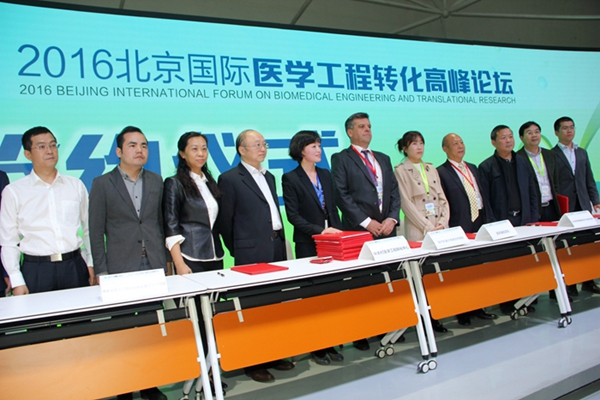
Qiu Zhongxun (second from left) attends the High-Level Forum on Medical Engineering Translation
“At present, our foundational positioning is that of a pharmaceutical e-commerce platform; however, our long-term vision is to evolve into an internet-based service enterprise, providing comprehensive services to the pharmaceutical industry. Our clientele includes suppliers, purchasers, service providers, and pharmaceutical companies,” said Qiu Zhongxun. He positions Yao Dou Wang as an industry gateway and an internet-based service enterprise, fostering collaborative partnerships with stakeholders across the upstream and downstream segments of the industry.
Yao Dou Wang has also sorted out its customers and the services it can provide.
I. Suppliers
Target Audience: Pharmaceutical, medical device, traditional Chinese medicine, cosmetics, and health supplement companies.
What We Offer: 100% coverage of China’s national distribution network, with precision marketing to a hundred-thousand-strong CSO base.
Yao Dou Wang has established a B2B+O2O marketing model. Online, it helps suppliers promote their product brands by operating corporate flagship stores and enables channel control through the platform. Offline, it leverages a nationwide service provider network to achieve the fastest and most precise coverage of China’s distribution channels, assisting suppliers in expanding new sales avenues. Additionally, the platform provides suppliers with data-driven marketing support through big data analytics and cloud services.
II. For Buyers
Target Audience: Hospitals, Pharmacies, Clinics, Pharmaceutical Distribution Enterprises, and Other Procurement Organizations
What It Offers: Yao Dou Wang builds a direct bridge from manufacturers to end-users for procurement clients such as hospitals, pharmacies, clinics, and pharmaceutical trading enterprises. By leveraging nationwide centralized volume-based price negotiations, it helps reduce procurement costs, improve procurement efficiency, and empower buyers with greater control over their purchasing processes. Users can also benefit from technical services provided by the platform, including integration with GSP and ERP systems.
III. Service Partners
Target Audience: Pharmaceutical Representatives Across China
What We Offer: Yao Dou Wang is recruiting service providers across China to facilitate the platform’s local operations. Pharmaceutical agents and distributors in various regions can become platform service partners, gaining access to hundreds of thousands of product resources and comprehensive operational rights for the internet platform. Yao Dou Wang has established diverse revenue models to help service providers transform and upgrade under the “Two-Invoice System,” empowering service partners to increase their annual revenue by more than tenfold.
IV. Pharmaceutical Companies
Target Audience: Pharmaceutical Companies in China
Yao Dou Wang will form an e-commerce consortium with pharmaceutical companies, transforming into an e-commerce CSO! First, it can leverage its nationwide system for collective bargaining and integrate upstream resources to help pharmaceutical companies reduce procurement costs. Additionally, pharmaceutical companies can enhance their service capabilities and expand their terminal coverage through the platform, while also benefiting from technical services such as the GSP system provided by the platform.
As can be seen, service is a prominent theme in the strategic planning of Yao Dou Wang. After positioning itself as the “Zhaogang.com” of the pharmaceutical industry, Yao Dou Wang can provide supply and marketing services tailored to the specific characteristics of upstream and downstream players in the pharmaceutical sector, helping them maximize their operational efficiency.
Regarding trends in pharmaceutical distribution, Qiu Zhongxun predicts that new pharmaceutical services integrating pharmaceutical e-commerce will become the mainstream of the industry in the future. He stated, “The period before 1995 was an era of complete marketization; the twenty years from 1995 to 2014 were the era of pharmaceutical tendering; and the period after 2014 marks the era of pharmaceutical e-commerce. The national policies introducing the ‘Two-Invoice System’ and the VAT reform aim to address information asymmetry and lack of transparency in pharmaceutical circulation. B2B pharmaceutical e-commerce serves precisely as the channel and solution to these two major issues. Pharmaceutical e-commerce will become the dominant mode of transaction in the future, while large pharmaceutical manufacturers and pharmaceutical companies will transform into, and indeed can only function as, distribution and logistics enterprises.”
Qiu Zhongxun’s assessment is not without basis. According to statistical yearbooks and related research reports, the cumulative scale of pharmaceutical e-commerce (B2B and B2C) has reached nearly RMB 100 billion, with B2B being the mainstream segment, accounting for approximately four-fifths of the total market size.
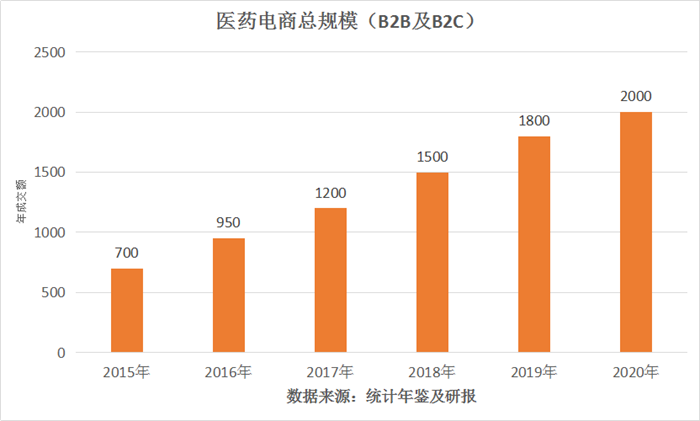
Furthermore, data indicates that the number of pharmaceutical e-commerce enterprises continues to rise. According to figures from the China Food and Drug Administration (CFDA), as of the end of last December, a total of 824 Internet Drug Transaction Service Qualification Certificates (excluding expired licenses) had been approved and issued by the CFDA and provincial food and drug administrations. These included 40 Class A certificates, 198 Class B certificates, and 586 Class C certificates. In 2016, 279 new licenses were issued, comprising 15 new Class A certificates, 81 new Class B certificates, and 183 new Class C certificates. The number of all three types of Internet Drug Transaction Service Qualification Certificates increased compared to the previous year, with the number of newly issued Class B certificates nearly doubling year-on-year (from 43 in 2015 to 81 in 2016).
The recently released "13th Five-Year Plan for Drug Distribution" also mentions the need to actively promote the widespread application of information technologies such as mobile internet and the Internet of Things (IoT) in the field of drug distribution, encourage enterprises to carry out service innovation based on the internet, and enrich drug distribution channels and development models. This is equivalent to providing policy support and protection for pharmaceutical e-commerce.
This undoubtedly presents significant opportunities for platform-based pharmaceutical e-commerce enterprises. First, recognition of pharmaceutical e-commerce by pharmaceutical manufacturers and distributors has increased. Second, driven by policy initiatives, the consolidation of the pharmaceutical industry enhances the negotiating power of platform-based pharmaceutical e-commerce companies with manufacturers and distributors. From the perspectives of information connectivity, demand matching, and service integration, continuous deep cultivation will become the preferred strategic direction for platform-based pharmaceutical e-commerce enterprises.