

Implementation Status of China's 2017 Target: 30% Family Doctor Contract Coverage Across Regions
The State Council recently issued the "Plan for Deepening the Reform of the Medical and Healthcare System during the 13th Five-Year Plan Period" (hereinafter referred to as the "Plan"). During the 13th Five-Year Plan period, China will achieve new breakthroughs in the development of five key systems: tiered diagnosis and treatment, modern hospital management, universal health insurance, drug supply guarantee, and comprehensive supervision. The Plan places tiered diagnosis and treatment at the forefront of the reforms, with the family doctor contract system serving as a crucial driver for its implementation.
In June last year, the "Guiding Opinions on Promoting Family Doctor Contract Services" (hereinafter referred to as the "Opinions") was jointly issued by the State Council’s Office of Healthcare Reform, the National Health and Family Planning Commission, the National Development and Reform Commission, the Ministry of Civil Affairs, the Ministry of Finance, the Ministry of Human Resources and Social Security, and the State Administration of Traditional Chinese Medicine, and came into effect on June 6, 2016. The goals set forth in the "Opinions" are to achieve a family doctor contract service coverage rate of over 30% by 2017, with a coverage rate of over 60% for key populations. By 2020, efforts will be made to expand contract services to cover the entire population, establish long-term and stable contractual service relationships, and basically achieve full coverage of the family doctor contract service system.
Following the issuance of the “Opinions,” provinces and municipalities across China have also introduced their own implementation measures for family doctor contract services, tailored to local conditions.Local policies were intensively issued in late 2016 and early 2017,Strive to Achieve the National Healthcare Reform Office’s Targets Within the Remaining Year. VCBeat (WeChat ID: vcbeat) has reviewed recent news reports on family doctor contract services across various provinces and municipalities, summarizing local implementation measures for the family doctor contracting system, and subsequently analyzing the changes this policy will bring to the healthcare industry.
“Family Doctor” Is Not a New TermThe pilot program for family doctor contract services has been implemented in certain regions of China for several years; however, it has received public acclaim without achieving widespread adoption. First, residents’ healthcare-seeking habits are not easily changed, and the market requires time to accept this new model of the doctor-patient relationship. Second, there is a severe shortage of general practitioners in China, particularly experienced senior general practitioners, leading to the prevalent phenomenon of “contracts signed but services not delivered.” The “Guiding Opinions” issued in June last year provided policy support for the family doctor contract model, elevating family doctor services to a national strategic level and outlining specific implementation targets. It mandated that the coverage rate of family doctor contract services reach over 30% by 2017.
A 30% coverage rate means that 410 million of China’s 1.37 billion population need to complete family doctor services by the end of this year.Contract SigningBased on a ratio of 2,000 patients per family doctor, China would have required approximately 200,000 family doctors by the end of 2017. To deliver high-quality services, assuming a ratio of 1,000 patients per family doctor, the country would need around 400,000 family doctors, indicating an even more substantial shortfall.
At present, family doctor teams are primarily composed of the following categories of medical personnel: first, registered general practitioners (including assistant general practitioners and traditional Chinese medicine general practitioners) at primary healthcare institutions; second, village doctors and physicians (assistant or licensed practitioners) at township health centers who are qualified to provide contracted services; and third, eligible physicians from public hospitals and retired clinicians with intermediate or senior professional titles, particularly those specializing in internal medicine, gynecology, pediatrics, and traditional Chinese medicine. Meanwhile, non-governmental healthcare institutions (including private clinics) that meet the eligibility criteria are encouraged to provide contracted services and are entitled to the same payment and reimbursement policies. As the workforce of general practitioners expands, a contracted service team led by general practitioners will gradually take shape.
In the construction of the healthcare system, tiered diagnosis and treatment has been a key objective since the new healthcare reform in 2009. The so-called tiered diagnosis and treatment system involves classifying diseases based on their severity, urgency, and complexity of treatment, with medical institutions at different levels assuming responsibility for treating different conditions, thereby achieving initial consultation at the primary care level and two-way referrals. Meanwhile, capacity building at the primary care level, represented by the family doctor system, is one of the specific reform pathways to promote the implementation of tiered diagnosis and treatment.
Promote the family doctor contract service, which mainly provides personalized health services to family members in the form of contracts by community family doctors, timely meeting their daily medical and healthcare needs. Residents' daily medical needs can be met in the community or at home, shifting the focus of healthcare forward and making family doctors the "health gatekeepers" for residents, transitioning from treating diseases to "preventing diseases before they occur," thereby reducing overall social medical expenditures. Additionally, through the referral system between upper and lower levels under the community family doctor scheme, a tiered diagnosis and treatment system is formed, reducing patients' blind choice of hospitals and their "authority worship" towards large hospitals, thus alleviating the difficulty of seeing a doctor in big cities and major hospitals.
Compared with entrepreneurship in traditional sectors, startups in the internet healthcare sector differ significantly. They require not only the integration of innovative technologies and the development of novel business models, but also proactive policy guidance.
During the development of internet-based healthcare, the introduction of a particular policy proved highly significant: the “Opinions on Implementing Appointment-Based Diagnosis and Treatment Services in Public Hospitals,” issued by the Ministry of Health in 2009. The emergence of internet technology made informatization one of the means to streamline medical processes. It was precisely the release of this document that launched the industrial journey of internet-based healthcare, endorsed the concept of “centralized appointment-based diagnosis and treatment platforms,” and facilitated the rapid growth of companies such as WeDoctor (Guahaowang) and Juyi160, whose core business revolves around online appointment registration.
By 2017, the coverage rate of family doctor contract services exceeded 30%, with the coverage rate for key populations surpassing 60%. We repeatedly emphasize these figures because the elevation of family doctor contract services to a national strategic level will not only bring disruptive changes to China’s healthcare environment and delivery models but also have a significant impact on the internet healthcare industry.
Previously, VCBeat analyzed the changes brought about by the implementation of the new system in terms of the doctor-patient model, residents' medical benefits, and family doctor performance. For enterprises, the implementation of the family doctor contract system will directly benefit three types of companies: those in medical informatics, portable medical devices, and third-party testing.
First, healthcare IT companies will receive substantial benefits.
Each family doctor is responsible for the health management of over a thousand individuals, particularly key populations suffering from chronic diseases such as hypertension, diabetes, and tuberculosis. Effective management of community patient records and enhanced doctor-patient communication will create new market opportunities for companies providing IT tools to physicians.
Meanwhile, family doctors play a crucial role in the tiered diagnosis and treatment model involving upward and downward referrals. They need to leverage health information technology to strengthen connectivity within the tiered healthcare system, transmit patient data to specialists for management, and thereby enhance the quality of primary care.
Family doctor teams can provide home visits; therefore, as team sizes expand, portable medical devices will experience explosive growth. Devices such as blood pressure monitors, glucometers, portable automated external defibrillators (AEDs), portable ECG monitors, and simple respirators are convenient for family doctors to carry into residents’ homes.
Family doctors and community medical institutions are deeply rooted in their communities. While they facilitate residents’ visits to clinics or enable house calls by physicians, there is still a need for telemedicine services. Here, telemedicine does not refer to consultation systems, but rather to systems for health data collection, monitoring, and medical alerting for residents. In the event of an acute medical emergency, family doctors can provide on-site management and first aid more rapidly than the 120 emergency medical services, thereby capitalizing on the “golden six minutes” for emergency care.Resuscitation, saving patients' lives.
With the decentralization of medical institutions and the growing number of family doctors, third-party testing laboratories will emerge as a substantial market. However, the third-party testing market driven by family physicians has a distinct characteristic: the tests offered are generally not overly complex, focusing primarily on routine monitoring for patients with stable chronic conditions. Compared to enduring long queues at tertiary hospitals, rapid and convenient third-party testing remains an attractive option.
Chronologically, Shanghai, Hangzhou, and Beijing were among the earliest pilot regions to implement family doctor contracting policies. However, as these earlier policies were largely local in nature, they lacked clarity regarding supporting medical insurance measures and incentive mechanisms for family doctors. Meanwhile, the disparity between high contracting rates and low utilization rates has been a frequent subject of criticism. The phenomenon of “signing without engagement” accurately reflected the reality of the previous family doctor contracting system. Trust deficits constitute the most significant weakness of the family doctor system, with tertiary Grade A hospitals remaining the preferred choice for medical care among residents across various regions.
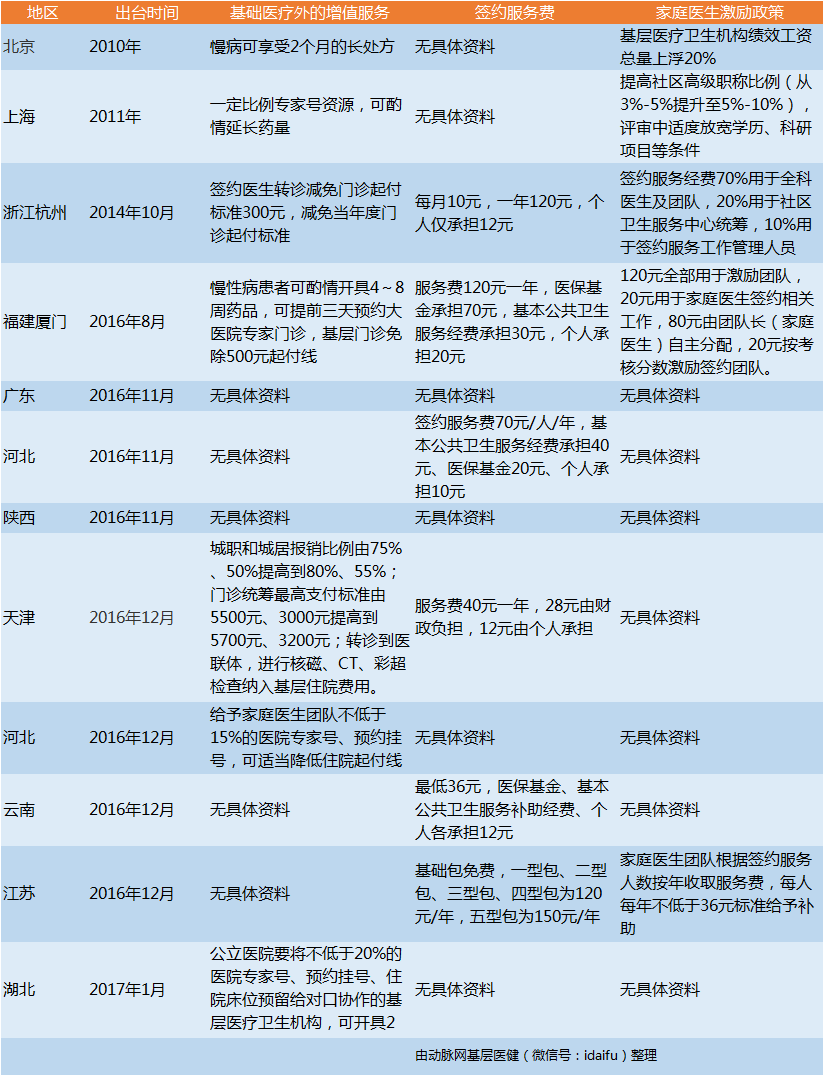
Following the release of the “Opinions” on the implementation of the family doctor contract system by the national government last June, multi-level and multi-faceted supportive policies have been introduced. In the process of implementation, various regions have also incorporated innovative institutional measures. From December 2016 to January 2017, local governments across China entered an intensive period of issuing family doctor contract policies tailored to their respective local conditions in order to advance the implementation of the “Opinions.” Based on news reports from various provinces and municipalities, VCBeat has compiled representative data on policy rollout timelines, service fees, and incentive mechanisms for family doctors in selected provinces and cities. The supportive policy measures can be summarized into the following key areas.
First: Priority referral. Superior hospitals within the regional medical consortium shall establish green channels for referrals, facilitating limited patient transfers by reserving specialist appointments, registration slots, and hospital beds at these higher-level institutions.
Second: Extended prescription durations for patients with chronic diseases. Family doctors may issue long-term medication prescriptions for contracted patients with chronic conditions.
Third: Subsidize the contract signing service fee. The contract signing service fee is shared among three parties: the medical insurance fund, local basic public health service funds, and the contracted residents. The out-of-pocket expense for individuals is minimal, typically ranging from 10 to 20 yuan per year, with certain disadvantaged groups eligible for free contract signing services.
Fourth: Some regions have increased the reimbursement rates for medical insurance. For patients seeking care at contracted primary healthcare institutions, the reimbursement rate is higher when referred by their contracted physician. This differential reimbursement structure encourages enrolled residents to seek care at the primary level.
Fifth: Incentives for family doctors. Increasing the proportion of senior professional titles in community health centers and raising the salary standards for community medical staff are key to addressing the shortage of primary care medical talent.
After signing a contract with a family doctor, residents will enjoy basic medical services, public health services, and agreed-upon health management services provided by the family doctor team. Basic medical services cover the diagnosis and treatment of common and frequently occurring diseases using both traditional Chinese medicine (TCM) and Western medicine, guidance on healthcare pathways, medication advice, and referral appointments. Public health services encompass the National Basic Public Health Services Program and other public health services stipulated by regulations. Health management services primarily involve developing personalized contracted service plans tailored to residents’ health status and needs, which may include basic medical services such as health assessments, home visits, home hospital beds, home nursing care, rehabilitation guidance, TCM-based preventive care (“treating potential diseases”), remote health monitoring, and disease prevention guidance.
After signing up, residents can enjoy differentiated preferential policies in areas such as medical consultations, referrals, medication, and health insurance.
First, regarding medical care access, family doctor teams will proactively refine their service models to provide contracted residents with a variety of services—including comprehensive continuous care, home visits, off-hour appointments, and scheduled consultations—in accordance with agreed-upon protocols.
Second, regarding referrals, family doctor teams will be allocated a certain proportion of specialist appointments and priority registration slots at hospitals, as well as given priority access to inpatient beds and other resources, thereby facilitating prioritized outpatient visits and hospitalization for enrolled residents. General practice departments or designated specialized units in secondary hospitals and above shall coordinate with family doctor referral services and establish green channels for referred patients.
Third, regarding medication management, family doctors may appropriately extend prescription durations for contracted patients with chronic diseases, thereby reducing the frequency of hospital visits for medication refills. For patients referred down from higher-level institutions, medications may be prescribed in accordance with their clinical conditions and the medical orders issued by the referring healthcare providers.
Fourth, regarding medical insurance, inpatient patients referred through family doctors in accordance with regulations are exempt from the requirement to file for referral and transfer records. For patients referred upward, a cumulative deductible policy is implemented; for inpatients referred downward, no separate primary-care hospitalization deductible is imposed. Meanwhile, localities may increase reimbursement rates or provide exemptions based on their specific circumstances.
The “Opinions” state that family doctor teams provide contracted services to residents as agreed, and collect an annual contracted service fee based on the number of enrolled individuals. The service fee is shared among three parties: the medical insurance fund, local basic public health service funds, and the enrolled residents. During subsequent implementation and promotion, local governments have established varying service fee standards in accordance with their respective levels of economic development, fiscal capacity, and the affordability of their medical insurance funds. Meanwhile, the content, pricing, and cost-sharing ratios for personalized service packages are determined independently by each locality.
Contracted service fees vary by region but remain modest, with annual fees ranging from RMB 40 to 120. The actual out-of-pocket cost for individuals is only around RMB 10, and further reductions or exemptions are available for disadvantaged groups, imposing virtually no financial burden on residents.
Without incentive mechanisms, the performance-based income of doctors who sign up for family doctor services is not high, leading to low motivation among them and significantly hindering the promotion of the family doctor model. Reports indicate that the average annual salary of doctors in tertiary hospitals in Beijing is around 140,000 yuan, whereas community doctors earn only 70,000 yuan. Keeping doctors at the grassroots level is not as simple as raising their salaries; it also requires enhancing their professional development opportunities and social status. Different regions have provided varied solutions on how to motivate medical personnel through supporting measures.
In summary, there are two key aspects. First, priority is given to general practitioners, community physicians, and family doctors in areas such as staffing quotas, personnel recruitment, professional title promotion, on-the-job training, and awards and recognitions. Second, a performance evaluation system for contracted services is established, with core indicators including the number and composition of enrolled individuals, service quality, health management outcomes, resident satisfaction, control of pharmaceutical and medical costs, and the proportion of contracted residents seeking primary care at grassroots facilities. Family doctor teams are regularly evaluated based on these criteria, and a portion of the contracted service fees is allocated as incentives to family doctors in the community.
In October 2014, the “Implementation Plan for Integrated Medical, Nursing, and Elderly Care Contracted Services in Hangzhou” was officially implemented. The contracted services include community medical care and two-way referral services, home hospital bed services, remote health monitoring and management services, and health assessment services.
In accordance with Document No. 122 [2014] of the Hangzhou Municipal People’s Government Office and Document No. 77 [2015] of the Hangzhou Health and Family Planning Commission,The integrated medical, nursing, and elderly care contract service fee is RMB 10 per month (RMB 120 per year), with the contracted individual bearing only RMB 12 annually., payment can be made using the accumulated funds in the individual account of basic medical insurance or directly in cash. Preferential policies waiving the individual’s share of the contract signing service fee are implemented for residents aged 60 and above, disadvantaged groups, individuals holding disability certificates, and persons entitled to special care and compensation.
For patients referred by their contracted physicians to other designated medical institutions within the main urban area for treatment,Waive the outpatient deductible of 300 yuan, the individual cost-sharing ratio is determined based on the tier of the designated medical institution where care is received. Except in emergencies, if a patient seeks care at another designated medical institution without a referral, the outpatient deductible will not be waived. For enrollees in Tier 1 and Tier 2 of the Urban and Rural Resident Basic Medical Insurance who opt for contracted services, the outpatient deductible for the current year shall be waived. If, due to medical necessity, a patient is referred by their contracted physician to another designated medical institution within the main urban area, their individual cost-sharing ratio shall be determined according to the standards applicable to community health service institutions.
70% of the funding for contracted services is allocated to general practitioners and their teams, 20% is reserved for the centralized management of community health service centers, and 10% is designated for personnel managing contracted service operations. Fees for contracted services are excluded from the total performance-based salary pool., encouraging physicians to proactively and actively provide more services.
In January 2017, Hubei Province issued the Implementation Opinions on Promoting Family Doctor Contract Services in Hubei Province (hereinafter referred to as the “Opinions”), deciding to launch family doctor contract services across the province starting from 2017. Family doctor teams shall collect annual contract service fees based on the number of contracted residents, with costs shared among the medical insurance fund, basic public health service funds, and payments by contracted residents.
Residents can access basic medical services provided by family doctor teams and benefit from differentiated policies in areas such as medical consultations, referrals, medication, and health insurance.Urban public hospitals shall reserve no less than 20% of expert consultation slots, appointment-based registration slots, and inpatient beds.To primary healthcare institutions engaged in paired assistance. These institutions may issue prescriptions based on patients’ clinical needs and orders from superior hospitals, without being restricted to the National Essential Medicines List; for patients with chronic diseases, they may issue extended-duration and long-term prescriptions in accordance with orders from superior hospitals.A single prescription may be issued for a maximum supply of 2 months.。
Xiamen, Fujian Province has driven comprehensive healthcare reform through a tiered diagnosis and treatment model featuring “collaborative management by three types of professionals.” Building on this foundation, the city has steadily advanced family doctor contract services, launching the Xiamen Implementation Plan for Family Doctor Primary Care Contract Services (Trial) in August 2016. The annual fee for family doctor contract services is RMB 120, with RMB 70 covered by the medical insurance fund, RMB 30 from basic public health service funds, and RMB 20 paid out-of-pocket by residents.
For patients with chronic conditions such as hypertension and diabetes, prescriptions may be issued for a duration of 4 to 8 weeks, as clinically indicated.Medications, priority appointment with specialists at major hospitals (three days earlier than regular appointments), and waiver of the initial deductible of 500 yuan for primary care clinics.Patients referred by family doctors for hospitalization are exempt from deductibles for second and subsequent admissions. A differentiated medical insurance policy is implemented, offering lower out-of-pocket ratios for patients seeking care at primary healthcare institutions. For contracted residents with clear diagnoses at tertiary hospitals who require ongoing medication, personalized drug procurement can be arranged through a "filing" system.
The family doctor contract service fee is 120 yuan per person, entirely allocated to incentivize team-based contracting services. Of this amount, 20 yuan is centrally managed by the institution for tasks related to family doctor contracting, while the remaining 80 yuan is autonomously distributed within the team after assessment by the team leader (family doctor). Additionally, 20 yuan is used to incentivize the contracting team based on comprehensive assessment scores.
Beijing took the lead in China in implementing “family doctor-style services” starting in 2010. The service teams, composed of general practitioners, community nurses, and preventive healthcare personnel, sign agreements and establish service contact cards with enrolled households based on the principles of voluntary enrollment and standardized service delivery. All residents living in Beijing can enroll with nearby community health service centers without household registration (hukou) restrictions. Service fees are jointly covered by the medical insurance fund, basic public health service funding, and the enrolled residents themselves.
Shanghai began piloting the family doctor contract system in 2011. In November 2015, Shanghai issued the "Guiding Opinions on the Comprehensive Promotion of the Family Doctor System in This City," launching a new round of comprehensive reforms in community health services. Through the "1+1+1" medical institution combination contracting model, residents can select one family doctor from a community health center, one district-level medical institution, and one municipal-level medical institution within the city, thereby forming a "1+1+1" contracted medical institution group. After signing the contract, patients are free to seek medical care within this designated group. The family doctor team charges an annual contract service fee to residents, which is jointly covered by three sources: the basic medical insurance fund, basic public health service funding, and out-of-pocket payments by the contracted residents.
Several “tangible benefits” for residents who sign up with family doctors include, in addition to basic medical services: In terms of referrals, family doctor teams will have access to a certain proportion of hospital specialist appointments, scheduled registration slots, and reserved beds. Regarding medication management, for patients with chronic conditions, family doctors may appropriately extend the quantity of medications dispensed per prescription. For patients referred down from higher-level facilities, medications may be prescribed in accordance with their condition and the instructions from physicians at the referring institutions. In terms of health insurance, differentiated reimbursement policies will be implemented for enrolled residents; for example, the deductible can be calculated consecutively for hospitalized patients who undergo approved referrals, and enrolled residents will receive a higher reimbursement rate when seeking care at primary care facilities.
Compensation distribution should be prioritized toward family doctors, increasing the proportion of senior professional titles in community health settings (from 3%–5% to 5%–10%). During evaluations, requirements for academic qualifications and research projects should be appropriately relaxed, while assessments focusing on skills and performance characteristics specific to community healthcare should be strengthened.
At the end of 2016, the Tianjin Municipal Health and Family Planning Commission issued the "Notice on Printing and Distributing the Trial Requirements for Family Doctor Contracted Services in Tianjin." The contract term for residents is one year,The annual contracted service fee is 40 yuan, with 28 yuan covered by government subsidies and 12 yuan borne by individuals.After signing up, residents will have access to appointment-based outpatient services at primary healthcare institutions, with priority consultations during reserved time slots. Family doctor teams will be allocated a certain number of resources from secondary and tertiary hospitals within the medical consortium, including specialist appointments, registered bookings, and reserved beds. Hospitals at the secondary level and above will establish green referral channels to facilitate priority consultations, examinations, and hospitalization for signed-up residents. Signed-up residents can also enjoy video consultation services with specialists from secondary and tertiary hospitals in the medical consortium. Family doctors may issue long-term prescription medications for chronic disease patients who have signed up.The single dispensing quantity is for 30 days.
Regarding reimbursement, starting from the month following the signing of the contract,For medical services at contracted primary healthcare institutions, the reimbursement rates for urban employee basic medical insurance and urban resident basic medical insurance have been increased from 75% and 50% to 80% and 55%, respectively; the maximum payment standards for outpatient pooling have been raised from RMB 5,500 and RMB 3,000 to RMB 5,700 and RMB 3,200, respectively.; Contracted insured individuals hospitalized at primary care institutions, during which periodReferred by family doctors to the medical consortium for MRI, CT, and color Doppler ultrasound examinations, the incurred medical expenses are included in the primary care inpatient costs.
In December 2016, the Hebei Provincial Health and Family Planning Commission, the Provincial Development and Reform Commission, and five other departments jointly issued the “Implementation Opinions on Promoting Family Doctor Contract Services,” launching family doctor contract services across the province.
Implement differentiated policies for contracted residents in areas such as medical consultations, referrals, medication management, and health insurance coverage. Family doctors may provide a variety of services to contracted residents in accordance with agreements, including comprehensive care, home visits, flexible-hour services, and appointment-based services.Allocate no less than 15% of hospital specialist appointments and scheduled registration slots to family doctor teams., priority is given to arranging inpatient beds. For contracted patients with chronic diseases, the prescription dosage may be extended as appropriate, and such prescriptions shall be included in the scope of outpatient medical insurance reimbursement in accordance with relevant regulations. Inpatient patients referred through family doctors in compliance with applicable rules are exempt from the medical insurance filing procedures for referrals and transfers; the inpatient deductible may be appropriately reduced, with specific standards determined by the pooling regions.
In December 2016, multiple departments in Yunnan Province jointly issued a document to promote the family doctor contract service. Residents of Yunnan may voluntarily select one tertiary hospital and one secondary hospital to establish a “1+1+1” combined family doctor contracting service model. Within this combination, patients may choose their healthcare providers according to their needs, with a gradual transition toward initial consultations at primary care facilities. Medical visits outside this combination should be accessed through referrals by family doctors.The medical insurance fund covers 12 yuan, the basic public health service subsidy covers 12 yuan, and individuals pay 12 yuan. The family doctor team collects service fees annually based on the number of contracted individuals, with subsidies provided at a standard of no less than 36 yuan per person per year for the contracting service fee.
In November 2016, Guangdong Province adopted the Implementation Plan for Accelerating the Family Doctor Contract Service System. This plan provides residents with basic and personalized services through family doctor contract service packages. It required all localities in Guangdong to finalize their localized contract service packages and publish the standards for fees and payments by January 31, 2017. The urban and rural family doctor contract services in Guangdong Province implement categorized contracting, paid contracting, and differentiated contracting, delivering basic and personalized services to residents in the form of family doctor contract service packages. By improving the income distribution and incentive mechanisms for family doctor teams and reasonably increasing the total performance-based salary pool for primary healthcare institutions, family doctors are enabled to raise their income levels appropriately by providing high-quality services.
In Jiangsu Province, 75% of community health service centers have launched family doctor services. Jingjiang City offers a variety of contract options,The Basic Package is free of charge. Type I, Type II, Type III, and Type IV Packages are priced at CNY 120 per year, while the Type V Package is priced at CNY 150 per year.Huai’an City implements the “1+X” model for family doctor (team) contract services, primarily targeting primary healthcare institutions such as community health service centers (stations) and township health centers. In this model, “1” refers to the basic public health services provided free of charge by the state, which are offered as a free service package to all permanent residents in accordance with standardized protocols; “X” denotes paid services included in personalized paid service packages, allowing residents to voluntarily select specific services for contracting.
By 2017, the coverage rate of family doctor contracted services exceeded 30%, with the coverage rate for key populations exceeding 60%. By 2020, efforts will be made to expand contracted services to the entire population, basically achieving full coverage of the family doctor contracted service system. There are less than three years left to achieve this goal.
The family doctor system is a crucial component of our healthcare reform. Experience from regions that have early on implemented the family doctor contract service model shows that the implementation process has not been smooth. To achieve breakthrough progress, in addition to policy support, multifaceted efforts are required, including publicity for contract policies, development of primary care workforce, shifts in public perception, and reforms of public medical institutions. It is hoped that localities will strengthen support based on national policies and establish a series of complementary institutional frameworks to effectively advance the tiered diagnosis and treatment system.
Source: Xinhua News Agency, provincial and municipal government websites, local news