

Traditional Chinese Medicine in Japan: A $10 Billion Industry with Only One Listed Company
This article is part of Huachuang Securities’ series of reports on the Japanese biopharmaceutical industry, republished with authorization by VCBeat.
Key Views in This Issue
1. Foreword.
“Orange trees grown north of the Huai River produce trifoliate oranges.” This proverb aptly describes the relationship among Traditional Chinese Medicine (TCM), Japanese Kampo, and Korean Hanbang. Although these three systems share a common origin, they have each evolved into distinct and remarkable practices in response to changing times and social contexts. As China is on the verge of fully liberalizing its market for TCM formula granules, Tsumura & Co., Japan’s largest Kampo manufacturer, has officially entered the domestic market through a partnership with Shanghai Pharmaceuticals Group. Will Japanese Kampo flourish once again in its place of origin? Let us first explore the history and evolution of Kampo.
2. The Past and Present of Kampo Medicine.
Kampo medicine is a medical system developed based on the principles of the ancient Chinese classics *Shanghan Lun* (Treatise on Cold Damage) and *Jingui Yaolue* (Essential Prescriptions from the Golden Cabinet). Medicinal products formulated by combining several natural substances in specific proportions according to Kampo theory are known as Kampo medicines. After more than a millennium of development, Japanese Kampo has diverged significantly from Traditional Chinese Medicine (TCM) in many aspects, including fundamental concepts and diagnostic and therapeutic approaches. It is a unique form of traditional medicine in Japan and constitutes an important component of Japanese clinical practice. As a key pharmaceutical formulation for Kampo medicines in clinical settings, compound granules have achieved a clinical usage rate of 89% in Japan, according to industry association statistics. In 2014, the total industrial output value of Kampo medicines reached JPY 9.992 billion, accounting for 2.44% of Japan’s total pharmaceutical industry output value that year.
3. Japanese Kampo medicine manufacturers.
At its peak, Japan had approximately 40 Kampo medicine manufacturers; however, only 17 remain today. With the exception of the industry leader, Tsumura & Co., which is a publicly listed company, the rest are small and medium-sized enterprises. Tsumura currently offers 141 products included in the national health insurance reimbursement list, accounting for approximately 84.5% of the annual sales revenue of prescription Kampo medicines, solidifying its position as the undisputed industry leader. In the over-the-counter (OTC) Kampo medicine sector, Kracie holds the top position with a 30% market share, while Tsumura ranks fourth with only a 5% share.
Main Text
I. The Past and Present of Kampo Medicine
Japanese Kampo medicine is a medical system developed based on the principles of the ancient classics *Shanghan Lun* (Treatise on Cold Damage Disorders) and *Jingui Yaolue* (Essential Prescriptions from the Golden Cabinet). Medicinal products formulated by combining several natural substances in specific proportions according to Kampo medical theories are known as Kampo formulations. After more than a thousand years of development, Japanese Kampo has diverged significantly from Traditional Chinese Medicine (TCM) in many aspects, including fundamental concepts and diagnostic and therapeutic methods. It is a unique traditional medical system of Japan and an important component of Japanese clinical medicine. As a key pharmaceutical form for the clinical application of Kampo medicines, compound granule preparations have achieved a clinical usage rate of up to 89% in Japan, according to statistical data from the industry association. Meanwhile, in 2014, the total industrial output value of Kampo medicines reached JPY 9.992 billion, accounting for 2.44% of the total output value of Japan’s pharmaceutical industry that year.
(1) The Origin of Kampo
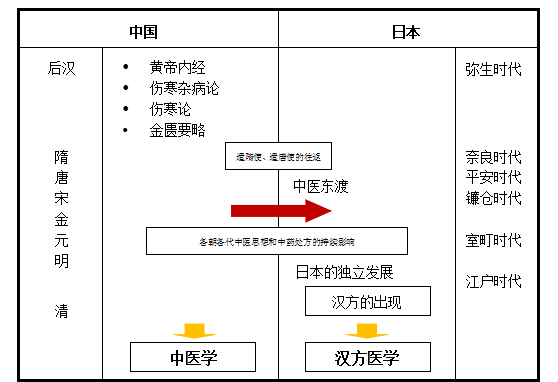
Kampo medicine is a medical system developed based on the principles found in the ancient classics Shanghan Lun (Treatise on Cold Damage) and Jingui Yaolue (Essential Prescriptions from the Golden Cabinet). Traditional Chinese Medicine was introduced to Japan from China in the 5th–6th centuries AD and underwent significant development adapted to Japan’s unique geographical environment, climate, population constitution, and lifestyle habits, ultimately evolving into Kampo medicine. It differs substantially from Traditional Chinese Medicine in many aspects, including basic concepts and diagnostic and therapeutic approaches, making it a traditional medical system unique to Japan. The core concept of Kampo medicine is “Sho” (syndrome/pattern), which is analogous to a diagnostic label in Western medicine and serves as the primary basis for diagnosis and treatment in Kampo practice.
Chart 1 The History of Kampo
Source: Huachuang Securities
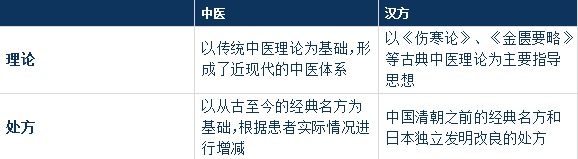
In contrast to Traditional Chinese Medicine (TCM), which is inclusive and has remained relevant over time, Japanese Kampo medicine is guided primarily by classical TCM theories such as those found in the Treatise on Cold Damage Disorders and the Essential Prescriptions from the Golden Cabinet. In addition to the four diagnostic methods of TCM—inspection, auscultation and olfaction, inquiry, and palpation—Kampo places particular emphasis on findings from abdominal diagnosis. Regarding prescription dispensing, TCM predominantly relies on personalized herbal decoctions, whereas Kampo prescriptions are largely dominated by mass-market compound granule formulations, driven by factors such as health insurance coverage.
Chart 2 Differences Between Traditional Chinese Medicine and Kampo
Source: Huachuang Securities
(II) Relevant Policies on Kampo Medicine
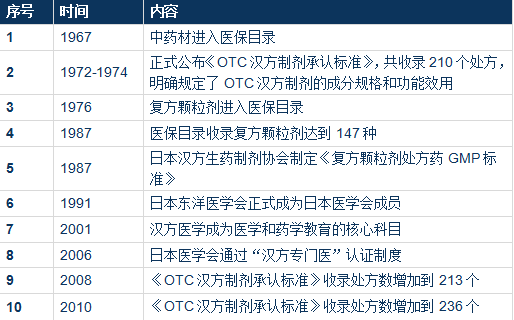
Kampo medicine has experienced its rise during the Edo period, decline following the Meiji Restoration, and revival in the Showa and Heisei eras, currently becoming a significant component in Japanese clinical medicine that cannot be overlooked. In particular, in 1967, thanks to the efforts of visionaries within the Japanese medical community, herbal ingredients used in Kampo medicines were officially included in the national health insurance reimbursement list. In 1976, compound granule formulations were also added to the reimbursement list and exempted from clinical trials required for new drug registration and approval, formally ushering in the renaissance of Kampo in Japan. Currently, there are 148 compound granule formulations covered by health insurance, and 236 over-the-counter (OTC) Kampo products with clearly defined compositional specifications and therapeutic indications. Meanwhile, Kampo medicine has become a mandatory subject in all Japanese medical schools. However, the exclusion of individually tailored Kampo decoctions from health insurance coverage has constrained the further development of Kampo in Japan. Additionally, as pressure on healthcare cost containment intensifies, discussions about removing Kampo medicines from the insurance reimbursement scope have grown increasingly frequent in recent years. After years of development, market growth driven solely by compound granule formulations is approaching its ceiling.
Figure 3 Overview of Policies Related to Kampo Medicine
Source: Huachuang Securities
There are two methods for preparing compound granules: spray drying and freeze drying. Compared with spray drying, freeze drying does not involve a heating process and is generally considered to cause less damage to the ingredients and efficacy of the drug. However, due to its high energy consumption, spray drying remains the predominant method used by manufacturers of compound granules in Japan.
(III) The Industrial Scale of Kampo Medicine
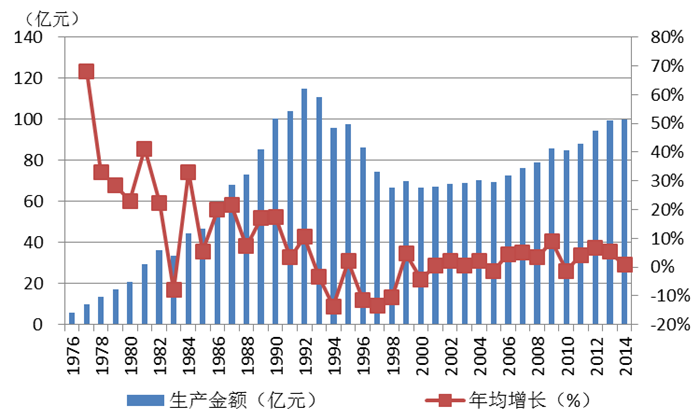
The inclusion of compound granules in the National Health Insurance reimbursement list and the promulgation of the “Standards for Approval of OTC Kampo Preparations” have driven the rapid development of Japan’s Kampo medicine industry. In 1992, the total industrial output value of Japan’s Kampo medicine reached a historical peak of JPY 11.47 billion, with the growth of prescription drugs being the primary driver of this overall surge. However, as Japan’s economy entered the “Lost Decade,” coupled with the market launch of certain alternative chemical drug products and emerging reports of adverse effects associated with Kampo medicines, the total industrial output value experienced a significant decline, hitting a historic low of JPY 6.66 billion in 1998. Currently, the industry is in a state of gradual recovery, with the total industrial output value reaching JPY 9.992 billion in 2014.
Chart 4 Overview of the Total Industrial Output Value of Kampo Medicines
Source: Huachuang Securities
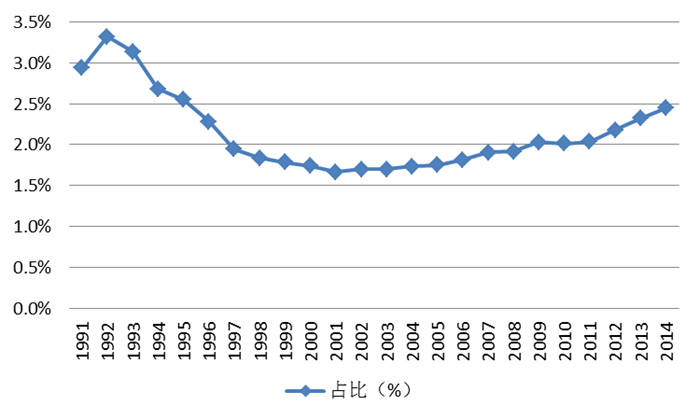
In terms of the overall share of Kampo medicines in the pharmaceutical industry, the proportion has followed a U-shaped trend since the 1990s. It declined from a peak of 3.32% in 1992 to 1.67% in 2001, before gradually recovering to reach 2.44% in 2014. By subsector, compound granules registered a growth rate of -5.4% in 2014, consistent with the broader downward trend in prescription drug growth amid healthcare insurance cost-containment measures. In contrast, over-the-counter (OTC) Kampo medicines achieved a growth rate of 29.6% in 2014, indicating that there is still significant untapped potential for OTC Kampo products and Kampo health supplements.
Figure 5. Share of Kampo Medicines in the Overall Pharmaceutical Industry
Source: Huachuang Securities
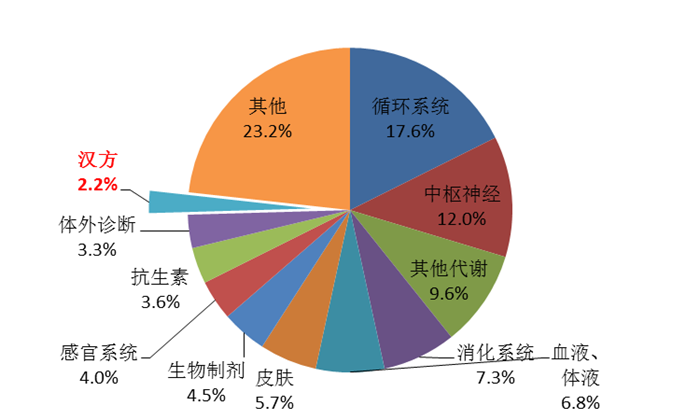
Furthermore, in terms of prescription drug categories, Kampo medicines ranked 17th in 2014, accounting for 2.2% of the total output value, with both the ranking and proportion remaining unchanged from the previous year. However, given that the market shares of the top-ranked categories are all showing a downward trend, we anticipate that Kampo medicines may become the next target for healthcare insurance cost-containment measures. For manufacturers of Kampo medicines, growth potential in the prescription drug segment is already minimal; over-the-counter (OTC) medications and health supplements are expected to emerge as the next areas of growth. Meanwhile, if production standards for compound granules are approved in China, exports of Kampo medicines to the Chinese market could also become a new growth driver.
Figure 6. Proportion of Prescription Drugs by Category in 2014
Source: Huachuang Securities
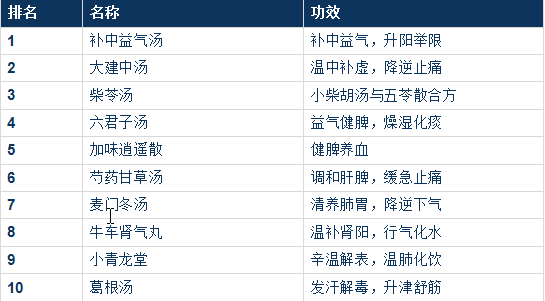
Among the top ten best-selling compound granule formulations, tonics and remedies for colds and fever occupy leading positions, with Bu Zhong Yi Qi Tang, Da Jian Zhong Tang, and Chai Ling Tang ranking in the top three.
Figure 7 2014Top 10 Compound Granules by Annual Sales Revenue
Source: Huachuang Securities
II. Kampo Medicine Manufacturers in Japan
During its peak, Japan had approximately 40 Kampo (traditional Chinese medicine) manufacturers; to date, only 17 remain. With the exception of Tsumura & Co., the industry leader and a publicly listed company, the rest are small and medium-sized enterprises. Tsumura currently offers 141 formulations included in the national health insurance reimbursement list, accounting for approximately 84.5% of the annual sales revenue of prescription Kampo drugs, firmly establishing it as the undisputed industry leader. In the over-the-counter (OTC) Kampo market, Kracie holds the top position with a 30% market share, while Tsumura ranks fourth with only a 5% share.
(1) Tsumura & Co. (Tokyo Stock Exchange Prime Market: 4540)
Tsumura, originally known as Tsumura Juntendo, initially built its business on the sale of the gynecological remedy “Chujoto.” However, the company rose to prominence thanks to the widespread market popularity of its Kampo-based bath additives. Leveraging the revenue from this success, Tsumura launched an extensive marketing campaign to promote Japanese Kampo medicine nationwide. Through the company’s efforts, Kampo formulations were included in Japan’s national health insurance reimbursement list without requiring efficacy or adverse effect testing. With 141 reimbursable products, Tsumura has become the undisputed leader and most imitated player in Japan’s Kampo pharmaceutical market.
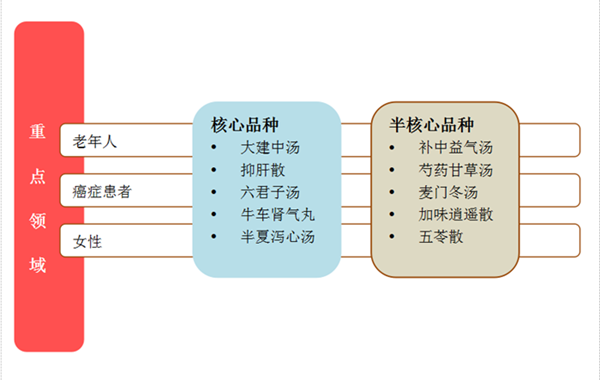
From the perspective of business composition, Kampo prescription drugs constitute the company’s core business, accounting for 95.3%, while the OTC Kampo drug business represents a smaller share at only 2.2%. Additionally, subsidiaries and other prescription drug businesses contribute 2% and 0.5%, respectively. Among the 148 compound granule formulations included in the National Reimbursement Drug List, the company offers 141 varieties, with 129 currently in production. The company utilizes 119 types of Chinese herbal materials, over 80% of which are imported from China. To further expand clinical demand for Kampo medicines, the company has collaborated with renowned universities and research institutions both within and outside Japan to conduct evidence-based clinical studies on five core products: Daikenchuto, Rikkunshito, Goshashinkigan, and Yokukansan. The aim is to establish the superior position of these five core products in clinical treatment through the analysis and comparison of clinical data. Meanwhile, the company is actively preparing for U.S. approval and certification of its Kampo medicines. Currently, the company is conducting Phase IIa clinical trials in the United States for Daikenchuto (TU-100) across three indications: ulcerative colitis, irritable bowel syndrome, and post-laparoscopic colectomy patients. The portion of the trial focusing on ulcerative colitis has been completed, and the design work for Phase IIb trials will commence once the clinical trials for the other two indications are concluded. Furthermore, the company is developing Kampo formulations aimed at reducing the side effects of anticancer drugs for oncology treatment.
Chart 8 Tsumura’s Key Focus Areas and Core Products
Source: Huachuang Securities
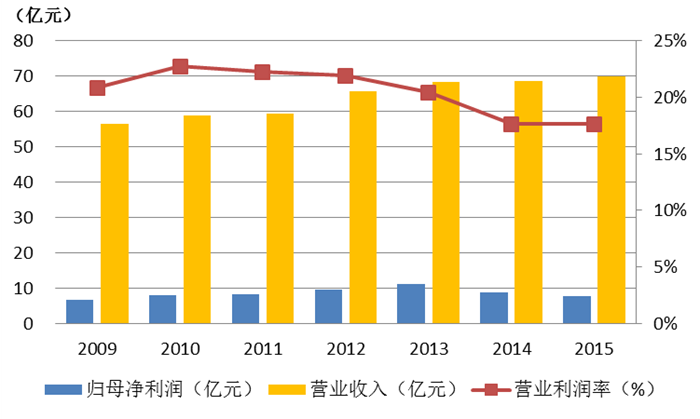
In 2015, the Company achieved operating revenue and net profit attributable to shareholders of the parent company of RMB 6.987 billion and RMB 779 million, representing year-on-year changes of +1.98% and -10.79%, respectively. Affected by the rise in prices of imported Chinese medicinal materials and the depreciation of the RMB exchange rate since 2013, the Company’s operating profit margin declined from approximately 20% in 2013 to around 17% in the past two years, thereby dragging the growth rate of net profit attributable to shareholders of the parent company from positive to negative.
Figure 9 Overview of Company Financial Data
Source: Huachuang Securities
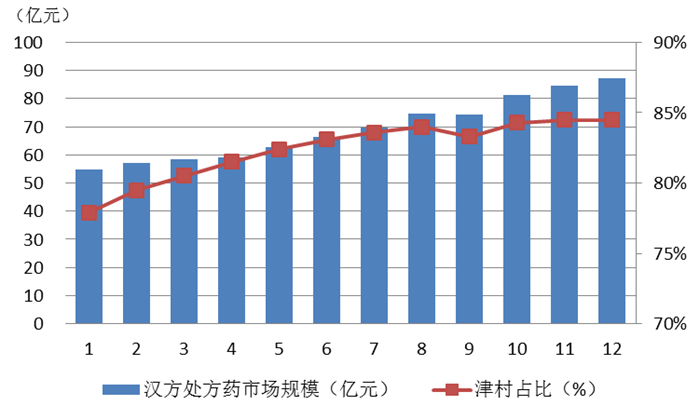
However, in terms of market share for Kampo prescription drugs, the company’s industry share has remained above 80% since fiscal year 2006, with the recent two-year figure of 84.5% marking a historical high, thereby underscoring the company’s dominant market position.
Chart 10 Market Size of Kampo Prescription Drugs and Tsumura’s Market Share
Source: Huachuang Securities
In its future strategic planning, the vast Chinese market has also become a key focus for the company. In addition to establishing a joint venture with Shanghai Pharmaceuticals Group to target the deregulation of compound traditional Chinese medicine (TCM) granules, the company is preparing to actively enter the competitive landscape of the TCM decoction pieces market. We believe that the company’s expertise in quality management and brand development and marketing of compound granules will help it develop the Chinese market into a new revenue growth driver.
(II) Kracia (non-listed company)
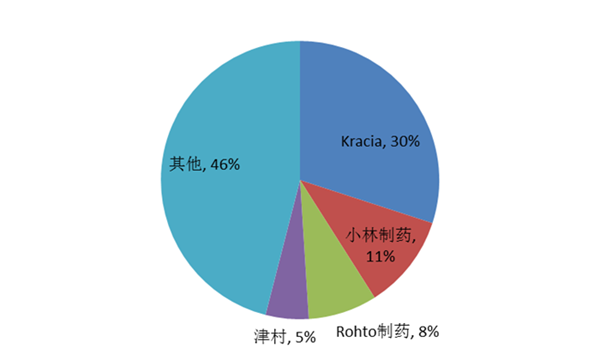
The company’s business spans the personal care and cosmetics, pharmaceutical, and food sectors. Within the pharmaceutical sector, its offerings include consumer-oriented health products—such as OTC Kampo medicines (distributed through pharmacies and drugstores), products dedicated to consultation services, and other health-related items—as well as prescription Kampo medications for clinical use. In 2010, the company held a 30% market share in Japan’s OTC Kampo medicine segment and a 10% share in the prescription Kampo medicine segment. Its joint venture in Qingdao, Qingdao Zhonghua Pharmaceutical Co., Ltd., is responsible for the supply of crude herbal materials.
Chart 11 2010YearOTCMarket Share of Kampo Medicines
Source: Nomura Research Institute, Huachuang Securities
Editor’s Note: This article is the third installment of Huachuang Securities’ observation series on Japan’s pharmaceutical and biotechnology industry. We will continue to curate and publish future issues for our readers’ benefit. Your continued interest is welcome.
Series Report Directory
Phase III: Traditional Chinese Medicine in Japan: Annual Output Value of Only 10 Billion, with Only One Listed Company
Part IV: Japanese Drug Prices Under Government Control: Strained Health Insurance Reimbursements and Constrained New Drug R&D Pricing