

Kangai Weishi Launches 'Cancer Care Butler' to Support Patients Throughout Their Entire Oncology Journey

On January 12, the 4.4 version of “Kang’ai Weishi” (Cancer Fighter) was officially launched, introducing the “Cancer Care Steward” service, designed to address all cancer-related challenges faced by patients. In fact, as early as March this year, Kang’ai Weishi had already proposed the concept of the “Cancer Care Steward.” After more than six months of refinement and product iterations, the Cancer Care Steward has established a comprehensive service chain, providing patients with end-to-end, stewardship-style cancer care services.
Jiang Zuochen, Founder and CEO of Kangai Weishi (Cancer Fighter), stated that the company is committed to creating an internet healthcare product with “warmth.” Doctors are unable to explain the details of every test to patients, help them analyze oncology guidelines and treatment plans, or assist in formulating daily dietary regimens. Kangai Weishi aims to address these doctor-patient and societal challenges in oncology care through its “Kangai Guanjia” (Cancer Care Steward) service.
# Cancer Care Companion: Supporting Patients Throughout Their Entire Cancer Journey
When it comes to butlers, the first image that comes to a journalist’s mind is the elegant, meticulous, and competent English butler portrayed in films. The sole responsibility of such a butler is to manage all aspects of daily life—including clothing, food, housing, and transportation—for the household or individual they serve. “Cancer Care Butler” has directly adapted this concept to the context of cancer care.
“Kang Ai Guan Jia oversees the entire cancer treatment journey for all patients who have purchased its services,” Jiang Zuochen told reporters. Kang Ai Guan Jia not only helps patients navigate healthcare provider selection but also provides support in daily living and psychological well-being.
The Kang Ai Guan Jia team is composed entirely of professional medical personnel, including nurses and doctors with many years of experience in oncology. Kang Ai Wei Shi positions the stewardship team between hospitals and patients to resolve doctor-patient conflicts. “It acts like a lubricant between the two parties. Doctors do not have sufficient time to explain excessive details to family members, so we take on that responsibility,” said Jiang Zuochen.
This concept emerged in the United States years ago, referring to a role situated between hospital physicians and patients’ families, known as case managers. After reviewing extensive data, Jiang Zuochen gained a deeper understanding of the value of case managers: their involvement has helped increase the five-year survival rate for cancer patients by 7%. This represents a significant advancement; however, such a role has not yet been established in China. Although some hospitals have launched pilot programs, this concept has yet to be widely adopted.
“Many people in China are unfamiliar with the term ‘medical record manager,’ making it difficult to promote and educate the public about this role,” said Jiang Zuochen. “Therefore, we rebranded the position as ‘care coordinator,’ a term already well-established by Cancer Guardian.”
Oncology Reviews: Cancer Care Steward Aggregates All Resources for the Anti-Cancer Journey
The care management team of “Cancer Guardian” assists patients in selecting hospitals and scheduling appointments with physicians. It also interprets laboratory and diagnostic test results, reviews medication regimens, and formulates personalized dietary and exercise plans based on individual patient conditions. The team operates around the clock, ensuring that users can promptly access professional assistance at any time.
After several years of development, Anti-Cancer Guardian has accumulated extensive resources in the oncology field. These resources will be consolidated into the Anti-Cancer Steward platform.
Jiang Zuochen revealed that Kangai Weishi has officially acquired equity stakes in three offline hospitals and has established its own medical team. These physicians will practice at multiple sites, including Kangai Weishi’s affiliated hospitals. When patients who have purchased the “Kangai Guanjia” service require assistance, they can engage in face-to-face consultations with their doctors at these offline facilities. This approach ensures ample time and channels for doctor-patient interaction, effectively addressing communication barriers between healthcare providers and patients.
Not only that, but offline hospitals have also resolved the issue of medication dispensing. This has long been a challenge for mobile health platforms, which are unable to sell drugs online. In particular, certain special prescription medications cannot be sold even by entities holding internet pharmaceutical sales qualifications. Therefore, Jiang Zuochen adopted a different approach by directly channeling resources into hospitals. Since hospitals possess the necessary qualifications to dispense medications, this problem was effectively addressed.
Having addressed the challenges of doctor-patient communication and medication sales, Jiang Zuochen turned his attention to overseas resources. Over a six-month period dedicated to preparing for the launch of "Cancer Care Steward," Anti-Cancer Guardian established in-depth collaborations with the Overseas Chinese Physicians Association. Through remote consultations, patients can communicate directly with local American physicians or Chinese-American doctors. In the future, Anti-Cancer Guardian will regularly invite these physicians to China for academic exchanges, enabling patients to engage in face-to-face consultations with overseas specialists by making advance appointments.
In the realm of overseas medical care, Kangai Weishi entered the market early, with its processes now standardized and scaled. Its services cover the United States, Japan, Hong Kong, Macao, Taiwan, as well as Southeast Asia, South Asia, and Eastern Europe. Currently, overseas medical care has become a relatively mature market. Therefore, Kangai Weishi has chosen to build its business segment through channel partnerships: first, by collaborating directly with U.S. hospitals to refer clients to them; and second, by leveraging traditional channels, currently partnering with high-quality service platforms.
In addition, the Anti-Cancer Guardian Mall provides more precise services to users who purchase the Anti-Cancer Steward package, recommending the most worthwhile and suitable products as well as the most essential information. Furthermore, Anti-Cancer Guardian has long maintained collaborations with numerous genetic testing companies; from these partners, three have been selected to engage in deeper cooperation specifically for the Anti-Cancer Steward business.
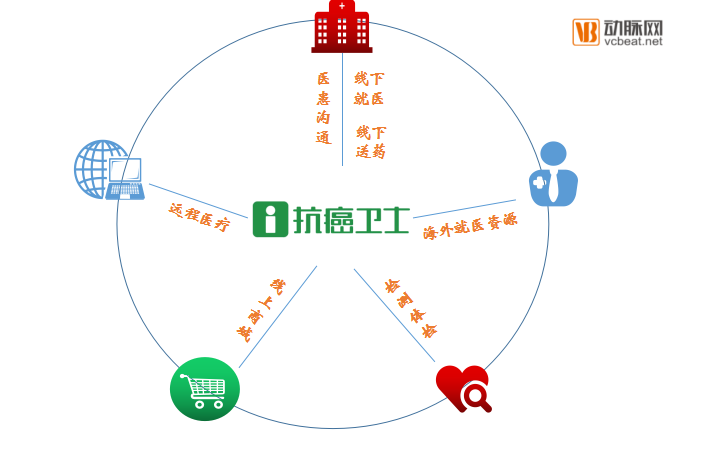
Cancer Care Steward aggregates all resources needed throughout the cancer treatment journey.
“In general, Kang’ai Guanjia brings together all the resources needed throughout the cancer-fighting journey,” said Jiang Zuochen. In other words, the core business of Kang’ai Weishi is currently Kang’ai Guanjia, whose primary function is to serve customers.
“This approach realizes our original vision, empowering every customer with the right to choose the services they desire.” Jiang Zuochen aims to build a Dianping-style platform for the oncology field through Kangai Guanjia.
Pioneering the O+O Model to Break Through the Bottlenecks of Mobile Healthcare
Previously, Kangai Weishi’s operations also spanned the entire oncology industry chain; however, unlike other models, it handled all these activities directly in-house, resulting in substantial personnel costs. “We used to manage every aspect ourselves, which led to high costs and a lack of specialization in any single area. Given the overly broad scope, we later decided to streamline our focus,” said Jiang Zuochen. “That focal point is Kangai Guanjia.”
“Currently, our primary focus is on developing the ‘Cancer Care Steward.’ For other business lines, we only need to establish one or two dedicated service units responsible for integrating products into the Cancer Care Steward platform,” Jiang Zuochen explained to the reporter. “This approach will reduce our various costs while effectively addressing patients’ needs.”
“We hope to serve a larger population with our limited time and manpower through the ‘Cancer Care Steward’ model,” he added. Since last July, Cancer Guardian has been experimenting with commercialization for six months, achieving remarkable results.
By adopting the O+O (Online-to-Offline) model that integrates online and offline services, Kangai Guanjia is able to address issues that light consultations cannot reach or resolve. This O+O model is a first-of-its-kind innovation in China. Jiang Zuochen revealed that with the emergence of mobile healthcare and internet hospitals in recent years, it was also time for this concierge-style service to appear.
Years of Accumulation: Cancer-Fighting Guardian Wins Industry Recognition
Although all preparations are now in place, Jiang Zuochen was initially apprehensive during the early stages of planning.
Taking hospitals as an example, Jiang Zuochen was not very confident about whether the hospitals would be willing to cooperate, let alone where the funds for equity investment in the hospitals would come from. But fortunately, the negotiation process went unexpectedly smoothly. All three hospitals were not only willing to allow Kangai Weishi (Cancer Guardian) to take equity stakes in them but even hoped that Kangai Weishi would directly assume controlling interests.
“Hospitals have collaborated with us before and understand the extent of our capabilities, so this process has been much easier than I had imagined.” At this point, Jiang Zuochen appeared very confident. It was precisely due to the accumulation over the past few years that rich resources were gathered to build “Cancer Care Steward,” enabling integration of all resources needed throughout the cancer treatment journey. Only by achieving tangible results could these resources be consolidated. All of this represents the industry’s recognition of Cancer Guardian.
Pre-sales for the “Anti-Cancer Steward” service began on January 5, with over 200 units sold in less than half a day. “Our steward team is not yet large enough to serve an unlimited population; we have currently allocated only 3,000 slots,” disclosed Jiang Zuochen. Upon its official launch, the steward team will provide comprehensive anti-cancer guidance services to these 3,000 users.
Oncology is a hot topic in healthcare, but the quality of oncology-focused mobile health apps varies widely. On December 12, 2014, VCBeat and Eggshell Research Institute published a review report titled “Detailed Analysis of Internet Healthcare Oncology Apps,” which surveyed 25 oncology apps. Two years later, VCBeat conducted a follow-up survey of these apps and found that only three remained operational, including Kang’ai Weishi (Cancer Fighter Guardian).
Addressing Patient Needs: Building Internet Products with Warmth
Unlike other companies, Anti-Cancer Guardian focuses on the post-diagnosis phase. After being diagnosed, patients face numerous challenges, the most prominent and fundamental of which is how to achieve long-term survival after treatment—a core issue that Anti-Cancer Guardian aims to address. “At this level, we have a first-mover advantage. Few companies have achieved this, and there are virtually no competitors offering such comprehensive case-management services,” revealed Jiang Zuochen. Moving forward, Anti-Cancer Guardian will continue to acquire equity stakes in offline hospitals, expanding its offline services to broader regions.
Kang Ai Wei Shi visits hospitals every month to interact with cancer patients. “Only through direct contact with patients can you understand what they truly need,” said Jiang Zuochen. “Our mission at Kang Ai Wei Shi is to help patients spend less while achieving a better quality of life and even longer survival.”